
Top Strategies for Psychological Safety in Remote Teams

Top Strategies for Psychological Safety in Remote Teams
In remote teams, psychological safety is critical for success. It ensures team members feel comfortable sharing ideas, asking questions, and admitting mistakes without fear. This article explores 10 actionable strategies to build psychological safety, especially in virtual settings where challenges like miscommunication and isolation are common. Here's a quick summary:
- Encourage participation: Use tools and rules like the "one contribution" rule to ensure everyone has a voice.
- Regular check-ins: Consistent meetings help maintain connection and address challenges early.
- Model vulnerability: Leaders should share their own challenges to promote openness.
- Set clear communication rules: Define response times and preferred channels to avoid confusion.
- Build personal connections: Create opportunities for informal bonding, like virtual coffee breaks.
- Ask questions, not blame: Focus on problem-solving instead of assigning fault.
- Handle disagreements empathetically: Use active listening and assume positive intent.
- Use transparent tools: Choose platforms that make roles and progress visible without micromanaging.
- Recognize contributions: Publicly acknowledge achievements to boost morale.
- Define expectations early: Establish clear roles, responsibilities, and norms to reduce uncertainty.
These strategies can help remote teams thrive by promoting trust, collaboration, and open communication.
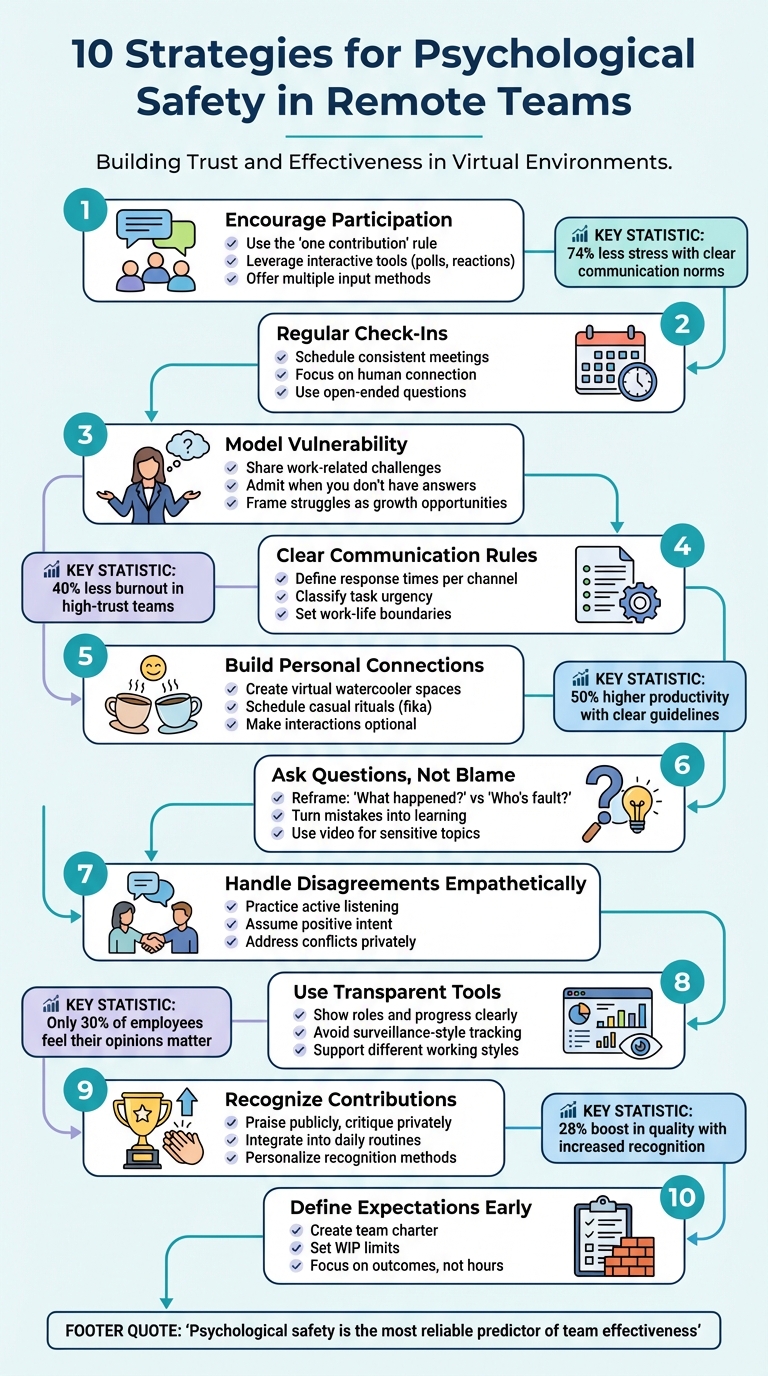
10 Strategies for Building Psychological Safety in Remote Teams
1. Create an Environment Where Everyone Feels Valued
Building psychological safety in remote teams requires intentional effort from leaders. Unlike in-office environments, remote work lacks impromptu hallway chats and nonverbal cues, leaving team members at risk of feeling disconnected or overlooked. This can lead to self-doubt and disengagement.
One major challenge in virtual settings is passive exclusion. For example, if someone remains quiet during a video call, their disengagement might go unnoticed. To address this, leaders should actively encourage participation. One effective approach is the "one contribution" rule, which ensures everyone speaks at least once before a meeting ends. Interactive tools - like hand-raising features, polls, and emoji reactions - can also help team members signal when they want to contribute.
It's also important to offer multiple ways for team members to share their input. While some may thrive in verbal discussions, others might feel more comfortable expressing their thoughts through written communication, voice notes, or collaborative tools like virtual whiteboards. Providing these options helps accommodate different preferences and prevents anyone from feeling excluded.
The stakes go beyond productivity. Research highlights that 38% of Black professionals feel unsafe speaking out about bias in the workplace. This statistic emphasizes the importance of fostering an inclusive environment where everyone feels empowered to share their perspectives and experiences.
2. Schedule Consistent Check-Ins
Remote work often misses those impromptu coffee chats or hallway conversations that naturally build trust. Without these informal moments, team members may feel isolated, leading to increased self-doubt or anxiety. Regular check-ins can help fill this gap, creating a space for connection and support.
Shift routine status updates to asynchronous tools, and use real-time meetings to focus on human interaction. Start meetings by asking team members how they feel about their workload. As Remote.com highlights:
"One short meeting a week can be the difference between a major burnout and a long and prosperous tenure with the company."
During one-on-ones, consider the "Platinum Rule": tailor your communication style to suit the individual. For instance, if someone is naturally reserved, keep the tone calm and low-pressure rather than overly energetic. Use open-ended questions like, "How do you feel about your workload?" to encourage honest dialogue.
Weekly check-ins are a great way to maintain both connection and productivity. Some fast-moving teams might prefer quick daily stand-ups, while others may find biweekly meetings sufficient. The key is sticking to a consistent schedule.
Adding social rituals, such as icebreakers or practices like "Fika" (a Swedish coffee break tradition), at the start of meetings can also foster camaraderie. These moments not only help gauge your colleagues' moods but also create an environment where it's okay to ask for help or admit mistakes. Consistent and thoughtful check-ins can make all the difference in remote work dynamics.
3. Lead by Sharing Your Own Challenges
Remote work often magnifies the urge to hide mistakes and focus on appearing competent. Without the nuances of in-person interactions, team members can miss the subtle reminders that everyone struggles at times. This is where leaders play a crucial role in setting the tone for openness.
Start with small, work-related examples. Leaders can bridge the isolation of remote work by showing vulnerability. You don’t need to dive into deeply personal matters right away. Instead, begin by acknowledging when you don’t have all the answers in a meeting or by owning up to a recent work error. Amy C. Edmondson, a professor at Harvard Business School, explains:
"The best way to show you're serious is to expose your own vulnerability by sharing your remote work challenges. Managers must lead by example."
When you share struggles, frame them as opportunities for growth and collaboration. For instance, talk about the steps you’re taking to address a challenge and ask for feedback or input. Research shows that when leaders share critiques from their performance reviews or admit they’re "a work in progress", it fosters psychological safety that can last for up to a year, rather than providing a fleeting boost from simply soliciting feedback.
The trick is balancing vulnerability with maintaining authority. Organizational psychologist Adam Grant emphasizes this balance:
"If team members only speak when they have solutions, major issues remain hidden."
By admitting uncertainty, you demonstrate that progress is more important than perfection. This approach encourages your team to seek help when needed, instead of concealing their struggles. It also sets the stage for a culture of transparency.
A practical way to normalize openness is by sharing specific, relatable challenges - like balancing work with childcare responsibilities. Doing so signals to your team that it’s okay to discuss their own scheduling or personal hurdles without fear of judgment.
4. Establish Clear Communication Guidelines
Remote teams face a unique challenge: the absence of face-to-face interactions often leaves room for miscommunication. Without clear rules, team members can feel uncertain about when to respond, which platform to use, or whether their message was understood. This lack of clarity can lead to stress and erode trust. Setting explicit communication guidelines is crucial for smoothing these issues and creating a sense of psychological safety.
Start with a framework to classify urgency. Not every task needs the same level of attention. By creating a system that categorizes tasks - ranging from "mission-critical" (requiring immediate action like a phone call) to "low-priority" using the Eisenhower Matrix (best suited for email or project management tools) - teams can better manage their time and energy. Steph Smith, author of The Holloway Guide to Remote Work, emphasizes:
"Distributed teams must decide on and document how they will communicate; otherwise chaos and confusion will follow."
The benefits of these norms are significant. High-trust teams with clear communication guidelines report 74% less stress, 40% less burnout, and 50% higher productivity. A helpful approach is adopting an "asynchronous by default" mindset. This means defining when real-time discussions are necessary - for example, brainstorming sessions might require a video call - versus when a written update in Slack or a shared document suffices.
Extend these guidelines to establish work-life boundaries. Define clear response windows and set expectations for after-hours communication. For instance, team members could feel free to turn off notifications after 6:00 PM without worrying about missing something crucial. Sid Sijbrandij, Co-founder and CEO of GitLab, highlights this idea:
"The only time a manager is allowed to inquire about how many hours you work is when they suspect you're working too many hours."
Documenting these rules in a team charter can make a world of difference. Specify response times for various channels - like two hours for Slack and 24 hours for email - and clarify the purpose of each platform. This approach not only reduces stress but also helps remote workers feel confident about what effective communication looks like.
5. Build Personal Connections Beyond Work
Building personal connections is essential for fostering psychological safety within teams. Remote work, however, has taken away those spontaneous moments - like hallway chats or coffee breaks - that naturally helped people bond. Without these informal interactions, team members may feel isolated or disconnected. The goal isn’t to force awkward socializing but to create meaningful opportunities for genuine connection.
Use live meetings for human interaction and move work updates to asynchronous tools like Slack or shared documents. This ensures that face-to-face time is spent on what truly matters: getting to know each other as individuals.
Tom Geraghty, Co-founder of Iterum Ltd, sums it up perfectly:
"Happy teams aren't happy because they're high performing: they're high performing because they're happy."
You can also set up "always-on" social spaces, like a persistent video link, where team members can drop in casually - think of it as a virtual watercooler. Some teams even schedule weekly rituals like "fika" (a coffee and chat session) or casual morning check-ins to create a sense of togetherness.
It’s important to keep these interactions optional and low-pressure. For example, you could start meetings with a few minutes of icebreakers or personal questions, like "What’s one good thing that happened to you this week?" These small moments help clarify emotional context and deepen mutual understanding. In fact, research from Google’s Project Aristotle found that physical proximity didn’t impact team performance as long as psychological safety was present.
6. Ask Questions Instead of Assigning Blame
Clear communication is essential, but how you address problems can make or break trust in a team. In remote settings, blame can quickly damage relationships and create an atmosphere of fear. When people worry about being called out, they may stop taking risks, hide their mistakes, or avoid speaking up - behaviors that can derail team performance. Shifting from blame to inquiry helps foster a more open and trusting environment.
Amy C. Edmondson, a professor at Harvard Business School, puts it this way:
"Psychological safety is not about being nice or lowering performance standards, it's about giving candid feedback, openly admitting mistakes, and learning from them."
Remote communication adds another layer of complexity. Without tone or body language, even a straightforward question like "Why did this happen?" can come across as accusatory. Tom Geraghty, Co-founder of Iterum Ltd, offers a helpful perspective:
"Never attribute to malice that which is adequately explained by stupidity [or miscommunication]."
Instead of asking, "Who dropped the ball?" try reframing the conversation with questions like "What happened here?" or "How can we improve?" These types of inquiries turn mistakes into opportunities for collective problem-solving. Whenever possible, address sensitive issues over video or voice calls, where tone and context can help clarify intent.
The numbers tell a story, too - only 30% of U.S. employees feel that their opinions matter at work. Leaders can change this by responding positively when team members raise concerns. For instance, thanking someone for pointing out an unrealistic timeline shows that curiosity and honesty are valued. This approach builds what’s known as "Learner Safety", where people feel comfortable admitting gaps in knowledge and seeking feedback.
7. Handle Disagreements with Empathy
Dealing with disagreements is part of any team dynamic, but the way you approach them can either strengthen your team or create lasting divides. In remote work, the challenge is even greater - digital communication lacks tone and body language, which makes misunderstandings more likely. A seemingly curt message on Slack, for instance, might just be someone typing in a hurry between meetings.
When conflicts arise, focus on shared objectives instead of pointing fingers. If a message feels abrasive, pause before reacting and consider Hanlon's Razor: assume miscommunication rather than bad intent. If things escalate, move the discussion to a voice or video call to clarify tone and intent.
The key to resolving disagreements lies in how you listen and respond. Active listening plays a critical role here. During virtual meetings, give your full attention to the speaker. This simple act not only shows respect but also fosters what researchers call a "safe communication climate". Instead of making assumptions, ask clarifying questions like, "Can you explain your perspective on this?".
For leaders, managing conflict effectively also means acknowledging your own limitations. Handle sensitive issues in private to avoid embarrassing anyone publicly, as that can erode trust.
It’s also important to remember that remote work often overlaps with personal responsibilities, like family or health concerns. Tailor your approach to each individual’s circumstances. This "Platinum Rule" mindset - treating others the way they need to be treated - can transform disagreements into collaborative problem-solving. By resolving conflicts with empathy, you help build the psychological safety that remote teams need to thrive.
8. Choose Tools That Support Transparency
The tools you choose can either build trust or erode it. In remote teams, where you can’t rely on casual office interactions to stay in the loop, transparency has to be intentional. As Tom Geraghty, Co-founder of Iterum Ltd, explains:
"If you're not being actively inclusive, you're risking being passively exclusive".
This is where tools that make work visible come into play. Task management systems that clearly show roles, responsibilities, and progress help team members see how their efforts contribute to the larger goals. These tools also make it easier for colleagues to step in and offer support when needed, even if they’re working from a different time zone. Features like Work In Progress (WIP) limits can also ensure that no one gets bogged down with an unmanageable workload.
For communication, it’s important to use platforms that cater to different working styles and contexts. A well-thought-out framework for selecting tools can ease "communication anxiety" - that nagging worry about missing important updates or conversations.
On a personal level, tools like malife can help individuals bring structure and clarity to their own workflows. Features like Life Areas and Today & Next views let team members quickly assess their priorities, making it easier to balance workload and avoid overcommitting. The app’s voice capture feature further simplifies the process of documenting tasks, ensuring shared projects stay updated without interrupting the flow of work.
One thing to steer clear of is surveillance-style tools that track screen time or mouse movements. These can harm psychological safety by creating an atmosphere of mistrust. Instead, focus on platforms that emphasize results and outcomes rather than micromanaging activity. By prioritizing tools that promote transparency and mutual trust, teams can create an environment where everyone feels informed, supported, and secure.
9. Acknowledge Contributions in Front of the Team
Public recognition plays a crucial role in making team members feel appreciated and valued, especially in a remote work environment where informal praise can easily get lost. Without these moments of acknowledgment, contributions might go unnoticed, which can erode trust and transparency - key pillars of psychological safety.
Surprisingly, only 25% of employees worldwide strongly agree they've received recognition or praise for their efforts in the past week. However, when organizations increase that number to 60%, they experience a 28% boost in quality and a 31% drop in absenteeism. Ryan Pendell, Senior Workplace Science Editor at Gallup, highlights the power of simple recognition:
"A passing word of praise that may have gone unnoticed in a physical workplace can make someone's entire day at home".
Leaders can set the tone by integrating recognition into daily routines. Start meetings with a quick acknowledgment of exceptional work, or use public channels like Slack or Teams for real-time shoutouts. Weekly rituals, such as a recognition roundup, can also spotlight achievements regularly. For particularly impactful contributions, a handwritten thank-you note adds a personal touch that makes the recognition feel even more meaningful.
It's essential to remember one golden rule: praise should happen in public, while constructive feedback should remain private. This approach fosters an open and positive atmosphere while ensuring feedback is delivered thoughtfully. Since recognition isn't one-size-fits-all, it's worth asking team members how they prefer to be acknowledged - some thrive on public shoutouts, while others might appreciate a more personal gesture.
To make recognition a natural part of the team culture, leaders should encourage its integration into everyday interactions. Use emojis, GIFs, and reaction features during virtual meetings to instantly show support for colleagues' ideas. When recognition becomes a consistent part of team routines, it prevents hard work from fading into the background of a remote workday. By creating a culture where contributions are regularly celebrated, teams can maintain a strong sense of connection and motivation, even from afar.
10. Define Team Expectations from the Start
Remote work eliminates much of the casual, on-the-spot learning that happens in traditional office settings. Without the ability to observe colleagues and pick up on unspoken norms, team members can feel unsure about how things are supposed to work. To avoid confusion and hesitation, it’s essential to make these implicit office norms explicit in virtual environments. This helps reduce anxiety and encourages open communication when taking interpersonal risks.
Even though remote work has become the norm for many, plenty of teams still lack clear guidelines. A team charter can help lay a solid foundation by clearly defining roles, responsibilities, and what success looks like for everyone involved. It should also establish which communication tools are used for specific purposes - for instance, Slack for urgent updates, email for detailed discussions, and separate channels or platforms for casual, social interactions.
Setting clear expectations creates an environment where structure and support thrive. Google's Project Aristotle found that physical proximity has no effect on team performance as long as psychological safety is present. In remote settings, achieving this safety requires clear structures. For example:
- Use work-in-progress (WIP) limits to indicate capacity and help protect boundaries.
- Set "right to disconnect" rules, such as no work-related messages after 6:00 PM.
- Leverage shared digital boards to make tasks and progress visible, enabling teammates to assist one another without needing constant check-ins.
Lastly, shift the focus from inputs to outcomes. Instead of tracking hours worked, measure success through results like customer satisfaction, revenue growth, or project milestones. This outcome-driven approach minimizes micromanagement and empowers team members to collaborate with confidence, free from constant scrutiny.
Conclusion
The strategies discussed here work together to create a secure and supportive virtual environment. Building psychological safety in remote teams requires consistent effort. It’s about fostering trust, encouraging collaboration, and driving performance. These approaches help form what researchers refer to as "networks of dependability", where team members feel safe to take risks, share ideas, and support one another without fear of judgment or backlash.
Psychological safety has been shown to be the most reliable predictor of team effectiveness. This is especially relevant now, as remote work becomes the norm for many organizations.
Start by sharing your own challenges with remote work - this sets the tone for your team to feel comfortable doing the same. Treat your work together as a shared learning experience where everyone’s input is valued. In written communication, apply Hanlon’s Razor: assume misunderstandings rather than malice when interpreting messages. Shift your focus from monitoring hours or online status to tracking meaningful outcomes, like customer satisfaction and revenue.
As Amy C. Edmondson, Professor at Harvard Business School, explains:
"Psychological safety is not about being nice or lowering performance standards, it's about giving candid feedback, openly admitting mistakes, and learning from them".
The aim isn’t to avoid conflict or create a stress-free environment - it’s to establish a space where people can perform at their best because they feel valued, heard, and supported.
The advantages go beyond short-term productivity. High psychological safety reduces burnout, improves retention, and drives innovation, making teams more resilient. This resilience is rooted in the culture of open communication and shared accountability outlined above. The real question is not whether you should invest in psychological safety, but whether you can afford not to.
FAQs
How can leaders build trust by showing vulnerability in remote teams?
Leaders can build trust within remote teams by being open about their own challenges, uncertainties, and even occasional mistakes. This kind of transparency creates a safe space where team members feel at ease sharing their thoughts or concerns without fear of being judged. When leaders demonstrate vulnerability, it sets the stage for trust and encourages honest communication - something especially important in remote work environments where casual, face-to-face interactions are rare.
To further nurture psychological safety, leaders should make it normal to ask questions, acknowledge mistakes, and seek feedback. Transparent communication, active listening, and humility are key practices that set the tone for genuine collaboration. By embracing these habits, leaders create a supportive atmosphere where everyone feels appreciated and motivated to contribute their best.
What are the best ways to maintain transparency in remote teams?
Building transparency in remote teams begins with promoting open communication and creating a safe environment where ideas and feedback can flow freely. Digital collaboration tools that allow team members to stay visible and encourage honest discussions are essential for this. Regular check-ins, like virtual meetings designed for open dialogue and active listening, are another way to strengthen trust and ensure everyone is on the same page.
Leadership plays a critical role here. When leaders show vulnerability and empathy, they set an example that encourages team members to speak up without fear of judgment. Tools like impact/effort prioritization in task management platforms, such as malife, can also help by clarifying priorities and keeping everyone aligned on progress and shared expectations. By combining clear communication, empathetic leadership, and effective tools, remote teams can create an environment where trust and psychological safety flourish.
How can remote teams communicate clearly while staying empathetic during disagreements?
Remote teams can maintain a balance between clear communication and empathy by creating an environment of psychological safety - a space where everyone feels comfortable sharing ideas and concerns without fear of being judged. This begins with setting clear guidelines for respectful conversations and practicing active listening to reduce misunderstandings and defensive reactions.
Empathy grows when team members connect on a personal level. Leaders and teammates can foster this by recognizing diverse perspectives, validating emotions, and being open about their own vulnerabilities. At the same time, clarity in communication ensures that messages are delivered and understood without ambiguity. By blending transparency, emotional sensitivity, and mutual respect, teams can handle disagreements constructively while maintaining trust and collaboration.