
Work-Life Boundaries for Remote Professionals

Work-Life Boundaries for Remote Professionals
Remote work blurs the line between work and personal life for many professionals. Nearly half of U.S. remote workers struggle with this issue, and more than half report working longer hours at home than in the office. Without clear boundaries, stress and burnout are common risks.
To regain control, here’s what you can do:
- Define work hours: Stick to a schedule based on your energy levels and communicate it clearly.
- Create a dedicated workspace: Separate work and personal areas to mentally shift between roles.
- Use tools to stay focused: Apps like malife can help manage tasks, reminders, and time blocks.
- Control notifications: Turn off work alerts after hours and schedule email check-ins.
- Build daily routines: Establish rituals to signal the start and end of your workday.
- Take breaks: Regular pauses can prevent burnout and improve productivity.
Consistency and regular reviews of your boundaries are key. By prioritizing balance, you can protect your well-being while staying productive.
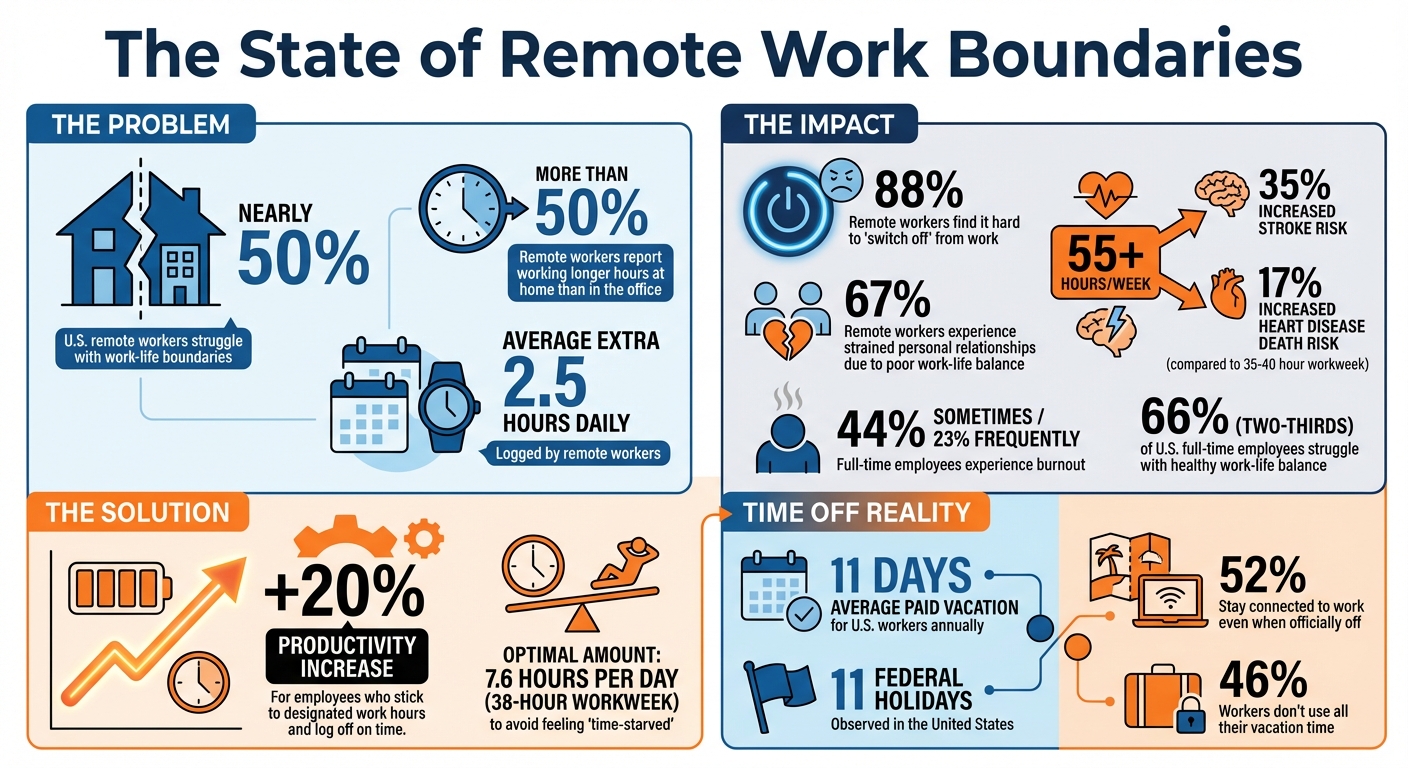
Remote Work Boundaries Statistics and Impact on Employee Well-being
Getting Ready: Pre-Checklist Steps
Before you can establish new boundaries, it’s important to take a step back and evaluate how your current routines blur the lines between work and personal life. This isn’t about beating yourself up - it’s about taking an honest look at how your time is divided. Think of it as gathering the groundwork for actionable changes.
Review Your Current Boundaries
Start by conducting a self-assessment of your habits. Pinpoint moments when you feel overwhelmed or stretched too thin. Pay attention to how you divide your time between work and personal responsibilities. Emotional clues like frustration, exhaustion that lingers even after rest, or thoughts about escaping your routine can signal boundary issues.
To get a clearer picture, track your time for 3–5 days. Look for patterns: when do work notifications interrupt family time? When do personal errands sneak into your work hours? Tools like malife's Journal feature can help you document these moments - whether they’re instances of blurred boundaries or times when you felt things were under control.
You’ll also want to think about your boundary preferences. Some people thrive with clear separations between work and home life (segmentation), while others do better when the two blend more naturally (integration). Dr. Beth Livingston, an Assistant Professor in Management and Entrepreneurship at the University of Iowa, offers this perspective:
"Ultimately what people want is control over their boundaries and over the configuration that works best for them".
There’s no universal answer here. What matters is finding an approach that fits your values and lifestyle.
Set Your Work Hours
Once you’ve mapped out your current habits, it’s time to define your work hours. Research shows that employees who stick to designated work hours and log off at the end of the day are 20% more productive than those who keep working late into the evening. Aiming for about 7.6 hours of work per day - roughly a 38-hour workweek - can help avoid feelings of being "time-starved".
Choose hours that align with your natural energy levels. For example, early risers often hit their peak focus around 9:00 AM, while night owls tend to feel sharpest closer to 4:00 PM. Schedule your most challenging tasks during these high-energy periods, and make it a priority to protect that time.
Once your hours are set, communicate them clearly to your colleagues and family. This reduces the expectation of being available 24/7, especially in an "instant messaging" work culture. Tools like malife's persistent reminders can help you stick to your schedule. For instance, you can set a reminder 10 minutes before your planned log-off time to start wrapping up, or a recurring alert at 5:00 PM to signal the end of your workday.
Choose Your Boundary Tools
Finally, equip yourself with the right tools to enforce your boundaries. Start by creating a dedicated workspace - one that’s ergonomically designed and physically separates work from home life. Digital tools are just as important. Use status settings in chat platforms to set expectations, such as marking yourself "Offline until 9:00 AM".
malife's Focus Timer is another handy tool. During work hours, it helps you stay on task while signaling to others in your household that you’re unavailable. It also provides natural stopping points - when the timer ends, it’s a cue to take a break or, at the end of the day, to fully disconnect. The Life Areas feature is another great resource, visually separating work tasks from personal ones so you can mentally shift gears when you close your laptop.
Main Boundaries Checklist
Now that you've reviewed your current routines and set clear work hours, it's time to take action. These steps are designed to help remote professionals establish and maintain boundaries, tackling common challenges with practical solutions you can implement right away.
Set Up a Work-Only Space
Carve out a specific area in your home that's strictly for work. Ideally, this would be a separate room with a door, but if that's not an option, even a consistent corner of your living room or a designated spot at the kitchen table can do the trick. The key is consistency - keep this space distinct from where you relax or spend personal time.
"Having a dedicated spot helps me mentally switch from being 'at home' to being 'at work,'" says Lora Vaughn, a remote professional.
To make the transition clearer, try using visual cues. For instance, place a specific object - like a small plant, a decorative item, or even a work-related book - on your desk during work hours. At the end of the day, remove it to signal to your brain that it's time to unwind.
Physical separation is crucial. Chris Johnson, Product Manager at Venn, notes:
"The lack of a clearly defined workspace also makes it difficult to know when it's time to shift from the professional to the personal".
Avoid blending work and leisure spaces. For example, don’t check emails or take work calls from your couch or bed. Keeping work activities confined to your designated area makes it easier to fully disconnect when the day is done.
Build Daily Routines
Without a commute, the boundary between "home" and "work" can blur quickly. Morning and evening routines can act as mental cues, helping you shift gears. Start your day with simple habits like taking a short walk, changing into work-specific clothes, or brewing a cup of coffee before sitting at your desk. These small rituals replace the traditional commute and help set the tone for a productive day.
When the workday ends, log out, mute notifications, and shut your laptop. Reclaim your personal time by scheduling activities like cooking, exercising, or spending time with loved ones. Tools like malife's Life Areas feature can help you block off personal time on your calendar, making it easier to stick to your boundaries.
Another helpful strategy is habit stacking. For example: "After I finish my morning shower, I will check my daily task list and prioritize tasks in malife." This approach links new habits to existing ones, making them easier to adopt without extra effort.
Share Your Availability
Your boundaries are only effective if others know about them. Update your digital calendar and communication tools to reflect your work hours. For example, use Slack or Microsoft Teams to set status updates indicating when you're unavailable, even for short breaks like lunch or a quick walk.
For longer absences, make it clear by updating your display name. Lora Vaughn suggests including specific dates, such as "Lora - PTO 01/13 to 01/15". This way, anyone trying to reach you will see you're out of the office. If you're using Google Calendar, enable the "Working Hours" feature to automatically notify others if they try to schedule a meeting outside your set hours.
To stay consistent, use malife's recurring tasks as reminders to update your availability each morning or after any changes to your schedule. When others see you consistently enforce your boundaries, they're more likely to respect them.
Control Notifications and Email
Protect your focus by managing digital distractions. Set "Do Not Disturb" mode on your work devices to activate automatically after your work hours. This ensures you won't be interrupted unnecessarily.
For emails, stick to scheduled check-ins - like 9:00 AM, 1:00 PM, and 4:00 PM - rather than keeping your inbox open all day. If you need to send emails after hours, use the "schedule send" feature so they arrive during the recipient's workday, respecting their boundaries as well.
Kristen Chung, a writer at Flowlu, highlights why this matters:
"Setting boundaries isn't a selfish act. It's crucial for your physical, mental, and emotional health".
By controlling notifications and emails, you're not just boosting productivity - you’re also safeguarding your well-being.
Use Time Blocks for Tasks
Focus on tasks that matter most by prioritizing them effectively. Tools like malife's Impact/Effort matrix can help you identify high-impact, low-effort tasks to tackle first, leaving less critical work for times when your energy dips.
Once you've prioritized, schedule focused work sessions using malife's Focus Timer. Aim for 90-minute blocks of deep work followed by 15-minute breaks to maintain your energy and avoid burnout. During these sessions, eliminate distractions: close unnecessary tabs, silence your phone, and let others in your household know you're unavailable.
Time blocking also helps separate different types of work. Dedicate specific blocks to deep work (like problem-solving or writing) and others to shallow tasks (like emails or administrative work). These structured blocks create natural stopping points, making it easier to wrap up your workday and maintain balance.
Maintaining Your Boundaries
Setting boundaries is just the beginning. Without consistent upkeep, urgent tasks and deadlines can quickly undermine them. The strategies below build on your boundaries, helping you maintain a steady work–life balance.
Schedule Regular Breaks
Treat breaks as non-negotiable appointments on your calendar, just like work meetings. The Pomodoro Technique can be a helpful guide: work in 25-minute focused intervals followed by 5-minute breaks, and after four cycles, take a longer 15–30-minute pause. Tools like malife's Focus Timer can help you stick to this structure without constantly watching the clock.
Physical separation from your workspace can also improve focus. As Jan Veroti explains:
"A physical separation between work and life, combined with predictable rituals, can immediately boost your concentration".
Step away from your desk during breaks - take a walk, stretch, or simply change your posture. To combat the isolation of remote work, consider scheduling virtual coffee breaks or casual video calls with colleagues. A Gallup survey of over 7,500 full-time employees revealed that 44% sometimes feel burned out, while 23% experience burnout frequently. Regular social interactions, even online, can help alleviate this. Set reminders to take consistent lunch breaks and step away from your screen. As Capitol Careers notes:
"Overworking yourself can cause burn outs and a decrease in motivation".
Manage After-Hours Requests
Before diving into after-hours tasks, assess the urgency. If the request isn’t time-sensitive, acknowledge it briefly and suggest an alternate timeline, such as: "I can have this ready by 9:00 AM tomorrow" or "I’ll address this first thing Monday morning".
If you receive requests via text, ask to move the conversation to email for better tracking. Workplace expert Lynn Taylor advises:
"It is a legitimate request to say, 'it would be really helpful to have the request in email form so I can search for it and have it there for the future all in one place'".
When responding to after-hours work, frame your reply around productivity. Mary Abbajay, author of Managing Up, suggests:
"Make them see there is something in it for them... I find it a challenge to pivot my time to get XYZ done at night, and then I can't come back refreshed in the morning. It takes away from my productivity level".
Track after-hours requests using malife's Journal to identify patterns - log the time, sender, and type of request. If you notice recurring themes, address them during regular work hours. For emergencies that require after-hours attention, negotiate compensatory time. For instance, if you work late on a Saturday, consider starting later on Monday or taking a few hours off midweek. Keep in mind that two-thirds of U.S. full-time employees report struggling with a healthy work–life balance.
Do Weekly Reviews
Dedicate 30–60 minutes each week to review your progress and adjust your boundaries. Choose a consistent time, like Sunday evening, and make it a routine. Use tools like malife's Life Areas feature to evaluate different aspects of your life - work, health, relationships, and personal growth. This overview can help you spot imbalances before they escalate.
During your review, reflect on key questions: What did I accomplish? What challenges arose? Am I feeling energized or burned out? Are there obstacles I need to address? What skills am I working on, and what areas need improvement?
If a particular task or commitment consistently causes frustration, it might be time to reassess your boundaries. As Workplace Strategies for Mental Health points out:
"Our boundaries can change for many different reasons. You should be flexible enough to re-evaluate if the boundary is something you've been able to maintain, whether it has been effective... and whether it is still necessary".
Document your findings to track progress over time. If adjustments are needed, communicate them clearly. For example: "I've decided to stop checking emails after 6:00 PM. I’ll respond to messages the next morning". Also, review your digital habits - if you’re responding to work messages during personal time, adjust your notifications. Update malife's recurring tasks as needed, whether that means scheduling more breaks or shifting tasks to different times of the day.
The stakes are high: working 55 or more hours a week increases the risk of stroke by 35% and the risk of dying from heart disease by 17% compared to a 35–40-hour workweek. Regular reviews can help you catch patterns of overwork before they harm your health.
Coordinate with Family
As you refine your boundaries, align them with your family’s schedule to maintain harmony at home. Your work habits affect everyone in your household, so involve them in the process. Share your work schedule, specify when you need uninterrupted focus, and clarify when you’ll be fully available. For instance, instead of a vague request for quiet, you might say: "I have video calls from 9:00 AM to 11:00 AM on Tuesdays and Thursdays, so I’ll need the living room to myself during those times." Clear communication helps others respect your boundaries.
If family discussions lead to work-related tasks, document them immediately using malife's Voice Capture.
Treat family time with the same importance as work meetings. Schedule dinners, kids’ activities, or date nights, and set reminders to help you transition smoothly from work to personal time. Licensed therapist Mona Eshaiker emphasizes:
"Daring to set boundaries is about having the courage to prioritize ourselves, our values, and our health at risk of judgment from others".
This principle applies at home, too - make sure your family time is as protected as your work hours.
Staying Balanced Long-Term
Review Progress Each Month
Keeping work and personal life separate requires regular check-ins. Set aside time each month - perhaps the last Sunday - to evaluate how well you're maintaining boundaries. This is especially important for remote workers, who often log an extra 2.5 hours daily, with 88% finding it hard to "switch off" from work. A monthly review can help you spot these habits before they lead to burnout.
Use tools like malife's Journal to document instances where your boundaries were crossed. Record the time, situation, and your reaction. Look for patterns: Are you answering emails after 7:00 PM? Do certain projects consistently spill into your weekends? Once you identify recurring issues, adjust your approach. If necessary, communicate these changes to your team or family. For example, you might say, "Starting next month, I won't be responding to Slack messages after 6:00 PM on weekdays."
It's also wise to reassess your workload. Move less urgent tasks to a "Later" list to protect your personal time. As DayViewer aptly puts it:
"The more clearly you define your limits, the more freedom you create within them. Strong boundaries don't restrict your life - they create the structure that allows you to thrive".
Poor work-life balance affects 67% of remote workers by straining personal relationships. Monthly reviews provide an opportunity to course-correct before things spiral. Once you've established a habit of monthly check-ins, consider adding seasonal breaks to further reinforce your boundaries.
Plan for U.S. Holidays
Federal holidays are built-in opportunities to step away from work - use them wisely. The United States observes 11 federal holidays, but 46% of workers don’t use all their vacation time, and 52% stay connected to work even when they’re technically off. Treat these holidays as sacred personal time.
Maximize your time off by pairing federal holidays with PTO days. For instance, taking four PTO days around a Monday or Friday holiday can give you nine consecutive days of rest. This strategy stretches your limited vacation days - the average U.S. worker gets just 11 days of paid vacation annually.
Leverage malife's persistent reminders to set clear boundaries during holidays. Update your status to "offline" and enable "Do Not Disturb" across work platforms. Coordinate with your team in advance to ensure coverage, reducing the urge to check in while you’re away.
As Foothold America points out:
"The 'always-on' challenge stems from deeply ingrained cultural beliefs that equate constant availability with professional commitment".
Push back against this mindset by fully disconnecting. Ferris Jabr, a science writer, underscores the importance of downtime:
"Downtime replenishes the brain's stores of attention and motivation, encourages productivity and creativity, and is essential to both achieve our highest levels of performance and simply form stable memories in everyday life".
Use federal holidays as anchors for rest throughout the year. These breaks are essential for maintaining balance over the long haul.
Conclusion
Maintaining work-life boundaries takes consistent effort and the work-life balance systems. Without these boundaries, remote workers face a higher risk of burnout and overwork. In fact, two-thirds of full-time employees in the U.S. already find it challenging to achieve a healthy work-life balance, which can have a direct impact on their morale and motivation.
Here’s the upside: sticking to clear boundaries can lead to real, measurable benefits. Taking time to disconnect from work has been shown to improve mood, enhance sleep quality, and lower stress levels. As Ellen Ernst Kossek, a professor at Purdue University, puts it:
"Effectively managing work-life boundaries can reduce role conflict and enhance the well-being of employees, teams, and organizations."
Tools like malife are designed to help you put these principles into practice. Features such as Life Areas, Today & Next views, and persistent reminders work together to keep your work and personal life separate.
FAQs
How can I clearly communicate my work hours to both colleagues and family while working remotely?
To create clear work hours, start by setting a consistent schedule, like 9:00 a.m.–5:00 p.m. EST, and make it accessible to both colleagues and family. Share it through tools like your work calendar or a shared planner. Be specific about what these hours are for - whether it’s focused work, meetings, or creative thinking - and outline what interruptions are acceptable, such as emergencies only.
Pairing your schedule with a simple routine can help signal when you’re in work mode. For instance, changing into work clothes or sitting at a designated desk can make the transition smoother. Tools like malife can simplify this process further. With features like task reminders, "Today" and "Next" task blocks, and a "Life Areas" view for sharing schedules, it helps keep everyone aligned. This approach minimizes unnecessary disruptions and reinforces your work-life boundaries.
How can remote professionals maintain a healthy work-life balance over time?
Maintaining a solid work-life balance as a remote professional takes effort and planning. Start by establishing clear boundaries between your job and personal life. Define specific working hours and stick to them consistently. Make sure to communicate these boundaries with your team so everyone is on the same page.
Designate a dedicated workspace to help you mentally separate your job from your home life. This small change can make a big difference. Also, don’t forget to take regular breaks to recharge - it’s easy to lose track of time when working remotely. Tools like malife can be a game-changer for organizing your tasks by priority and tracking both work and personal goals. This keeps you focused during work hours and ensures you’re making the most of your free time.
Finally, carve out time for activities that bring you joy outside of work. Whether it’s hitting the gym, hanging out with family and friends, or diving into a hobby, these moments are essential for maintaining your well-being and staying productive over the long haul.
What tools can help me maintain work-life boundaries while working remotely?
Balancing work and personal life as a remote professional can be challenging, but the right tools can make a huge difference. To maintain clear boundaries, look for tools that help you organize tasks, stay focused, and manage your time effectively. For example, malife is a handy life planner that lets you sort tasks by Life Areas, prioritize based on effort versus impact, and stay on top of things with features like persistent reminders and voice capture. With tools built to support structure and follow-through, you can establish a routine that respects both your professional and personal commitments.