
Mental Energy Conservation: 7 Simple Tips
Mental Energy Conservation: 7 Simple Tips
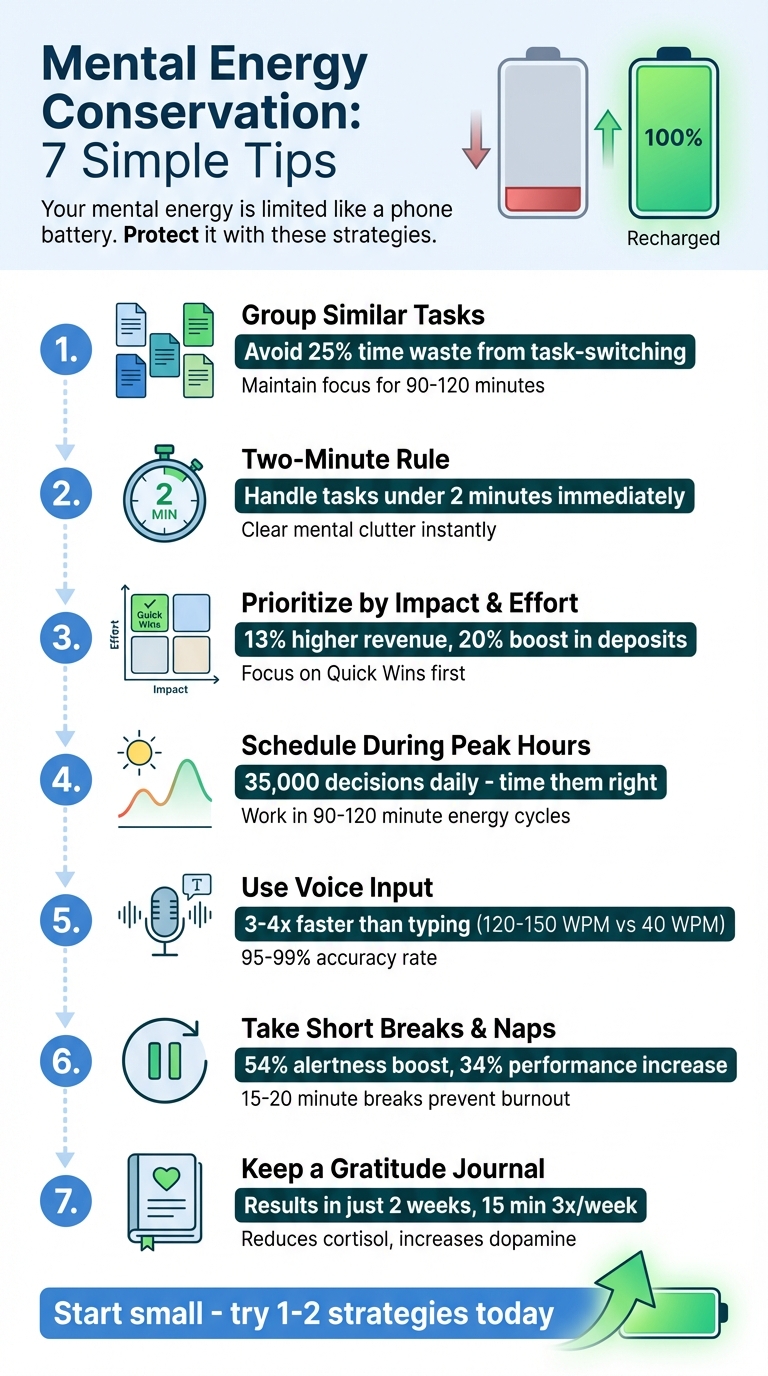
Your mental energy is limited, like a phone battery. Every decision you make drains that reserve, leading to fatigue, brain fog, and reduced focus. But here’s the good news: you can recharge and protect your mental energy with simple strategies. From batching tasks to taking short breaks, these tips will help you stay productive and focused throughout the day:
- Group similar tasks to avoid constant switching, which can waste up to 25% of your time.
- Handle quick tasks immediately using the Two-Minute Rule to clear mental clutter.
- Prioritize by impact and effort to focus on high-value tasks.
- Schedule important work during peak energy hours to maximize productivity.
- Use voice input to quickly offload tasks and free up mental space.
- Take short breaks or naps to recharge and prevent burnout.
- Keep a gratitude journal to shift your mindset and reduce stress.
These practical steps can help you optimize your focus, conserve energy, and avoid decision fatigue. Start small - try one or two strategies today to see the difference.
7 Strategies to Conserve Mental Energy and Boost Daily Productivity
1. Group Similar Decisions Together
Your brain isn't wired to handle constant task-switching. Every time you shift focus, your mind has to "reboot", which can increase the time it takes to complete tasks by as much as 25%.
Why Grouping Decisions Works
Batching decisions isn't just about saving time - it's about preserving your mental energy for what really matters. By grouping similar decisions, you can maintain focus for 90 to 120 minutes, which aligns perfectly with your natural attention cycles. This strategy also helps combat decision fatigue, the mental drain caused by the endless stream of small choices you face daily.
"A temporary shift in attention from one task to another - stopping to answer an e-mail or take a phone call, for instance - increases the amount of time necessary to finish the primary task by as much as 25%, a phenomenon known as 'switching time.'" - Tony Schwartz and Catherine McCarthy, The Energy Project
Simple Ways to Start
You don’t need a complex system to make batching work. Take Steve Wanner, for example. He only checked his email twice a day - at 10:15 AM and 2:30 PM - dedicating 45 minutes each time to clear his inbox entirely. Similarly, Dan Cluna let calls go to voicemail during meetings and returned them all at once during a set time, which cut his overall meeting durations in half.
Stay Focused All Day
To keep your energy levels high, plan your priorities the night before. Reserve specific time blocks for communication - just two or three sessions a day to handle emails and messages - so you’re not constantly interrupted by notifications. For repetitive tasks like taking vitamins or checking medications, set reminders to take the burden off your memory. Over time, these habits become automatic, freeing up mental space for more important work.
2. Apply the Two-Minute Rule for Quick Tasks
Grouping similar decisions helps reduce major interruptions, but tackling minor tasks right away can save even more of your mental energy.
Small tasks have a sneaky way of piling up. Even though they seem insignificant, they linger in your mind, quietly draining your focus. That’s where the Two-Minute Rule comes in: if a task takes less than two minutes, handle it immediately.
Why It Helps Conserve Mental Energy
Unfinished tasks don’t just sit there - they occupy valuable space in your working memory. Your brain keeps tabs on them in the background, which means you’re using mental energy even when you’re not actively thinking about them. By knocking out quick tasks as they come up, you free your mind to concentrate on what really matters.
This approach also simplifies task management. Instead of scheduling and rescheduling minor items, you eliminate them on the spot. No more mental clutter, no more tracking unfinished work - it’s a small change with a big payoff for your productivity.
How to Make It a Habit
Integrating the Two-Minute Rule into your daily routine is simple. When a quick task pops up - like sending a short email, filing a document, confirming an appointment, or making a brief call - take care of it immediately, especially during natural breaks like finishing a meeting or wrapping up a project.
But timing matters. Protect your prime focus periods, such as your 90-to-120 minute high-focus cycles. If a two-minute task interrupts deep work, jot it down and revisit it during a lower-energy part of your day, like mid-afternoon. This way, you stay productive without derailing your momentum.
Keeping Your Focus Intact
Clearing quick tasks as they arise helps you avoid unnecessary attention shifts, which can cost up to 25% more time. By addressing these small items immediately, you keep your mental workspace clear and ready for more demanding tasks.
"Every time we use our brainpower to focus and make decisions, we deplete our daily mental reserves a bit more - making it harder to exercise self-control later on." - Caeleigh MacNeil, Asana
The real benefit lies in the cumulative effect. By consistently handling small tasks right away, you protect your mental energy for the work that truly requires your attention, while keeping trivial distractions from weighing you down.
3. Prioritize Tasks by Impact and Effort in malife
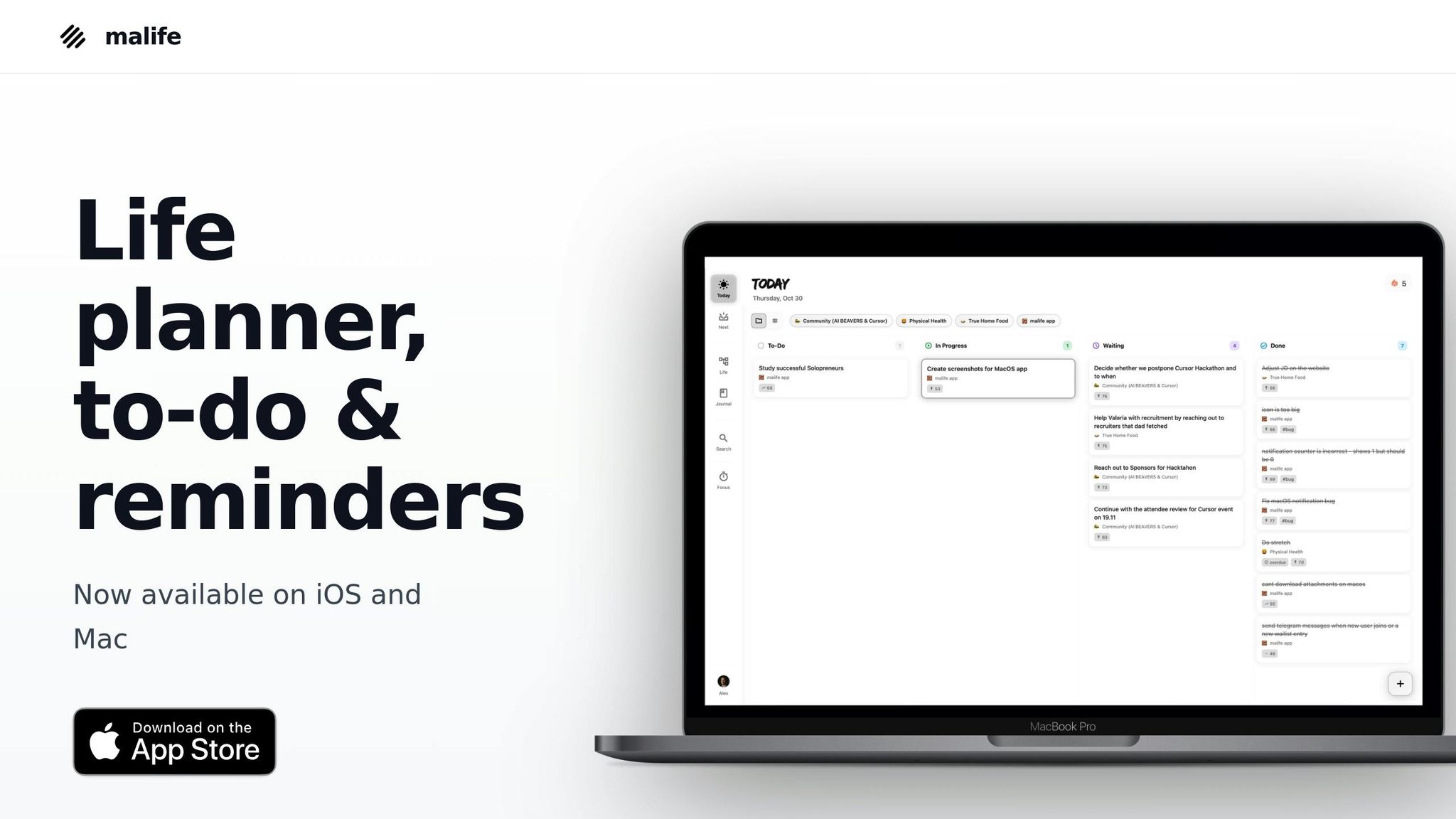
After tackling quick tasks efficiently, the next step is to prioritize based on how much impact a task has versus the effort it requires. Traditional to-do lists often lead to decision fatigue, but malife's impact/effort prioritization method simplifies this process. It organizes tasks into four clear categories: Quick Wins (high impact, low effort), Major Projects (high impact, high effort), Fill-ins (low impact, low effort), and Time Wasters (low impact, high effort). This system helps you focus on what truly matters without draining your energy.
Effectiveness in Conserving Mental Energy
This method is a game-changer for conserving your mental energy. By identifying Quick Wins - tasks that deliver big results with minimal effort - you can build momentum without overexerting yourself. For example, a 2006 energy management program at Wachovia Bank demonstrated how focusing energy effectively led to a 13% higher increase in loan revenues and a 20% boost in deposits over just three months.
Ease of Implementation
Using malife’s impact/effort matrix is simple. When adding a task, evaluate its potential value (impact) and the resources it will consume (effort). The app then visually sorts your tasks, making it easy to assign Major Projects to your peak focus periods, which typically last 90–120 minutes. Meanwhile, Fill-ins can be scheduled during natural energy dips, aligning your work with your body's rhythms. This strategy helps you avoid the 20–30% productivity loss that often occurs when you work against your biological clock.
Support for Maintaining Focus Throughout the Day
This matrix does more than organize tasks - it helps maintain your focus. By pre-selecting priorities, you eliminate the "What should I do next?" dilemma, which can save up to 25% of your time by reducing context switching.
"Energy fluctuates wildly based on sleep, stress, nutrition, and meaning. You only have about 90-120 minutes of peak cognitive performance at a time before your brain needs recovery."
– Leon Ho, Founder & CEO of Lifehack
With clear Quick Wins and Time Wasters removed from your list, you can stay focused throughout the day. This structured approach complements earlier energy-saving strategies, ensuring your tasks align with your natural productivity cycles and maximizing your efficiency.
4. Schedule Decisions During Peak Energy Hours
Your brain doesn’t operate at full throttle all day. It works in 90-to-120-minute cycles of high-focus energy followed by natural dips. Ignoring these natural rhythms can slash productivity by as much as 20–30%. To stay sharp, plan your most challenging decisions when your mental energy is at its peak. Recognizing and respecting these cycles is a game-changer for structuring your day.
Managing Mental Energy Wisely
The average adult makes a staggering 35,000 decisions every day. Each choice chips away at your mental reserves, a phenomenon known as decision fatigue. To avoid burning out, align high-stakes decisions with your peak energy hours. Studies show that making critical decisions during these optimal periods leads to better outcomes - whether in performance or revenue generation.
A Simple Way to Identify Peak Hours
Start with a 3-day energy audit. Every two hours, rate your mental energy on a scale from 1 to 10 (e.g., 6–9 AM, 12–2 PM, 3–5 PM, 7–9 PM). This will reveal patterns, and for most people, mornings tend to be the sharpest. Once you pinpoint your peak times, guard them fiercely. For example, Steve Wanner, a partner at Ernst & Young, boosted his productivity by limiting email checks to 10:15 AM and 2:30 PM instead of responding to every notification. By dedicating 45-minute blocks to email, he cleared his inbox faster and saved energy for more critical tasks. This simple strategy helps you prioritize what matters most when your mind is at its best.
Staying Focused Throughout the Day
Try the "First Priority" Rule: decide on your most important task the night before and tackle it first thing in the morning - before diving into emails or phone calls. Save strategic planning and complex problem-solving for your peak hours. Meanwhile, handle lower-stakes tasks like emails or administrative work during your natural afternoon energy dip. This method also prevents the 25% productivity loss caused by frequent task-switching. By working with your brain’s natural rhythms, you’ll make the most of your peak hours while giving it time to recharge during lighter tasks.
5. Capture Tasks with Voice Input
Effectiveness in Conserving Mental Energy
Every time a new task crosses your mind, your brain faces a choice: hold onto it or jot it down. Holding onto ideas creates what productivity expert David Allen calls "open loops" - those lingering thoughts that quietly sap your mental energy, even when you're not actively thinking about them. As Allen famously says: "Your mind is for having ideas, not holding them". Voice input helps close these loops by allowing you to offload tasks instantly. This frees up your brain for actual thinking, rather than wasting energy on remembering.
The efficiency of voice input is undeniable. Most people speak at a rate of 120–150 words per minute, while typing averages just 40 WPM. That makes speaking 3 to 4 times faster than typing, which means fewer interruptions and less chance of breaking your focus. This speed advantage makes it an ideal tool for staying productive without losing your train of thought.
Ease of Implementation
Modern voice recognition technology is highly accurate, with success rates of 95–99%. This makes it practical for everyday use. You can speak naturally, and the system will automatically process your words - no need to navigate menus or type manually. For example, saying something like, "Call the dentist tomorrow at 2 PM", prompts the system to organize the details for you, handling dates and context seamlessly.
To get the best results, hold your phone 6–12 inches from your mouth and dictate in a quiet environment to reduce background noise. Start with simple tasks like creating reminders or grocery lists to build confidence. Once you're comfortable, you can move on to more complex entries. The goal is to make voice input second nature - when a thought arises, you capture it immediately and move on.
Support for Maintaining Focus Throughout the Day
Voice capture is particularly useful during your 90- to 120-minute ultradian cycles - those natural periods of high focus and energy. Instead of letting stray tasks disrupt your concentration, you can externalize them instantly with voice input. Whether you're commuting, walking, or tackling low-energy moments, this approach clears your mental backlog without cutting into your most productive time. By offloading tasks as they come up, you preserve the mental clarity needed to focus on what truly matters, avoiding the "brain fog" that comes from juggling too many thoughts at once.
6. Take Short Breaks and Naps
Effectiveness in Conserving Mental Energy
Your brain has a finite supply of mental energy, and it depletes during demanding tasks. As William S. Helton, a professor at George Mason University, explains:
"We don't know exactly what in the brain gets depleted, but when you do a cognitively demanding task, it operates as though there's a 'mental fuel' that gets burned up".
When this energy runs low, no amount of effort can fully compensate for the drop in performance.
Taking short breaks is one of the easiest ways to recharge. Research indicates that even micro-breaks lasting less than 10 minutes can improve vigor (d = 0.36) and reduce fatigue (d = 0.35). For example, schoolchildren taking 20- to 30-minute breaks before standardized tests scored as if they’d had an extra 19 days of school. In workplaces, rest breaks have been linked to a 5% boost in quantitative work performance and an 8% increase in qualitative results. These benefits highlight how essential breaks are for maintaining mental stamina.
Power naps serve a similar purpose, offering a quick reset in a compact timeframe. A nap of 15 to 20 minutes can refresh your mind without causing the grogginess that comes from entering deep sleep. NASA researchers found that a planned 26-minute nap improved alertness by 54% and job performance by 34% for long-haul pilots. However, naps longer than 30 minutes can lead to "sleep inertia", a foggy state that might take up to an hour to shake off. Keeping naps short is crucial to avoid this.
Ease of Implementation
The beauty of breaks lies in their simplicity. You don’t need fancy tools or rituals - just step away from your tasks for a few minutes. Even brief pauses can enhance focus and performance. This practice pairs perfectly with other strategies to keep your cognitive reserves in check throughout the day.
For naps, the process is equally straightforward. Find a quiet, dim spot (or use an eye mask and earplugs), set an alarm for 15–20 minutes, and let yourself relax. Early afternoon, between 1 p.m. and 3 p.m., is ideal for napping since it coincides with the body's natural energy dip. Some people even try a "coffee nap", drinking a cup of coffee right before a 20-minute nap. The caffeine kicks in just as they wake up, leaving them energized.
To get the most out of your breaks, align them with your natural energy cycles. Your body typically operates in 90- to 120-minute waves of high and low energy. When you start feeling restless or catch yourself yawning, it’s a good time to pause and recharge.
Support for Maintaining Focus Throughout the Day
Timing your breaks strategically can make a big difference. Morning breaks are especially effective because your mental energy is still relatively intact early in the day. A 5- to 15-minute break in the morning can help sustain energy levels throughout the day, preventing the exhaustion that often hits later.
Organizations that encourage structured breaks see noticeable improvements in employee well-being and productivity. Scheduling regular pauses helps maintain steady energy levels and sidesteps the dreaded afternoon slump.
The type of break you take also matters. While simply resting can be helpful, active breaks - like 6 minutes of light exercise or relaxation techniques - are even more effective. A study published in Stress and Health demonstrated that short interventions, such as guided body scans or aerobic exercises, significantly reduced mental fatigue and increased vigor. These benefits lasted for at least 20 minutes after the break. Whether it’s a quick stretch or a moment of mindfulness, the right kind of break can keep you sharp and energized.
7. Keep a Daily Gratitude Journal in malife
Effectiveness in Conserving Mental Energy
Beyond organizing tasks and taking breaks, practicing gratitude is another powerful way to conserve mental energy.
Our brains are naturally wired to scan for problems, which can be mentally draining. Gratitude journaling shifts this focus. Instead of dwelling on challenges, it trains your mind to notice and appreciate what’s going well. Lisa Valentine, an author and educator, explains it beautifully:
"Living gratefully doesn't insulate me from life, it allows me to more readily embrace joy and move through pain".
Writing down what you’re grateful for triggers the release of dopamine and serotonin, chemicals that enhance happiness. It also reduces cortisol, the stress hormone that depletes your mental energy. Studies reveal that just two weeks of daily gratitude journaling can lead to better sleep, increased optimism, and improved moods compared to focusing on daily frustrations. Improved sleep, in turn, helps replenish the mental energy needed to tackle the next day.
Philip Lazarus, an associate professor of psychology, emphasizes the long-term benefits:
"Gratitude is like a muscle. The more we practice being grateful the more we become connected to gratitude's transformative benefits".
By focusing on positive moments, you conserve mental energy that might otherwise be lost to negative thoughts and frustrations. This practice becomes an emotional anchor, helping you process tough emotions more quickly and regain a calm, focused mindset. It’s a small but impactful shift that sets the tone for a productive day.
Ease of Implementation
Incorporating this habit into your routine is straightforward with malife. Simply open the app and jot down one or two specific moments of gratitude. Even on hectic days, a single meaningful sentence can keep the practice alive. The key is to be specific: instead of writing "I’m grateful for my family", try something like "I’m grateful my partner made coffee this morning." These detailed entries create a stronger emotional connection.
This habit doesn’t require much time - just 15 minutes, three times a week is enough to see results. Habits often take 21 days to form, and malife’s user-friendly interface makes it easy to stick with it. You can record moments of gratitude as they happen, which helps reinforce positive emotions before the details slip away. Focus on unexpected or small moments - they tend to have the strongest emotional impact.
Support for Maintaining Focus Throughout the Day
Your gratitude journal in malife can also act as a quick reset during stressful times. Having a tangible record of positive moments allows you to revisit and rekindle feelings of appreciation, helping you step out of the mental fog caused by stress. Lindel Greggery, a mindfulness coach, highlights this connection:
"Managing our energy by managing our attention is a core skill to prevent burnout".
Revisiting your gratitude entries can restore focus and reduce stress, freeing up mental resources to thoughtfully address challenges instead of reacting impulsively. When faced with a tough situation, try using the "long lens" perspective: ask yourself how this will look six months from now, and then find one small thing to appreciate in the moment. This simple reframing helps prevent the energy drain that comes from feeling stuck or overwhelmed.
Conclusion
Daily decision fatigue can sap your mental energy, leaving you less effective as the day goes on. Aytekin Tank, Founder and CEO of Jotform, captures this perfectly:
"Each day, we make tens of thousands of decisions... our decision-making ability worsens after we pass a certain threshold - a phenomenon known as decision fatigue".
To counter this, here’s a quick recap of strategies to conserve your mental bandwidth: group similar decisions to avoid constant context switching, use the two-minute rule to handle small tasks right away, focus on what matters most instead of chasing urgency, tackle demanding tasks when your energy is highest, offload thoughts instantly with voice capture, take short breaks or naps to recharge, and keep a gratitude journal to shift your mindset away from negativity.
The key is to start small. Choose one or two strategies that align with your current struggles. For example, try using voice capture to quickly unload your thoughts or set recurring reminders for routine tasks. As Emma McAdam, LMFT, wisely points out:
"When you have a recurring reminder, you'll take care of the little habits that add up to better mental health. Again, systems are better than resolutions".
The malife platform can help you implement these strategies seamlessly. It organizes tasks by Life Areas, prioritizes them based on Impact and Effort, enables quick voice captures, and supports your gratitude practice - all designed to help you conserve mental energy and focus on what truly matters.
FAQs
How can I figure out the times of day when I’m most productive?
To figure out when you're at your best, start by keeping an eye on your energy levels throughout the day. Notice when you feel sharp, focused, or ready to tackle big tasks - these moments often align with your body’s natural rhythms, like ultradian cycles, which are periods of about 90 minutes of high energy followed by a dip.
It’s also helpful to think about your sleep and wake habits to identify your chronotype - whether you’re naturally a morning person or more of a night owl. For instance, if you’re a morning person, you might find your peak focus early in the day. On the other hand, night owls often hit their stride later in the evening. By tracking these patterns, you can plan to tackle high-priority tasks during your peak energy windows and save lighter work for times when your energy drops. A small shift like this can make a big difference in how much you get done!
What are some simple ways to prioritize tasks effectively?
To manage your tasks efficiently, try the 1-3-9 method. This involves selecting 1 crucial task, 3 important ones, and 9 smaller, less pressing tasks for your day. Start with the most critical task to set the tone and build momentum for the rest of your work.
Another useful strategy is the Eisenhower Matrix, which sorts tasks based on their urgency and importance. This approach helps you focus on high-priority tasks while deciding which ones to delegate or postpone.
Both methods are straightforward and effective for organizing your day, keeping your energy focused, and maintaining productivity.
How can gratitude journaling help save mental energy?
Gratitude journaling is a powerful way to ease mental strain and cultivate a more positive mindset. By regularly noting what you're thankful for, you naturally steer your focus away from stress and those nagging negative thoughts that can sap your energy.
This habit encourages a sense of appreciation and helps maintain emotional balance, making it easier to tackle the day with focus and resilience. Rather than getting stuck on challenges, it allows you to direct your energy toward what genuinely matters, promoting mental clarity and overall well-being.