
10 Tips to Beat Decision Fatigue

10 Tips to Beat Decision Fatigue
Feeling drained from endless choices? Decision fatigue is real - your brain can only handle so many decisions before it starts cutting corners. On average, adults make 35,000 decisions daily, leading to impulsive actions or complete paralysis by the end of the day. But there’s good news: simple strategies can help you conserve mental energy and make better choices.
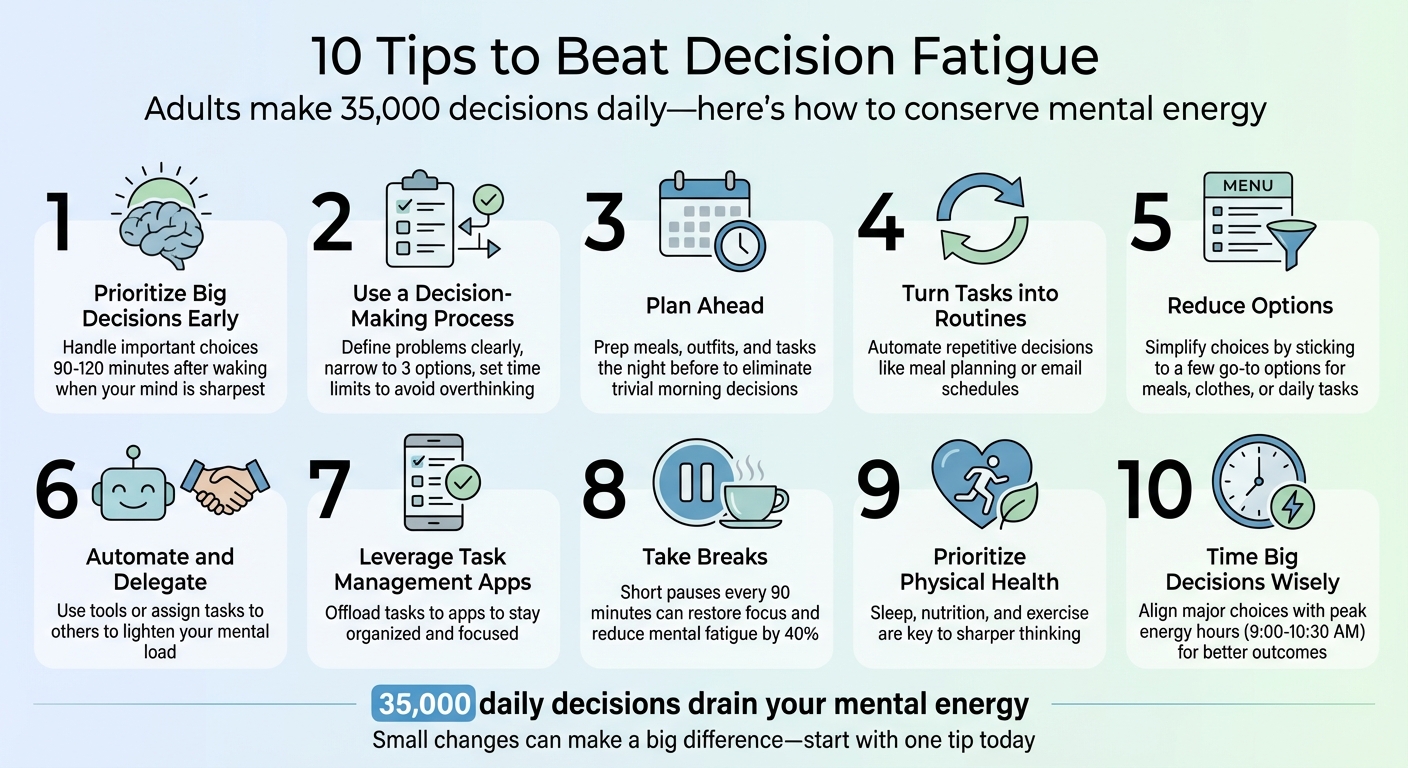
Here’s a quick breakdown of the 10 tips to tackle decision fatigue:
- Prioritize big decisions early: Handle important choices when your mind is sharpest, typically 90–120 minutes after waking.
- Use a decision-making process: Define problems clearly, narrow options, and set time limits to avoid overthinking.
- Plan ahead: Prep meals, outfits, and tasks the night before to eliminate trivial morning decisions.
- Turn tasks into routines: Automate repetitive decisions like meal planning or email schedules.
- Reduce options: Simplify choices by sticking to a few go-to options for meals, clothes, or daily tasks.
- Automate and delegate: Use tools or assign tasks to others to lighten your mental load.
- Leverage task management apps: Offload tasks to apps like malife to stay organized and focused.
- Take breaks: Short pauses every 90 minutes can restore focus and reduce mental fatigue.
- Prioritize physical health: Sleep, nutrition, and exercise are key to sharper thinking.
- Time big decisions wisely: Align major choices with your peak energy hours for better outcomes.
Key takeaway: Simplify your daily decisions with routines, tools, and better timing to free up mental energy for what matters most. Small changes can make a big difference.
10 Strategies to Beat Decision Fatigue and Conserve Mental Energy
1. Focus on High-Impact Decisions First
Not all decisions are created equal. High-impact decisions are those that directly influence your long-term goals, align with your core values, and push you closer to achieving your vision. Think of decisions like choosing a new career path or setting strategic priorities for an important project. On the other hand, low-impact choices - like deciding what to eat for lunch or which email to open first - consume mental energy without delivering meaningful results.
To make the most of your mental resources, structure your day so that critical decisions are tackled when your mind is at its sharpest. Research suggests that your brain operates at peak performance roughly 90 to 120 minutes after waking. This is the ideal time to address major decisions. As the day progresses, mental fatigue can creep in, leading to indecision or impulsive choices. A 2011 study even found that decisions made later in the day are often less favorable. Taking a post-lunch break or engaging in a brief mental reset can help restore clarity and improve decision-making quality.
To simplify the decision-making process, use a few targeted questions to evaluate your options: "Does this directly support my top three priorities?" and "What am I giving up by focusing on this instead of something else?". Tools like the Impact/Effort Matrix can also help. This method involves categorizing tasks based on their potential impact and the effort required. Start with "High Impact-Low Effort" tasks, then move to "High Impact-High Effort" ones that require a more detailed plan.
Set aside the first two hours of your day for strategic decisions. Additionally, limit yourself to two or three major choices each day - your "decision budget" - and save routine or less critical tasks for later. By managing your energy and focusing on what truly matters, you can make better decisions and avoid burnout.
2. Build a Simple Decision-Making Process
Once you've prioritized focusing on high-impact decisions, the next step is to create a straightforward process for handling everyday choices. A consistent framework can help you evaluate options quickly and save mental energy for what truly matters. Instead of getting bogged down with endless comparisons, you’ll have a reliable system to follow that keeps things simple.
Start by defining the problem clearly. Be specific about what you're trying to solve. Narrow your options to three, weigh the pros and cons briefly, and set a strict time limit to avoid overthinking. After making your decision, write it down along with your reasoning. This not only prevents you from revisiting the same decision later but also ensures you don't forget why you chose a particular path in the first place. This habit can free up your mental bandwidth for more important matters.
Adopt a "good enough" mindset. Known as "satisficing", this approach focuses on picking an option that meets your essential needs rather than chasing perfection. For repetitive tasks - like deciding what to eat or managing your inbox - establish a standardized routine. Having a go-to process for these recurring decisions keeps your brain in the same mode and saves energy for tackling bigger, more complex challenges.
3. Plan Ahead
Making decisions in advance can save you from the mental fatigue of constant, trivial choices throughout the day. Whether it’s deciding on your outfit, planning meals, or organizing daily tasks, a bit of preparation can free up your mind to handle unexpected challenges and focus on what truly matters. Here’s how you can make this work.
Start with preparing the night before. Lay out your clothes, pack your bag, and figure out breakfast before heading to bed. This simple habit helps you avoid the usual morning rush and chaos. Studies suggest that decision-making is sharper and more deliberate in the morning, while impulsivity tends to creep in as the day progresses. So, take advantage of the calmer evening hours to set yourself up for success the next day.
Try the "decide once" rule for repetitive tasks. Instead of debating when to do laundry every week, pick a fixed day - like Mondays - and stick to it. Similarly, meal planning becomes easier with themed nights like "Taco Tuesdays" or "Meatless Mondays." These themes simplify grocery shopping and eliminate the need to constantly rethink your menu. By automating these small decisions, you save time and mental energy.
To stay on top of tasks, focus on prioritizing effectively. At a time when you’re most alert, jot down the top three things you need to tackle the next day. This prevents the dreaded "analysis paralysis" that can hit when you’re already tired. If you prefer digital tools, task management apps like malife can help. They let you organize tasks by Life Areas, work from a Today & Next view, quickly add tasks with voice capture, and use an Impact/Effort system to prioritize what matters most.
"By creating routines that then turn into habits, we reduce the number of decisions we need to make - and conserve our energy for bigger tasks and decisions." - Leigh Miller, LCSW, Kaiser Permanente
4. Turn Repetitive Tasks into Routines
Continuing the idea of planning ahead, turning repetitive decisions into routines can save even more mental energy. Repeated tasks have a way of wearing us down over time. By creating routines, you essentially put these activities on autopilot, freeing up your brain to concentrate on what’s truly important. The trick is to identify tasks that are predictable and don’t require much creative thinking - these are perfect candidates for streamlining or automation.
Start with the small, frequent decisions that disrupt your focus during the day. High-profile leaders like Barack Obama, Mark Zuckerberg, and Steve Jobs famously simplified their lives by adopting a daily uniform, cutting out the need to decide what to wear [7, 11, 12, 22]. You don’t have to go that far, but you could simplify your mornings by sticking to two or three breakfast options, setting specific times to check emails, or using templates for tasks you tackle regularly.
Another effective strategy is habit stacking. This involves linking a new behavior to an existing routine. James Clear, author of Atomic Habits, describes it as: "After/Before [CURRENT HABIT], I will [NEW HABIT]". For instance, "After I pour my morning coffee, I’ll review my top three priorities for the day." The more specific your trigger, the more likely the habit will stick. This approach reduces the number of decisions you need to make, helping you preserve your focus for more impactful work.
"By creating routines that then turn into habits, we reduce the number of decisions we need to make - and conserve our energy for bigger tasks and decisions." - Leigh Miller, LCSW, Kaiser Permanente
Digital tools can also make managing routines easier. For instance, apps like malife simplify recurring tasks. Whether it’s a weekly grocery list or a monthly budget review, you can set reminders once and let the app handle the rest. With features like adjustable reminders (+10m, +1h, +1d), you can quickly reschedule tasks without the hassle of constant replanning. By combining routines with smart tools, you can stay on track without the mental drain of micromanaging your day.
5. Reduce Your Options
Did you know the average person makes 35,000 choices every day? Most of these decisions seem small - like choosing a toothpaste brand, deciding what to wear, or picking lunch - but each one chips away at your mental energy. The more options you face, the more your brain works, even for trivial matters. That’s why cutting down your choices can help preserve your focus for decisions that actually matter.
Picture this: you’re at the grocery store staring at over 10 ketchup options. Without realizing it, your brain is weighing the pros and cons of each one. This constant evaluation can lead to analysis paralysis, where you feel so overwhelmed that you either delay making a choice or avoid it altogether. By narrowing your options, you can avoid this mental gridlock.
Start by simplifying low-stakes, repetitive decisions. For example, limit your breakfast choices to two or three favorites and rotate them weekly. Streamline your wardrobe to a few outfits you feel good in. When ordering takeout, stick to a handful of go-to restaurants instead of endlessly scrolling through menus. These small adjustments free up mental energy for the big decisions - like tackling work strategies or managing your finances.
Research backs this up. A study of more than 1,100 judicial decisions found that judges were more likely to grant parole early in the day when their mental energy was fresh. By the afternoon, their ability to deliberate effectively had noticeably declined. Similarly, doctors are more likely to prescribe antibiotics later in the day, showing how decision fatigue impacts judgment. Simplifying minor choices helps protect your ability to think clearly when it matters most.
To take this a step further, consider using practical tools to streamline your decision-making. For instance, apps like malife can help you organize your tasks by Life Areas and focus on what’s most pressing with features like the Today & Next view. The app’s Impact vs. Effort prioritization tool makes it easy to spot which tasks deserve your attention, cutting through the clutter and reducing the mental toll of figuring out where to begin.
6. Automate and Delegate When Possible
Everyday decisions - like paying bills or responding to emails - chip away at your mental energy. By automating repetitive tasks, such as scheduling bill payments or using email templates, you can eliminate entire categories of decisions from your day. This frees up brainpower for more meaningful choices.
Delegation works in a similar way. Handing off tasks to others reduces your mental load. Tools like the Eisenhower Matrix can help you identify which tasks are urgent but not important, making it easier to decide what to delegate. Even at home, small acts like letting your partner decide dinner or asking a friend to choose the movie can lighten your mental burden. Grouping similar tasks - like handling emails in one focused session - can also cut down on the energy lost to constant context switching.
"I'm trying to pare down decisions. I don't want to decide on what I'm eating or wearing because I have too many other decisions to make." - Barack Obama
Studies show that switching between different types of tasks can cost you up to 40% of your productive time. By batching similar decisions, you can keep your brain in the same "mode", reducing the mental exhaustion that comes with shifting gears.
Using a task management app like malife can make this even easier. It organizes tasks into Life Areas and separates immediate priorities with features like Today & Next views, helping you focus on what matters most.
Start small to integrate automation and delegation into your routine. Automate one recurring payment this week, delegate a single task at work, and try batching similar decisions into one session. Over time, these small adjustments add up, preserving your energy for the choices that truly count.
7. Use a Task Management App
Your brain isn’t designed to juggle dozens of tasks, deadlines, and reminders all at once. Trying to keep everything in your head forces your mind to work overtime, draining the energy you need for more important decisions.
That’s where a task management app can make all the difference. Offloading tasks to a system you trust takes the pressure off your brain. In fact, studies show that over 35% of people use task management software to organize their day, and nearly 50% rely on to-do list apps for better time management. Writing down tasks or using an app reduces mental strain and helps you stay focused.
Take malife, for example. It organizes tasks into Life Areas - categories like health, work, relationships, and finances - so you can quickly see what’s on track and what needs attention. This setup helps you stay in the same mental flow rather than constantly switching gears. The app’s Today & Next view focuses only on what’s immediately relevant, cutting through the noise and avoiding decision fatigue. Plus, malife’s Impact/Effort prioritization system makes sorting tasks simple, so you don’t have to spend your mornings figuring out what to tackle first.
Other features, like voice capture, allow you to add tasks on the go while the app fills in details for you. Persistent reminders with quick options (+10m, +1h, +1d) eliminate the small but draining decisions of when to follow up. Research even highlights that the average person switches between tasks more than 300 times during a workday. By organizing tasks into clear categories and priorities, malife helps you cut down on these constant interruptions and keeps your focus sharp.
Start by adding your top three priorities to malife. Set a reminder for your most important task tomorrow morning. You’ll quickly notice how much lighter your mind feels when it’s not carrying everything at once.
8. Take Regular Breaks
Regular breaks are essential for keeping your mind sharp and your decision-making on point. Research shows that after about 90 minutes of focused work, your cognitive performance takes a nosedive, draining your mental energy and increasing the likelihood of poor decisions.
Make it a habit to schedule short breaks throughout your day. Even a quick 5-minute pause can cut mental fatigue by 40%, while well-timed breaks can improve focus by up to 23%. One fascinating study on Israeli judges revealed that decision fatigue caused approval rates to plummet to almost 0%, only to recover after taking breaks. These findings highlight just how critical it is to step away and recharge.
"Taking a 5-10 minute break after a period of intense focus allows your brain to reset, helping you maintain workplace productivity over longer periods." – Allison Dunn, CEO and Business Coach, Deliberate Directions
Use your break time wisely. Get your blood flowing with a quick walk or some desk stretches. Try deep breathing exercises or simply take a moment to observe your surroundings mindfully. Even grabbing a healthy snack can help stabilize your energy levels.
Consider following the 90-minute rule: work for 90 minutes, then take a 5–10 minute break. During these breaks, step outside, stretch, or try the 4-4-6 breathing technique (inhale for 4 seconds, hold for 4 seconds, exhale for 6 seconds). These small actions can clear mental fog, sharpen your focus, and keep you performing at your best.
9. Take Care of Your Physical Health
While mental strategies can simplify decision-making, your physical health plays a crucial role in keeping your mind sharp. When your body is run-down, it’s harder to make sound decisions. Prioritizing sleep, eating well, and staying active creates the foundation for clearer thinking and better choices throughout the day.
Start with sleep. Quality sleep is the cornerstone of good decision-making. It gives your brain the reset it needs to handle high-pressure decisions effectively. On the flip side, lack of sleep diminishes impulse control and emotional balance, often leading to rash or poorly thought-out choices.
Feed your brain the right way. Nutrition is just as important as sleep when it comes to mental clarity. Incorporate foods like leafy greens (think kale and spinach), antioxidant-packed berries, and omega-3-rich raw nuts and seeds into your diet to support brain health. Healthy fats from sources like avocado oil, olive oil, and coconut oil also help your body and brain function at their best. Steer clear of refined sugars, processed flours, and artificial sweeteners, as they can cloud your judgment and lead to brain fog.
"Definitely don't make big decisions when you're tired or hungry." – Dr. Lisa MacLean, Psychiatrist and Chief Wellness Officer at Henry Ford Health.
Stay active. Pair good sleep and nutrition with regular physical activity to complete the trifecta. Aim for at least 30 minutes of movement each day - even something as simple as a brisk walk or taking the stairs can make a big difference [31, 11]. Exercise not only improves mood by releasing endorphins but also sharpens cognitive function. Plus, it supports better sleep, creating a positive cycle that enhances your ability to make thoughtful decisions.
"Not only promotes better sleep but also releases endorphins, which elevate mood and improve cognitive function." – Emily Greffenius, Precision Nutrition.
10. Make Big Decisions When Your Energy Is High
Your brain doesn’t maintain the same decision-making ability all day - it ebbs and flows with your energy levels. Research suggests your cognitive function peaks about 90 to 120 minutes after waking up. This is when your mind is sharpest, making it the ideal window for tackling high-stakes decisions. During this time, you're better equipped to weigh options carefully without falling into traps like overthinking or making rash choices.
Studies even show that judges tend to make fewer favorable rulings as their mental energy diminishes throughout the day. This highlights how crucial it is to align big decisions with your mental peak. By scheduling your most important choices during your brain’s prime hours, you can approach them with clarity and focus.
Aim to make your critical decisions between 9:00 AM and 10:30 AM, when your cognitive energy is at its peak. If a major decision can’t wait until the next morning, opt for a balanced, low-glycemic meal beforehand to keep your glucose levels stable - this helps maintain your mental sharpness.
"Cognitive energy is your most valuable asset as a leader. Protect it with as much care as your time or money." – Gerald J. Leonard, CEO, Turnberry Premiere.
To make the most of this strategy, apply the 80/20 rule: identify the 20% of decisions that will have the biggest impact on your results and tackle those during your peak energy hours. Save routine or less demanding tasks for later in the day when your mental reserves are naturally lower. By timing your decisions wisely, you can reduce decision fatigue and maximize your productivity.
Conclusion
Decision fatigue is a constant challenge, but even small adjustments can make a big difference. Start with just one or two strategies - like automating your morning routine, grouping similar tasks together, or making your most important decisions during your peak energy hours.
When routines become habits, they reduce the number of choices you face daily, saving your mental energy for more important matters. Once these habits are established, they require far less effort to maintain, giving you the cognitive space to focus on what truly matters.
Using task management tools can also ease your mental load. Writing down tasks shifts them out of your head and onto a platform, reducing stress and improving resilience. Research supports this approach, and tools like malife can simplify your day with features such as Life Areas organization, Today & Next views, and automated reminders. These tools help you prioritize important decisions and handle recurring tasks, cutting down on the countless small choices that can drain your energy.
Even one small change can have a noticeable impact on your mental stamina. Decision fatigue isn’t permanent - it improves with rest and well-structured routines. Over time, these incremental adjustments build your confidence and strengthen your ability to make sound decisions. Remember, it’s about progress, not perfection. As former President Barack Obama once said:
"I'm trying to pare down decisions. I don't want to make decisions about what I'm eating or wearing. Because I have too many other decisions to make".
Save your mental energy for decisions that truly matter, and let your routines take care of the rest. Your mind will thank you for it.
FAQs
How can I figure out the best time of day to make important decisions?
To figure out your best decision-making hours, spend a week tracking your energy and focus levels. Pay attention to how well you slept, any exercise you did, your caffeine intake, and rate how alert or sluggish you feel throughout the day. Patterns will likely emerge - many people find they’re sharpest a few hours after waking up, especially following some light activity. Regularly getting 7-9 hours of sleep and staying physically active can also boost mental clarity and help cut down on decision fatigue.
Once you identify your peak energy hours, use them wisely. Reserve that time for important decisions like planning, budgeting, or having meaningful discussions. Tools like malife can make this easier by helping you set reminders and categorize tasks under a “Peak-Energy Decisions” list. Over time, this strategy can help you make the most of your day, leaving routine or less demanding tasks for when your energy dips.
How can I simplify my daily tasks through automation?
Automating everyday tasks can help ease decision fatigue and free up mental energy for more meaningful priorities. Here are some practical ways to make it happen:
- Leverage a task management app like malife to organize your day effortlessly. These apps let you capture tasks using voice commands, set reminders that won’t let you forget, schedule recurring activities, and prioritize based on what’s most important. They transform repetitive decisions into automatic, hassle-free actions.
- Use voice commands with smart assistants like Alexa or Siri to simplify your routine. Whether it’s adding reminders, creating calendar events, or controlling smart-home gadgets, voice commands save you time and help you stay focused on bigger tasks.
- Set up recurring reminders for routine activities. Apps like malife allow you to schedule tasks that repeat daily, weekly, or on specific dates, so you’ll never overlook important to-dos.
By automating these small, repetitive decisions, you can streamline your day and concentrate on what really deserves your attention.
How does your physical health affect your ability to make decisions?
Your physical health has a direct impact on how well you make decisions. Why? Because your brain depends on rest and movement to operate at its peak. Getting enough sleep isn’t just about feeling rested - it’s about recharging your mental energy, improving your focus, and cutting down on decision fatigue. On the other hand, regular exercise gets your blood flowing and releases chemicals that boost memory, sharpen focus, and help you manage stress. Together, these habits keep your mind alert and ready to tackle challenges throughout the day.
Simple routines like following a consistent sleep schedule, staying physically active, and taking short breaks during work can go a long way in preserving the mental energy you need for sound decision-making. Tools like malife can make this even easier by helping you set bedtime reminders, track your workouts, and juggle health goals alongside your daily tasks.