
Pareto Principle: 80/20 Rule for Task Prioritization

Pareto Principle: 80/20 Rule for Task Prioritization
The 80/20 rule, or Pareto Principle, highlights that 80% of outcomes come from 20% of efforts. This simple idea can help you focus on the tasks that truly matter. Instead of trying to do everything, identify the small percentage of activities that drive the majority of your results.
Key Takeaways:
- What It Means: A small portion of your work creates the largest impact.
- Why It Matters: Helps you focus on important tasks instead of spreading yourself thin.
- How to Apply It:
- List all tasks and group them into categories (Work, Health, etc.).
- Identify high-impact tasks by asking:
- Does this align with my goals?
- What happens if I don’t do this?
- If I could only do 3 things today, what would they be?
- Prioritize tasks based on impact vs. effort.
- Use tools like time-blocking or prioritization frameworks (e.g., Eisenhower Matrix).
Quick Tips:
- Track your time for two weeks to find patterns.
- Focus your energy during peak productivity hours.
- Regularly review and adjust your priorities to stay on track.
The Pareto Principle isn’t about working harder - it’s about working smarter by focusing on what drives results.
How to Find Your High-Impact 20% Tasks
Figuring out which tasks fall into your critical 20% requires a thoughtful and organized approach. Start by jotting down every task, project, and commitment in your life - work deadlines, personal errands, side projects, you name it. This step helps declutter your mind and gives you a clear picture of where your time and energy are currently going. Once everything is laid out, the next step is to group these tasks in a way that highlights meaningful patterns.
Group Tasks by Life Areas or Projects
After listing everything, sort tasks into categories based on Life Areas like Work, Health, Finance, Personal Growth, Relationships, and Wellness. This categorization can reveal patterns you might not have noticed before. For example, you might find that most of your work results stem from client meetings and strategic planning, while routine administrative tasks contribute little to your overall outcomes.
Tools like malife's Life Areas feature can make this process more visual and actionable. Instead of staring at a chaotic master list, you’ll see tasks neatly organized by domain. This clarity helps you identify what’s on track and what’s falling behind. Features like color-coding can also spotlight imbalances - like when work-related tasks dominate and health priorities take a backseat.
Questions to Identify High-Impact Tasks
To separate the tasks that truly matter from those that don’t, ask yourself these key questions:
- "Does this task directly contribute to my long-term goals?" If a task doesn’t align with your strategic objectives or your "north star", it’s likely not worth prioritizing.
- "What would happen if I didn’t do this task?" If skipping the task has little to no consequence, it’s probably just busywork.
- "If I could only accomplish three things today, what would they be?" This helps you zero in on what’s truly important.
"Efficiency is doing things right; effectiveness is doing the right things." – Peter Drucker, Management Consultant
Another crucial consideration is return on investment (ROI). Ask yourself: "How confident am I that this task will lead to a positive outcome?" or "Is this the single most important thing I can do to generate value or revenue?". These questions encourage you to focus on creating meaningful results rather than just staying busy. Once you’ve filtered your tasks this way, use data to back up your decisions.
Use Data to Prioritize
Track your daily tasks and their outcomes for two weeks. This simple exercise can reveal the 20% of tasks that yield the biggest results. This approach aligns perfectly with the 80/20 rule, helping you pinpoint the few actions that drive the majority of your success. In business settings, use metrics like customer feedback, sales data, or support logs to identify which activities are responsible for most of your results - or problems.
Applying the "5 Whys" technique can also help uncover the root causes behind your tasks. Often, addressing one core issue can resolve multiple smaller problems at once. Scoring tasks based on their impact - whether it’s revenue, cost savings, or problem-solving - can help you rank them effectively.
For a quick way to prioritize, try malife's Impact vs. Effort feature. By scoring tasks on both their potential impact and required effort, you can easily identify high-impact, low-effort opportunities. These are the tasks that truly move the needle, while avoiding those that eat up time without delivering meaningful results.
How to Apply the 80/20 Rule in Daily and Weekly Planning
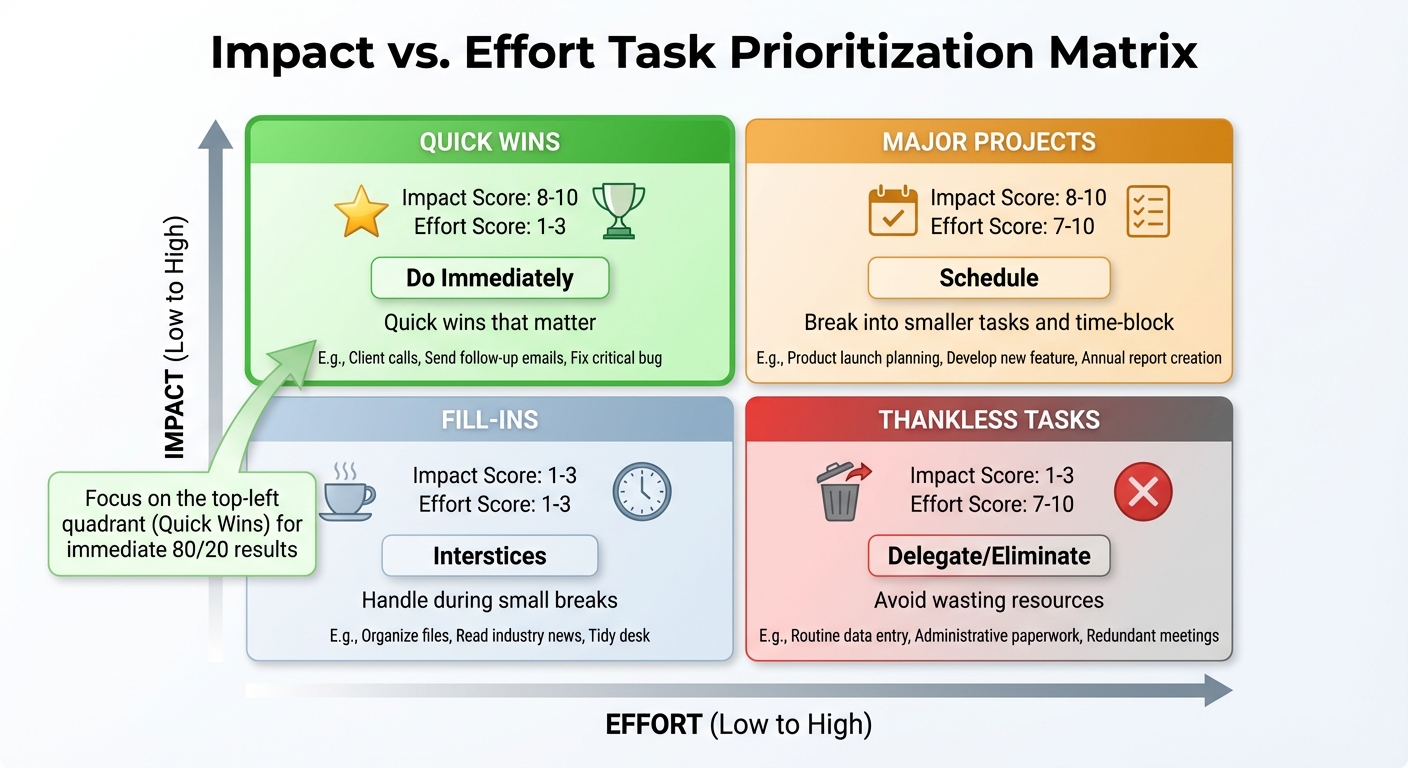
80/20 Rule Task Prioritization Matrix: Impact vs Effort Guide
Once you've pinpointed your most impactful tasks, the next step is to design your schedule around them. This involves setting clear priorities, dedicating your most productive hours to these tasks, and cutting out activities that don’t deliver meaningful results.
Set Focused Goals for the Day and Week
Start by identifying 1–3 key outcomes for each day and week. These should be the goals that truly make a difference - like closing an important deal, launching a feature, or completing a critical report.
Make sure your weekly goals align with your long-term objectives, often referred to as your "North Star" - the ultimate direction guiding your efforts.
"80% of your outcomes result from just 20% of your effort." – Lindsey Ellefson, Features Editor, Lifehacker
Schedule High-Impact Tasks First
Plan to tackle your high-impact tasks during your peak productivity hours. Research shows that most people are only highly productive for about 2 hours and 53 minutes each day. Whether your peak time is mid-morning or early afternoon, reserve this window exclusively for your most vital work.
Using time blocking can help you stay on track. By assigning specific time slots to these tasks, you create mini-deadlines and reduce the risk of distractions like meetings or emails. For instance, tools like malife’s Today view allow you to prioritize high-impact tasks while keeping lower-priority ones in a "Next" section until you’re ready for them. This setup helps maintain focus and prevents the stress of an overflowing to-do list.
Once your schedule is set, it’s time to refine your task list by identifying what to delegate or eliminate.
Deprioritize or Delegate Low-Impact Tasks
To weed out tasks that don’t contribute much, try the 80/20 Scoring Method. Rate each task on a scale of 1–10 for both the effort required and the potential results. Tasks that require a lot of effort but deliver minimal impact - like routine data entry or simple email replies - should be delegated, automated, or removed entirely.
Another effective tool is the Eisenhower Matrix, which helps categorize tasks into four groups: urgent/important (do immediately), important/not urgent (schedule), urgent/not important (delegate), and neither (eliminate). For tasks that are low-impact but still need attention, use interstices - those small gaps between meetings or larger work blocks - to knock them out quickly.
Here’s a quick breakdown of how to approach tasks based on their impact and effort:
| Task Category | Impact Score (1-10) | Effort Score (1-10) | Action Strategy |
|---|---|---|---|
| High Impact / Low Effort | 8-10 | 1-3 | Do Immediately: Quick wins that matter. |
| High Impact / High Effort | 8-10 | 7-10 | Schedule: Break into smaller tasks and time-block. |
| Low Impact / Low Effort | 1-3 | 1-3 | Interstices: Handle during small breaks. |
| Low Impact / High Effort | 1-3 | 7-10 | Delegate/Eliminate: Avoid wasting resources. |
To fine-tune your approach, conduct a two-week audit of how you spend your time. Track your activities and their outcomes, then identify the 20% of tasks that led to 80% of your successes. Shift everything else to your "Next" list or delegate it.
Balance Impact and Effort
The 80/20 rule helps pinpoint tasks that drive results, but understanding the effort required ensures you can tackle them effectively. High-impact tasks often demand varying levels of resources, and finding a balance prevents wasted time on minor tasks while critical priorities are neglected.
"Plenty of important things take so much effort that, in the end, they're not worth actually doing." – Geoffrey James, Contributing Editor, Inc.com
The trick is to rank tasks by priority. Assign each task two scores: one for effort (1 being the least) and another for potential results (10 being the highest). Then, calculate the ratio (effort/results); the lower the ratio, the higher the priority. For instance, making a customer referral call might score 1 for effort and 10 for results, giving it a priority score of 0.1 - making it a top task. On the other hand, writing a detailed trip report might score 10 for effort and 2 for results, yielding a priority score of 5, which suggests it should be delegated or deferred. This method complements earlier task categorization, ensuring every action aligns with your goals.
Prioritize Tasks Using Impact vs. Effort
To manage tasks effectively, divide them into four groups: Quick Wins (high impact, low effort), Major Projects (high impact, high effort), Fill-ins (low impact, low effort), and Thankless Tasks (low impact, high effort). Quick wins should be your first focus since they provide immediate progress. Major projects require breaking down into smaller steps and scheduling dedicated time. Fill-ins can be done during spare moments or passed on to someone else, while thankless tasks should be eliminated as they drain resources without meaningful results.
This method encourages you to ask critical questions like, "Which tasks contribute directly to long-term goals?" or "If I could only accomplish three things today, what would they be?" By filtering tasks through both impact and effort, you ensure that saying "yes" to a high-impact task doesn't unintentionally mean saying "no" to something even more important.
Use malife to Visualize and Prioritize Tasks
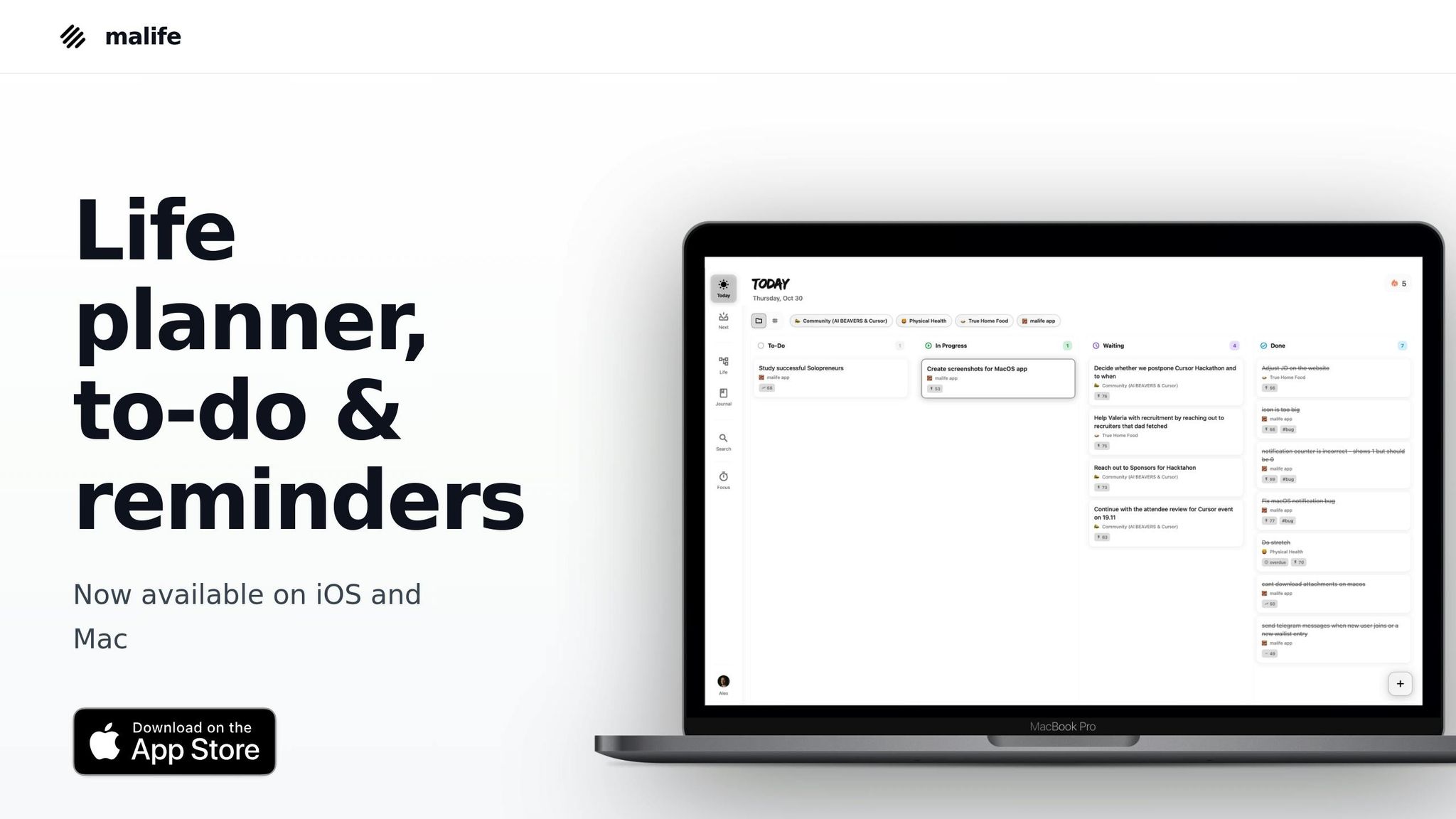
Once priorities are clear, visual tools can help you stay on track. malife’s Impact/Effort system allows you to tag tasks based on their return on investment, keeping the most valuable ones in focus. When you add a task, you can assign it an impact and effort rating, which automatically organizes it into either your Today or Next view based on its priority level. This makes it easy to identify quick wins that deserve immediate attention and major projects that need time set aside.
malife’s Today & Next flow ensures your high-impact tasks remain front and center without cluttering your workspace with unnecessary items. At a glance, you can see which tasks offer the best value for the least effort, helping you consistently focus on the critical 20% that delivers 80% of your results. Features like time blocking and reminders make it simple to integrate the impact/effort framework into your daily routine.
Review and Refine Your 80/20 Prioritization
Priorities evolve, and what drove 80% of your results last month might not hold the same weight next month. Regular reviews help you stay aligned with what truly matters.
Conduct a Weekly Review
Set aside time each week - perhaps on Friday afternoon or Sunday evening - to evaluate your accomplishments. Start by listing your tasks, then pinpoint the top 20% that made the biggest impact. Use this insight to plan your focus for the upcoming week.
Research from the Journal of Organizational Behavior Management shows that individuals who track their time spend up to 10 times more on high-priority tasks. Tracking creates awareness, helping you separate "side quests" (like organizing files or responding to non-urgent emails) from the "main mission" - the tasks that directly push you closer to your goals. When new priorities arise, try the "swapping" method: treat tasks like items in a queue, and consciously de-prioritize something else to make room for the new focus.
| Review Frequency | Purpose | Key Action |
|---|---|---|
| Weekly | Tactical Alignment | List tasks, identify the top 20%, and schedule peak focus hours. |
| Monthly/Quarterly | Strategic Pivot | Review metrics to ensure high-impact tasks are still delivering results. |
| Project-Based | Resource Allocation | Audit workload and swap tasks to avoid burnout. |
These reviews keep your efforts targeted and adaptable.
Track Progress with malife
During your weekly review, take advantage of malife's Life Areas and Journal tools to evaluate progress. These features allow you to check in on key areas like Work, Wellness, Relationships, and Personal Development, ensuring no area gets overlooked while you're focused on others.
Jot down quick daily reflections to reinforce what’s working. After two weeks, review these notes to spot patterns and confirm which 20% of tasks are delivering the most results. The Projects view in malife ensures your major initiatives stay on track, helping you avoid stalls and maintain momentum. Combining reflection with structured tracking keeps your priorities aligned with your goals.
Stay Focused on the Vital Few
Regular reviews provide the foundation for staying focused on the tasks that matter most.
"If everything is called a priority, then nothing is." – Ron Ashkenas, Principal, Ashkenas Consulting
One of the biggest risks to the 80/20 approach is letting low-value tasks sneak back into your routine. Studies show workers spend 58% of their day on "work about work" (like coordination and communication), leaving just 33% for strategic tasks. To combat this, timebox administrative tasks into specific blocks rather than letting them scatter throughout your day. Reserve your peak energy periods for the top 20% of tasks to ensure maximum impact.
For small, low-priority tasks that pop up during your review, apply the two-minute rule: if it takes less than two minutes, handle it immediately to prevent a backlog. For everything else, evaluate whether it genuinely supports your goals or is just unnecessary clutter. Regularly "spring clean" your task list to remove items that no longer serve a purpose. These habits keep your focus sharp and ensure your daily actions consistently align with the 80/20 principle.
Conclusion
The Pareto Principle shifts your attention away from countless low-impact activities and zeroes in on the critical few that generate 80% of your outcomes - whether you're striving to achieve career milestones, prioritize your health, or strengthen personal connections. This approach helps you build a purposeful and efficient daily routine.
To put the 80/20 rule into practice, conduct regular reviews to pinpoint tasks that truly make a difference. Prioritize these during your most productive hours, and consistently trim your to-do list by cutting out distractions that add little value. Focusing on what truly matters not only saves time but also reduces stress and accelerates your progress.
FAQs
How do I figure out which tasks are the most impactful to focus on?
To get started, jot down all your tasks and assess each one by its impact (the value it brings) and the effort needed to complete it. Pinpoint the top 20% of tasks that offer the greatest impact with the least amount of effort - these should be your main priorities.
By zeroing in on these high-impact tasks, you can accomplish more meaningful outcomes while steering clear of time-wasting busywork.
What tools can help me use the 80/20 rule to prioritize tasks?
Using the 80/20 rule effectively means focusing on tasks that deliver the most value while cutting down on distractions. malife, a versatile life planner and to-do app, is designed to help you do just that. It lets you prioritize tasks by weighing their impact against the effort required, categorize them by different areas of your life, and stay organized with its "Today & Next" workflow. Handy features like voice capture and persistent reminders ensure that your most important tasks never slip through the cracks.
With its impact rating system, malife pinpoints the 20% of activities that contribute to 80% of your outcomes. This makes it easier to zero in on what truly counts, helping you make meaningful strides in both your personal and professional goals.
How often should I review and adjust my task priorities to stay focused?
To stay focused on what truly moves the needle, take a moment each day to reassess your priorities. Spending just a few minutes to identify which tasks will make the biggest difference can help you stay on track and make the most of your time.
In addition, carve out time once a week for a more thorough review. Use this opportunity to reorganize your to-do list, add any new high-priority items, and decide which lower-value tasks can be delegated or eliminated. By combining quick daily check-ins with a more in-depth weekly planning session, you can keep your energy directed toward what matters most and maintain a steady level of productivity.