
How Visual Clutter Affects Productivity

How Visual Clutter Affects Productivity
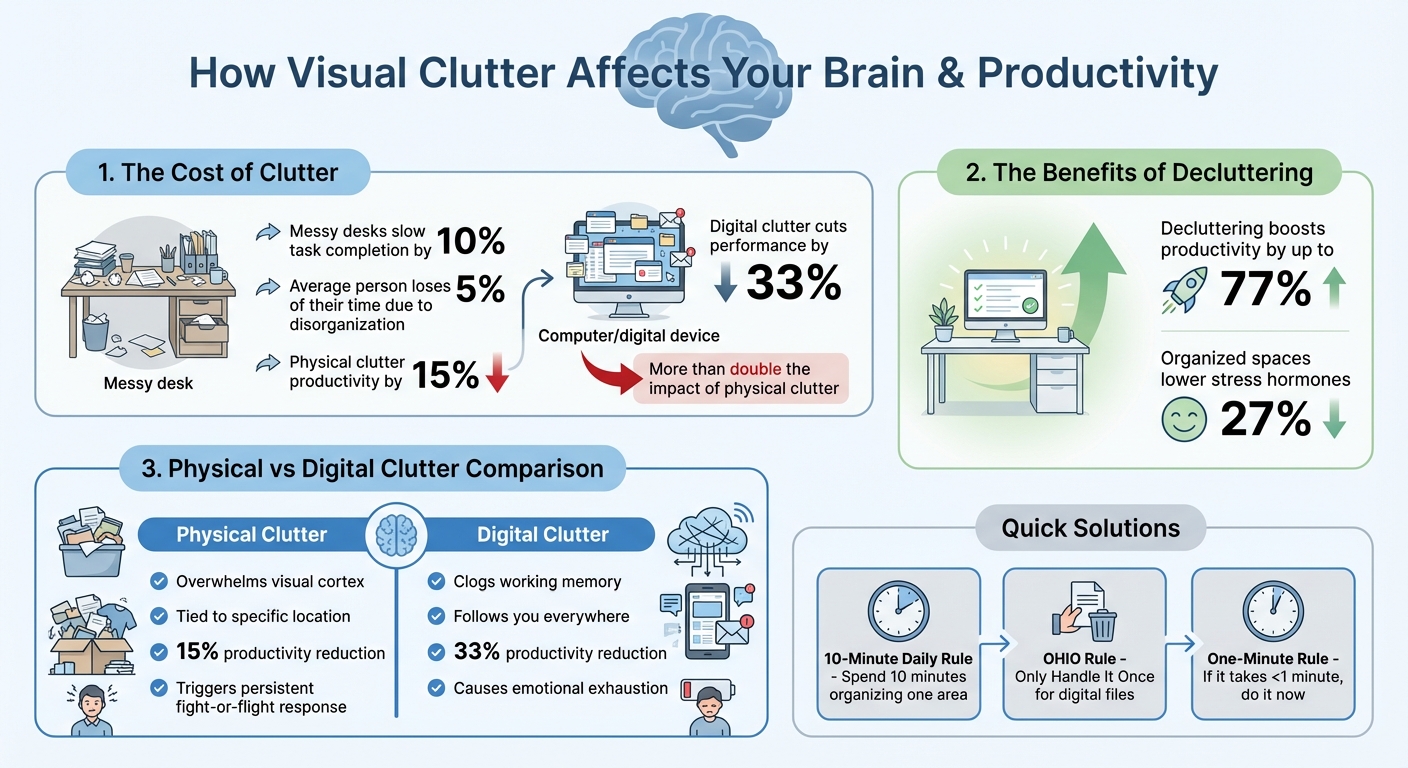
Visual clutter - whether it's a messy desk or a screen full of open tabs - can drain your energy, increase stress, and reduce productivity. Research shows that clutter impacts your brain's ability to focus, increases cortisol levels, and slows down decision-making. Here's the key takeaway:
- Messy desks slow task completion by 10%.
- Decluttering can boost productivity by up to 77%.
- Organized spaces lower stress hormones by 27%.
Both physical and digital clutter demand extra mental effort, making it harder to focus and stay efficient. Want to fix it? Start small. Spend a few minutes daily organizing your space, apply the "OHIO Rule" (Only Handle It Once) for digital files, and give every item a specific place. Tools like malife can simplify these habits, helping you stay on track and regain control.
Visual Clutter Impact on Productivity and Stress Statistics
Research on Visual Clutter: Key Findings
Princeton Study on Focus and Visual Clutter
Professor Sabine Kastner from Princeton University has dedicated over 20 years to understanding how visual clutter disrupts focus. In a study featured in the June 3, 2015, issue of Princeton Alumni Weekly, Kastner used functional magnetic resonance imaging (fMRI) to observe brain activity as participants viewed complex urban scenes. They were tasked with focusing on a specific target, like a car or a person, amidst the visual chaos. The findings were striking: even when participants tried to ignore the surrounding distractions, their brains still processed the blurred background. This suggests that clutter overwhelms the frontal cortex, which is responsible for filtering out irrelevant information, ultimately impairing performance. As Kastner succinctly stated:
"A cluttered desk may make a mind too full".
Additional research has also examined how clutter affects neural communication and stress levels, shedding more light on its impact.
Yale and UCLA Studies on Stress and Clutter

A 2024 study by Yale School of Medicine, published in Neuron, delved into how visual clutter - referred to as "crowding" - affects the brain's primary visual cortex. The researchers discovered that while clutter doesn’t disrupt the sequence of information transfer between neurons, it does reduce the efficiency of neural communication. In simpler terms, the brain processes information more slowly when surrounded by visual chaos. This inefficiency not only hampers productivity but also contributes to mental fatigue.
UCLA's Center on Everyday Lives of Families (CELF) took a different angle in 2009, focusing on how cluttered home environments influence stress levels. Their findings revealed that messy spaces lead to elevated physiological stress markers, showing that clutter can overwhelm individuals and diminish their overall sense of well-being.
Journal of Environmental Psychology: Productivity and Clutter
The effects of clutter extend beyond focus and stress, touching on broader aspects of life satisfaction. Research published in the Journal of Environmental Psychology found a moderate link between clutter and reduced psychological well-being. People in cluttered environments reported lower levels of happiness and an increase in negative emotions. Beyond being an eyesore, clutter was shown to diminish the aesthetic enjoyment of spaces, further affecting mental health.
Clutter's impact is also evident in professional settings. In workplaces, clutter creates an "extraneous cognitive load", essentially overloading working memory and making complex problem-solving more difficult. According to Harvard Business Review, employees working at messy desks were found to be less efficient, less persistent, and more prone to frustration and fatigue compared to those working in organized spaces.
Physical vs. Digital Clutter: How They Compare
Effects on Brain and Behavior
Physical and digital clutter affect the brain in distinct ways, each with its own challenges. Physical clutter overwhelms the visual cortex. For example, a cluttered desk bombards the brain with competing stimuli, forcing it to split focus and work harder to process the environment.
Digital clutter, on the other hand, clogs up working memory - the mental space your brain uses for active problem-solving. As Nuvance Health describes:
"Picture your brain as a supercomputer with a limited amount of RAM (working memory) at any given moment. When your environment is cluttered, your brain's processing centers become overwhelmed by all the incoming signals."
One major difference is portability. Physical clutter is tied to a specific location - like a messy desk you can leave behind for a while. Digital clutter, however, follows you everywhere, across devices and screens. It's a constant presence, quietly draining your cognitive resources even when you're not actively engaging with it. This ever-present nature of digital clutter makes it particularly disruptive, as it continually undermines your ability to focus and maintain a productive mindset.
Impact on Productivity and Stress
The effects of clutter extend beyond the brain, significantly impacting productivity and stress levels. Studies show that physical clutter can reduce productivity by about 15%, while digital and mental clutter can cut performance by nearly 33% - more than double the impact. Digital clutter is especially draining, as it constantly taxes cognitive resources, leading to impaired focus and slower decision-making.
Both types of clutter trigger stress, but in different ways. Physical clutter often causes a persistent, low-level "fight-or-flight" response. For instance, people who describe their homes as cluttered are found to have higher levels of cortisol, the stress hormone, throughout the day. Digital clutter, on the other hand, can lead to emotional exhaustion and "decisional procrastination", where the overwhelming number of choices delays decision-making and perpetuates the cycle of clutter.
The way clutter accumulates also sets the two apart. Physical clutter builds up due to limited space and the effort required to organize tangible items. In contrast, digital clutter grows rapidly because modern storage is essentially limitless, and people rarely feel the need to delete unnecessary files. Dr. Emanuel Maidenberg, Clinical Professor of Psychiatry at UCLA, explains:
"It becomes a habit that is motivated by anxiety... the fear of needing this information at some point in the future and yet not having access to it."
These differences highlight how both types of clutter uniquely challenge our mental and emotional well-being, making it essential to address each in its own way.
How to Reduce Clutter and Improve Productivity
Organizing Your Physical Space
A messy environment can feel overwhelming, making it harder to focus and manage your time effectively. The first step to tackling this is giving every item a specific "home." This helps cut down on unnecessary distractions and creates a sense of order.
Start small - spend just 10 minutes a day clearing a single area, like your desk or a drawer. Joseph Ferrari, a psychology professor at DePaul University, emphasizes the benefits of this approach:
"You'll feel less exhaustion, enhance your productivity at the office, and greatly improve the quality of your life if you can learn how to declutter and become organized".
The trick is to stay consistent. Those small daily actions add up, making it easier to maintain an organized space over time.
Cleaning Up Digital Clutter
Just like physical clutter, digital mess can sap your energy and focus. But managing it requires a slightly different approach. One helpful strategy is the OHIO Rule - "Only Handle It Once." When you open an email or download a file, decide right away whether to delete it, file it, or act on it. This keeps digital clutter from piling up.
Another useful method is the One-Minute Rule: if a digital task takes less than a minute, do it immediately instead of letting it linger. Dedicate just five minutes daily to tidying up your digital space - unsubscribe from newsletters you don’t read, delete unnecessary emails, or organize a few files into folders. Behavioral neuroscientist Daniel Levitin highlights the cost of disorganization:
"The average person likely loses 5 percent of their time due to disorganization".
By adopting these simple habits, you can reclaim that lost time and create a more streamlined digital environment.
How malife Helps You Stay Organized

Digital tools can make staying organized much easier, and malife is designed to address both the root causes and effects of clutter. Its Life Areas feature ensures every task and project has a clear place, much like managing tasks with Kanban, reducing the mental strain caused by scattered information. Instead of juggling multiple apps or sticky notes, you can organize tasks under categories like work, health, relationships, and personal goals.
The Today & Next views simplify your focus by showing only what’s immediately important. This reduces the brain’s struggle to process competing priorities and helps you concentrate on one task at a time. Additionally, persistent reminders act as a backup for your memory, letting you focus on getting things done rather than remembering what needs doing. When a reminder pops up, apply the OHIO rule - handle it, schedule it, or delete it to keep things under control.
With malife’s tools, you can put these clutter-busting strategies into practice, creating a system that promotes better focus and productivity while keeping your mind clear.
Conclusion: Achieving Clarity and Better Productivity
Research shows that visual clutter doesn't just make your environment look messy - it actually drains your mental energy, increases stress levels, and slows you down. Studies reveal that messy spaces can cost you up to 10% more time and reduce your efficiency by 5%. On the flip side, decluttering has been shown to boost productivity by 77% and lower cortisol levels by 27%. The takeaway? A cleaner space leads to a sharper, more focused mind.
The secret lies in building habits that stick. Simple practices, like setting aside a few minutes each day for decluttering, can create lasting order. Try the "one-touch rule" for digital tasks - handle each item only once - and make sure every item in your space has a designated home. As Natalie Christine Dattilo, a Clinical Psychologist at Harvard Medical School, explains:
"When we take care of our home in an intentional and loving way, we send an important message to ourselves that we are worth the time and effort it takes".
This is where malife comes in. Designed to simplify your life, malife organizes your tasks into clear Life Areas and priority views, cutting down the mental chaos caused by scattered information. Features like the Today & Next views help you zero in on what needs your attention now, while persistent reminders ensure nothing gets overlooked. Instead of juggling multiple tools, malife offers a streamlined system to keep you focused and on track.
FAQs
How does visual clutter affect our ability to concentrate?
Visual clutter overwhelms the brain's visual cortex, making it tougher to concentrate and prioritize information. This overload can lead to inefficiency, as the brain works harder to sift through unnecessary details instead of focusing on what’s important.
Cluttered surroundings can also make tasks feel more daunting, contributing to mental fatigue and stress. On the other hand, a clean and organized space allows the brain to process information more smoothly, boosting focus and productivity.
How can I declutter my digital workspace to improve productivity?
To tidy up your digital workspace and improve productivity, begin by organizing your computer files and desktop. Get rid of files you no longer need, sort the rest into clearly labeled folders, and keep only the most important apps and documents visible. This simple step can cut down distractions and help you stay focused.
Make it a habit to regularly review and clean up your digital space to stop clutter from piling up again. A well-organized workspace not only reduces stress but also makes it easier to stay productive all day long.
Why is it important to manage both physical and digital clutter for better productivity?
Managing clutter - both physical and digital - is key to staying productive. A chaotic desk or home can leave you feeling stressed and frustrated, even pushing you toward burnout. On the other hand, digital clutter, like endless notifications or a cluttered desktop, can make it tough to focus and stay organized.
Both forms of clutter weigh heavily on your cognitive load, making it harder to prioritize and get things done. But when you take the time to clean and organize your space - whether it’s your desk or your digital workspace - you create an environment that supports mental clarity, minimizes distractions, and helps you maintain focus for longer periods.