
Science Behind Meditation and Productivity

Science Behind Meditation and Productivity
Meditation isn’t just about relaxation - it’s a proven way to improve focus, memory, and productivity. Research shows regular meditation can help you regain concentration faster after interruptions, reduce stress, and even enhance decision-making. Key findings include:
- Improved Focus: Just 13 minutes a day for 8 weeks enhances attention.
- Stronger Memory: A 2-week mindfulness course boosted test scores and reduced mind-wandering.
- Lower Stress: Meditation calms the brain’s stress center and regulates emotions.
Studies reveal even short, consistent sessions (10–20 minutes daily) can sharpen mental clarity and boost performance at work. Whether it’s through better focus or reduced stress, meditation offers practical tools for staying sharp and efficient in today’s fast-paced world.
How Meditation Improves Cognitive Function
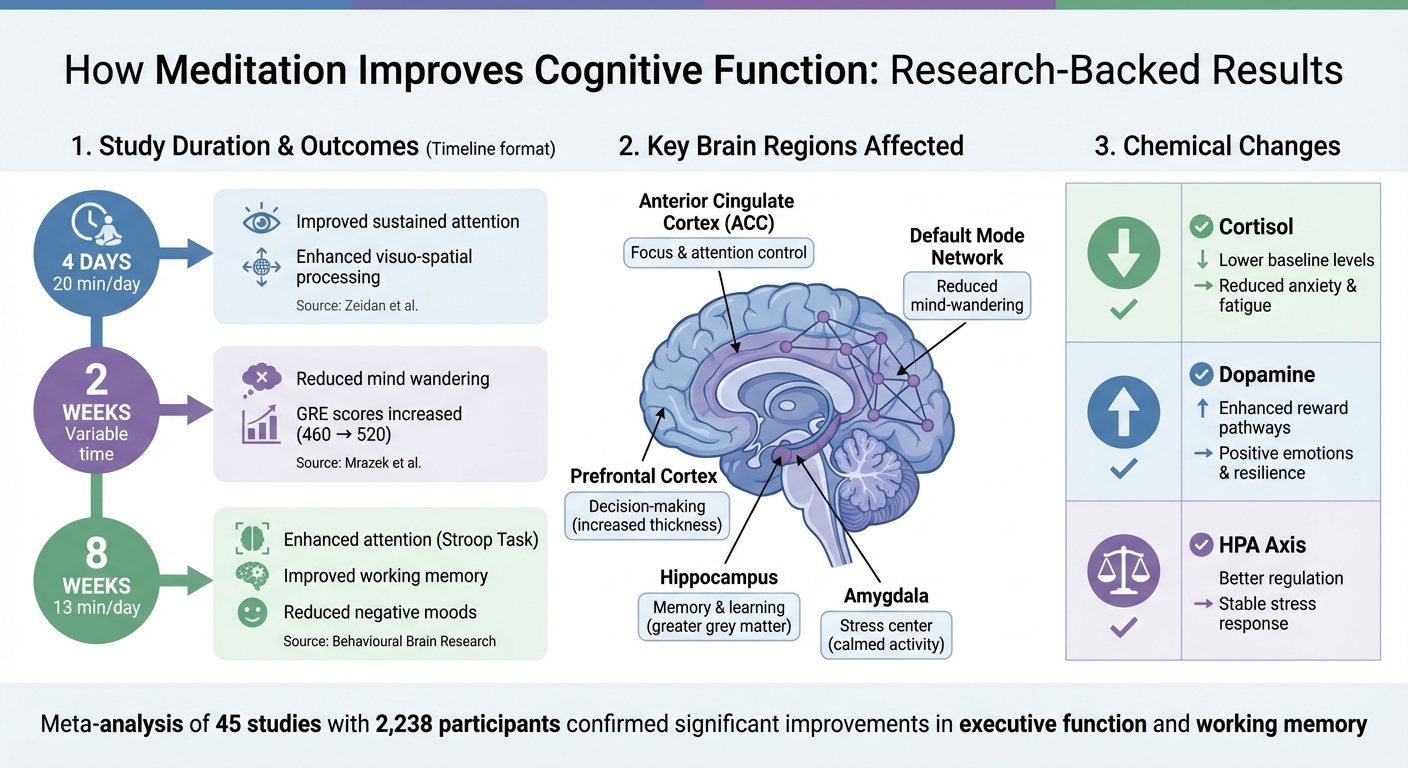
Meditation Benefits: Duration, Practice Time, and Cognitive Outcomes
Meditation offers measurable benefits for your brain, influencing how you think, focus, and perform throughout the day. These improvements span three key areas: focus, memory, and stress management. Together, they create a solid foundation for better mental performance and productivity.
Better Focus and Attention
Meditation sharpens your ability to focus by engaging the Anterior Cingulate Cortex (ACC), the part of the brain responsible for controlling attention. A 2019 study in Behavioural Brain Research revealed that practicing just 13 minutes of guided meditation daily for 8 weeks led to significant improvements in focus, as measured by the Stroop Task - a common test for attention.
Even shorter meditation sessions can make a difference. Research from the University of North Carolina, Charlotte, led by Fadel Zeidan, showed that beginners who meditated for 20 minutes a day over 4 days experienced noticeable improvements in sustained attention compared to a control group. Zeidan explained:
"Our findings suggest that 4 days of meditation training can enhance the ability to sustain attention; benefits that have previously been reported with long-term meditators."
The secret lies in "deautomatization", a process where meditation helps you break free from automatic, distracted behaviors and refocus on the present task. This is particularly useful in work settings where constant interruptions can derail productivity.
Stronger Memory and Mental Flexibility
Meditation doesn’t just improve focus - it also boosts your working memory, the mental space used to process and manage information. A 2013 study from the University of California, Santa Barbara, led by Michael Mrazek, found that students who completed a 2-week mindfulness course improved their GRE reading comprehension scores (from around 460 to 520) and reduced mind wandering.
"Cultivating mindfulness is an effective and efficient technique for improving cognitive function, with wide-reaching consequences." - Michael D. Mrazek, University of California, Santa Barbara
While short-term practice can help, research shows that 8 weeks of daily meditation is the minimum needed for significant gains in working memory and recognition memory for beginners. Meditation also enhances cognitive flexibility, allowing you to adapt your thinking and approach problems in new ways. Studies show that meditators perform better than non-meditators on tasks requiring suppression of habitual responses and adoption of fresh strategies.
By combining improved memory and adaptability, meditation equips you to tackle mental challenges with greater ease.
Lower Stress and Better Emotional Control
Stress and anxiety can cloud your thinking and slow you down, but meditation helps by calming the amygdala, the brain’s stress center, while strengthening the prefrontal cortex’s ability to regulate emotions.
The effects are noticeable. Short meditation sessions have been shown to reduce fatigue and anxiety while improving working memory and visuo-spatial skills. Longer-term practice amplifies these benefits: 8 weeks of daily meditation has been linked to reductions in negative moods and improvements in recognition memory.
A meta-analysis of 45 randomized studies involving 2,238 participants confirmed that mindfulness programs significantly improve executive function and working memory compared to control groups. By lowering cortisol levels and heart rate while enhancing awareness, meditation creates a calm yet alert mental state - ideal for productive work.
| Study Duration | Daily Time | Outcome | Source |
|---|---|---|---|
| 4 Days | 20 Minutes | Improved sustained attention and visuo-spatial processing | Zeidan et al. |
| 2 Weeks | Variable | Reduced mind wandering; higher GRE scores | Mrazek et al. |
| 8 Weeks | 13 Minutes | Enhanced attention (Stroop Task) and working memory | Behavioural Brain Research |
The Brain Science Behind Meditation and Productivity
Meditation isn't just about feeling calmer or more centered - it actually changes the brain in ways that enhance productivity. These changes are not only psychological but also physical, as shown by neuroimaging studies. The structural shifts in the brain lay the groundwork for the cognitive improvements linked to meditation.
Brain Structure and Neural Connection Changes
Meditation rewires the brain to support sharper focus and better decision-making. Studies have identified physical changes in at least eight brain regions, including those that govern attention, memory, and emotional control.
One of the most studied areas is the Anterior Cingulate Cortex (ACC), which becomes thicker with regular meditation. This part of the brain is essential for maintaining focus and resisting distractions - skills critical for productivity. Even short-term meditation can lead to white matter changes in the ACC, improving connectivity between brain regions.
Other notable changes include increased cortical thickness in the prefrontal cortex (responsible for decision-making) and greater grey matter density in the hippocampus (key for memory and learning). Long-term meditation practitioners also show enhanced communication between the brain's hemispheres, thanks to a thicker corpus callosum.
Research highlights meditation’s impact on the Default Mode Network (DMN) - the part of the brain active during daydreaming or mind-wandering. Meditation reduces activity in the DMN, which helps minimize unproductive mental distractions and boosts self-awareness.
"The anterior cingulate cortex is the region associated with attention in which changes in activity and/or structure in response to mindfulness meditation are most consistently reported." - Nature Reviews Neuroscience
Impact on the Autonomic Nervous System
Meditation goes beyond brain structure - it also fine-tunes the body's stress response. It balances the interaction between the central and autonomic nervous systems, enhancing focus and emotional stability.
The Central Autonomic System (CAN) plays a central role here, involving the bilateral dorsal anterior insula and midcingulate cortex. During meditation, these areas activate the Executive Control and Salience networks, which handle conflict monitoring and internal body awareness.
"The results... converge in identifying the bilateral dorsal anterior insula and midcingulate cortex as the critical areas of the central autonomic system (CAN)." - Neuroscience and Biobehavioral Reviews
Meditation also stimulates the parasympathetic nervous system, which helps the body relax and recover from stress. This activation reduces distress signals in both the autonomic nervous system and the hypothalamic-pituitary-adrenal (HPA) axis. The result? A calm yet focused state of mind, often described as "mind like water." Even short meditation sessions can lower stress hormones and improve immune function.
In one study, 152 managers participated in an eight-week meditation program. The results showed noticeable improvements in job performance and satisfaction, as rated by their employers.
Hormone and Brain Chemistry Effects
Meditation doesn’t just reshape the brain and nervous system - it also regulates hormones and brain chemistry. By modulating the HPA axis, meditation reduces baseline cortisol levels and tempers the body's stress response.
Lower cortisol levels are linked to better mental clarity and reduced feelings of anxiety and fatigue. Meditation also enhances dopamine-related reward pathways, promoting positive emotions and resilience against stress.
| Chemical/System | Effect of Meditation | Impact on Productivity |
|---|---|---|
| Cortisol | Lower baseline and reactive levels | Reduces anxiety and fatigue; prevents cognitive decline under stress |
| Reward Pathways | Enhanced dopamine activity | Boosts positive emotions and resilience; combats burnout |
| HPA Axis | Better regulation | Stabilizes stress responses in high-pressure environments |
These chemical shifts improve key executive functions, such as attention, working memory, and cognitive flexibility. Studies also show increased left-sided anterior brain activation - linked to positive emotions - after meditation. To see measurable benefits in focus, memory, and mood, a daily practice of 13 minutes of guided meditation over 8 weeks is recommended.
Using Meditation to Boost Work and Personal Productivity
Workplace Research on Meditation and Performance
Meditation has been shown to enhance work engagement, job performance, and overall satisfaction. For instance, a study conducted with Japanese professionals revealed that meditation practice significantly influenced work engagement (β = 0.112), subjective job performance (β = 0.116), and job satisfaction (β = 0.079), even after accounting for demographic and behavioral factors. Similarly, a 2014 randomized controlled trial involving 152 mid-level managers found that an eight-week Meditation Awareness Training (MAT) program led to noticeable and lasting improvements in job performance, stress management, and satisfaction compared to a control group.
"Meditation-based (i.e., present-moment-focussed) working styles may be more effective than goal-based (i.e., future-orientated) working styles."
– Edo Shonin, Psychology Division, Nottingham Trent University
Another study in 2019 explored the impact of a mindfulness meditation app on 238 employees from two large UK companies. Participants who completed an average of 17 guided meditation sessions (10 to 20 minutes each) over eight weeks experienced significant improvements in well-being, reduced distress, and lower job strain. These benefits were still evident at a 16-week follow-up.
Short Meditation Sessions for Busy Schedules
Even brief meditation practices can deliver significant cognitive and emotional benefits. Research shows that just four days of meditation, with sessions lasting 20 minutes or even as short as 13 minutes daily, can enhance attention, working memory, and executive functioning.
"Four days (20 min/day) of MM training was effective in significantly increasing mindfulness scores... [and] promoted significant effects on several cognitive tasks that require sustained attention and executive processing efficiency."
– Zeidan F, Researcher
Short sessions of 10 to 20 minutes are also effective in reducing job strain and boosting psychological well-being. The key is consistency - practicing a couple of times per week can significantly lower distress levels and improve perceptions of workplace support.
These manageable sessions can easily fit into a busy schedule, especially with the help of practical tools designed to support mindfulness.
Combining Meditation with malife

Building on these cognitive benefits, malife offers a structured way to incorporate meditation into your daily routine. Its Life Areas feature lets you create a dedicated space, such as "Wellness" or "Personal Growth", ensuring mindfulness stays a priority alongside your other responsibilities.
With malife’s Impact/Effort prioritization, you can categorize short meditation sessions (10 to 12 minutes) as "Low Effort / High Impact" activities. The app’s Focus Timer helps you shift from scattered thoughts to a more centered and productive mindset, paving the way for deeper focus and flow.
To keep your practice consistent, malife provides persistent reminders that prompt mindfulness breaks during high-stress periods. These notifications come with flexible options to reschedule (+10 minutes, +1 hour, or +1 day), making it easier to adapt to unexpected changes in your day. The Today & Next view further supports a calm, present-focused approach, aligning with the principles of meditation.
The app’s Journal feature allows you to document your insights, track mood changes, and celebrate progress, creating a feedback loop that highlights how mindfulness translates into measurable productivity improvements.
Conclusion
Meditation isn't just about finding inner peace - it actively reshapes brain function and boosts workplace performance. Studies show that even short sessions of 10–20 minutes can significantly improve focus, memory, and emotional regulation. Over time, regular practice can bring deeper benefits, like lowering cortisol levels, enhancing job performance, and increasing work engagement.
By strengthening mental clarity and decision-making, meditation creates a foundation for better productivity. For instance, research highlights that consistent practice correlates with higher job satisfaction (β = 0.079) and improved subjective performance at work (β = 0.116). These brain-level changes translate directly into measurable gains in daily effectiveness.
The best part? Meditation is incredibly accessible. Just ten minutes a day can enhance cognitive flexibility and working memory, provided you stick with it.
Pairing meditation with productivity tools takes its impact to the next level. For example, using meditation alongside apps like malife creates a powerful combination - mindfulness sharpens your focus, while the app helps you manage tasks more efficiently. This approach aligns with research suggesting that focusing on the present moment can often outperform purely goal-driven strategies.
Start small and stay consistent. Whether you're setting aside a few minutes for meditation in malife's Life Areas or using its Focus Timer, you're not just managing tasks - you’re building the mental framework for meaningful and effective work.
FAQs
How long does it take for meditation to improve focus and memory?
Studies show that meditating for just 13 minutes daily can boost focus, working memory, and recognition memory in as little as eight weeks. That said, noticeable improvements usually don’t appear after only four weeks, so patience is essential.
The secret lies in consistency. Regular meditation trains your mind to stay in the moment, gradually sharpening mental clarity and improving productivity over time.
How does regular meditation change the brain to improve focus and productivity?
Regular meditation can bring noticeable changes to the brain, improving focus, emotional stability, and mental clarity. It promotes neuroplasticity, which is the brain's ability to form and strengthen neural connections. Key areas like the prefrontal cortex and hippocampus - responsible for attention and self-regulation - show marked improvements over time. Plus, meditation helps reduce stress by shrinking the amygdala, the part of the brain that triggers stress responses.
Another benefit is how meditation calms the brain’s default-mode network. This network is often responsible for distractions like overthinking and daydreaming. By quieting it, meditation helps you stay present, manage impulses, and maintain a steady, focused mindset. These brain changes make it easier to concentrate and can even boost productivity.
If you’re looking to make meditation a regular part of your routine, tools like the malife app can be a great support. It lets you schedule sessions, set reminders, and track your progress, helping meditation fit effortlessly into your daily life.
Can short daily meditation sessions really help reduce stress?
Yes, even brief meditation sessions - just 8 to 10 minutes a day - can make a noticeable difference in reducing stress. Research has found that consistent meditation helps decrease cortisol levels, the hormone linked to stress, while also easing anxiety and improving mental clarity.
Spending just a few minutes daily on meditation can establish a routine that boosts both your mental health and productivity.