
How to Recharge Energy with GTD Principles
How to Recharge Energy with GTD Principles
Feeling burned out? You’re not alone. By 2025, 82% of employees are expected to face burnout, and over half already feel drained by the end of their workday. The problem isn’t just time management - it’s failing to align tasks with fluctuating energy levels. This is where Getting Things Done (GTD) steps in, offering a way to manage tasks while preserving energy.
Here’s how GTD helps:
- Offload mental clutter: Move tasks out of your head into a trusted system.
- Prioritize by energy: Match tasks to your energy levels - tackle complex work during high-energy periods and save simpler tasks for low-energy moments.
- Sync with natural rhythms: Work in cycles of 90–120 minutes, followed by breaks.
- Weekly reviews: Regularly update your system to stay clear and focused.
GTD Principles and Energy Management
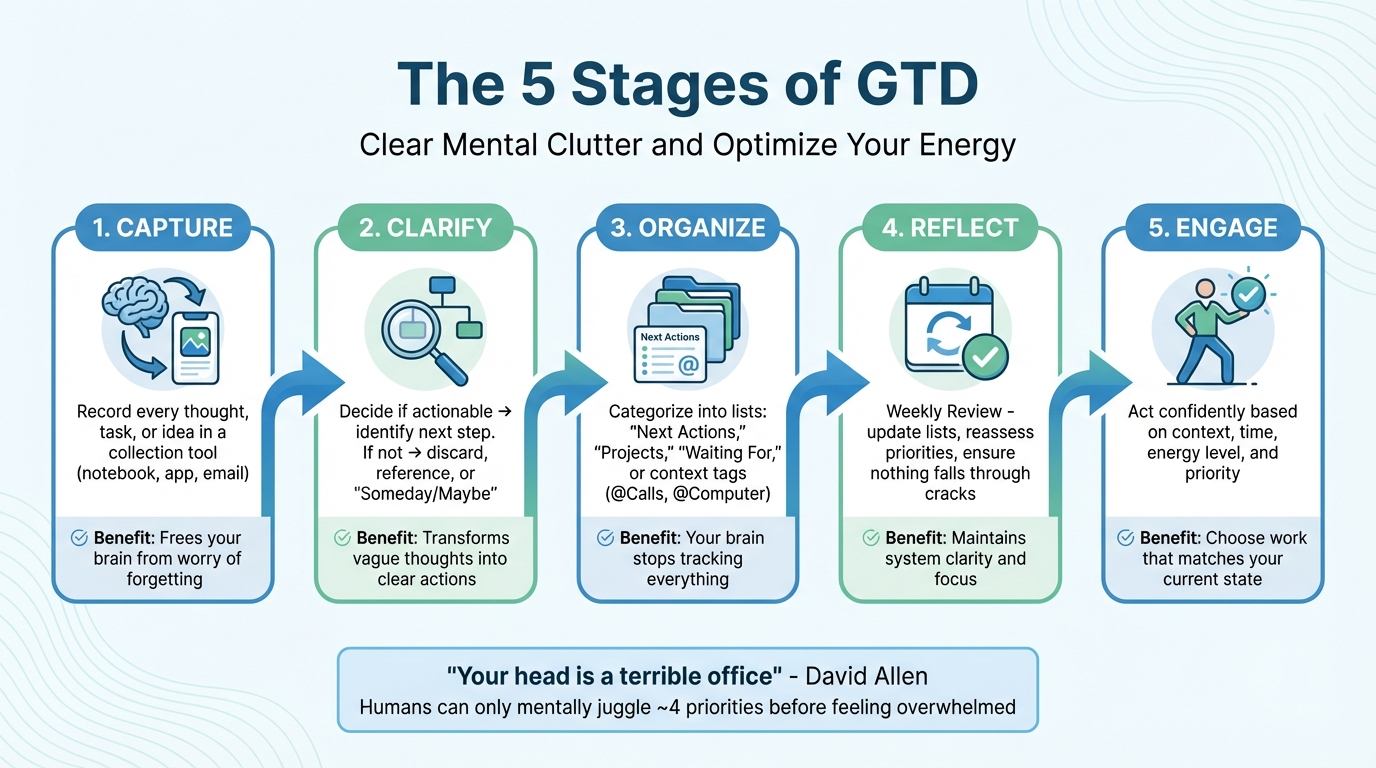
The 5 Stages of GTD for Energy Management and Mental Clarity
GTD (Getting Things Done) takes the mental load off by moving tasks out of your head and into a reliable system. As David Allen famously said, "Your head is a terrible office". Research backs this up, showing that humans can only mentally juggle about four priorities at a time before feeling overwhelmed. When you exceed that limit, your brain gets overloaded, leading to stress and scattered thinking.
By transferring tasks into a trusted system, you can achieve what Allen calls a "mind like water" - a state where your mind is clear, creative, and less strained.
The 5 Stages of GTD
To see how GTD clears mental clutter and optimizes energy, let’s break down its five key stages:
- Capture: The moment a thought, task, or idea pops into your head, you record it in a collection tool - whether it’s a notebook, an app, or even your email inbox. This simple act frees your brain from the worry of forgetting.
- Clarify: Next, you decide if each item is actionable. If it is, you identify the very next step. If not, you either discard it, save it for reference, or add it to a "Someday/Maybe" list.
- Organize: Once clarified, tasks are categorized into lists like "Next Actions", "Projects", "Waiting For", or context-specific lists such as "@Calls" or "@Computer." This ensures your brain doesn’t have to keep track of everything.
- Reflect: Regular reviews - especially the Weekly Review - are crucial. They help you update your lists, reassess your priorities, and ensure nothing falls through the cracks.
- Engage: Finally, you act. With a clear system in place, you can confidently choose what to work on based on your current situation and energy level.
How Energy Affects Task Prioritization
Once your system is set up, GTD helps you match tasks to your energy levels, especially during the Engage stage. When deciding what to work on, GTD suggests using four criteria:
| Engagement Criterion | Description |
|---|---|
| Context | What can you realistically do given your current location or tools? This avoids wasting energy on tasks you can’t tackle right now. |
| Time Available | How much time do you have before your next commitment? This ensures you choose tasks that fit into the time you have. |
| Energy Available | How much mental or physical energy do you have? This guides you to pick simpler tasks when you’re tired and save high-focus work for when you’re energized. |
| Priority | Which task is the most urgent or impactful? This ensures your energy goes toward work that matters most. |
"Energy Available" often becomes the deciding factor. For instance, when you’re low on energy, you might focus on easy administrative tasks. On the other hand, when you’re feeling sharp, it’s the perfect time to dive into high-concentration work. This approach aligns with the body’s natural ultradian rhythms - 90- to 120-minute cycles of high energy followed by lower energy periods.
A real-world example of this comes from Wachovia Bank, where 106 employees optimized their work around these rhythms. The results? They significantly outperformed their peers who didn’t follow similar practices. By syncing tasks with your energy levels throughout the day, you can work smarter and make the most of your natural productivity cycles.
Aligning Tasks to Your Energy Levels
Finding Your Energy Peaks and Lows
Your energy levels naturally rise and fall throughout the day, influenced by factors like biology, sleep, and daily rhythms. Instead of fighting these fluctuations, learn to work with them by identifying your peak periods and lower-energy moments.
Start with a 3-day energy audit. Every two hours, rate your physical, emotional, mental, and spiritual energy on a scale from 1 to 10. Jot down the time, what you were doing, and how focused you felt. After three days, patterns will start to emerge. For instance, you may discover that you're sharpest from 9:00 AM to 11:00 AM, hit a slump after lunch, and then regain focus in the late afternoon.
Understanding your chronotype can also help. Morning types tend to perform best between 8:00 AM and 11:00 AM, while evening types thrive between 4:00 PM and 8:00 PM. Most people fall somewhere in the middle, with peak focus typically occurring between 10:00 AM and 1:00 PM.
Once you've identified your energy patterns, divide your day into three zones:
- Peak Focus Zone: Reserve this time for tasks that require deep concentration, like creative work or problem-solving.
- Supportive Task Zone: Use this for less demanding activities, such as answering emails or attending meetings.
- Reset Blocks: Take these moments to recharge with short walks, light planning, or other restorative activities.
By aligning tasks with your energy levels, you can make the most of your natural rhythms.
Sorting Tasks by Energy Requirements
Not all tasks demand the same level of energy. During the Clarify stage, assess how much focus each task requires. For example, writing a strategic proposal will take significantly more mental effort than organizing your inbox.
Group tasks based on their energy demands:
- High-Energy Tasks: These include activities like strategic planning, creative brainstorming, or solving complex problems.
- Low-Energy Tasks: These are simpler, like data entry, scheduling, or responding to routine emails.
Label tasks in your system with tags like "@high_focus" or "@low_energy" so you can easily match them to your current energy state.
To refine this approach, use the Energy ROI Matrix:
| Task Type | Energy Level | When to Schedule |
|---|---|---|
| High Impact + High Energy | Peak hours | Prioritize these tasks during your most productive times - they're your top priorities. |
| High Impact + Low Energy | Medium windows | Tackle these during your second-best energy periods by batching similar tasks. |
| Low Impact + High Energy | Delegate/eliminate | Avoid wasting peak energy on these - consider delegating or skipping them altogether. |
| Low Impact + Low Energy | Energy troughs | Save these for low-energy moments, like mid-afternoon slumps. |
This system helps you focus on what matters most while ensuring you stay efficient, even during slower periods.
Using malife for Energy-Based Task Management
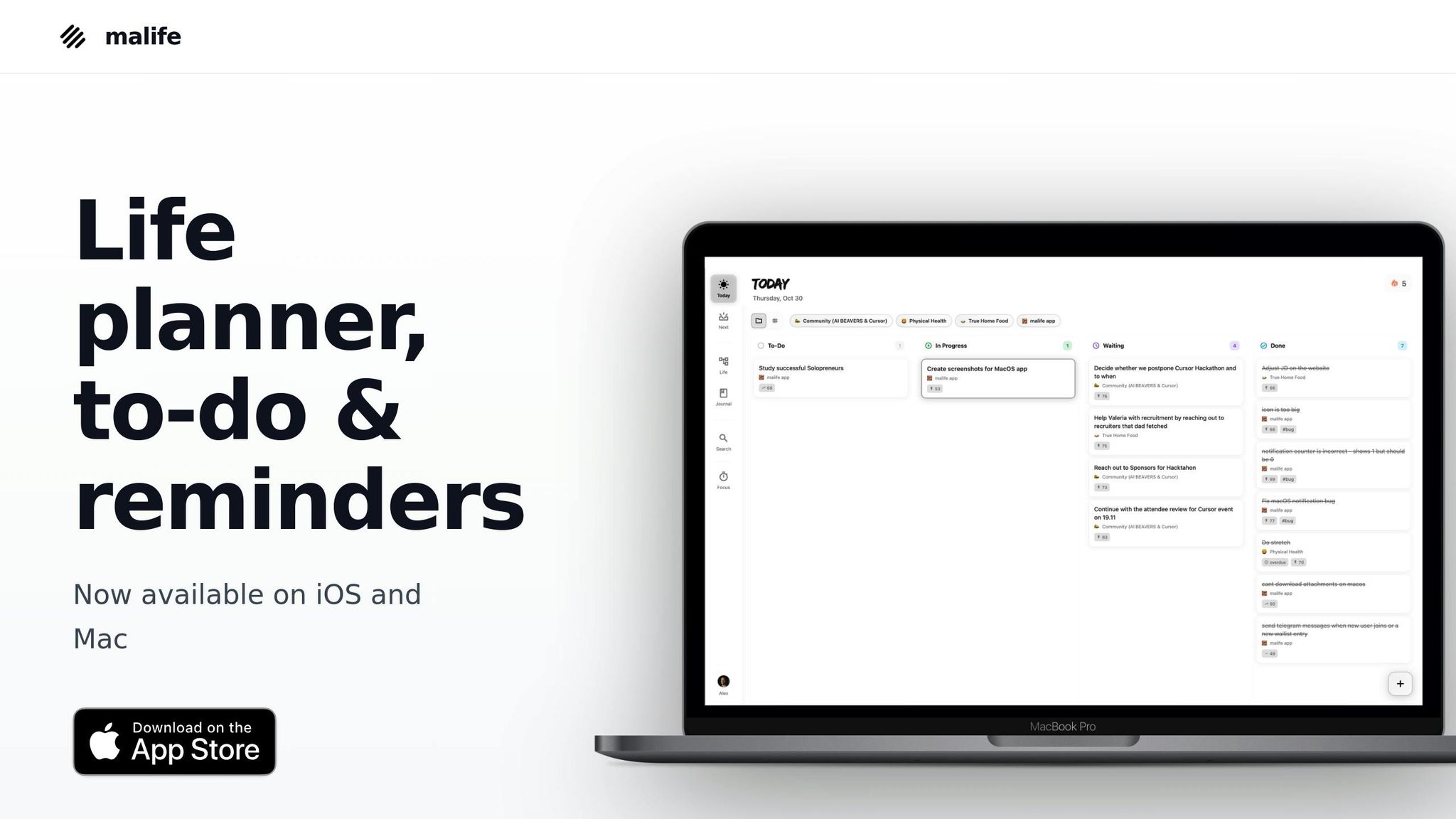
Building on the GTD framework, malife offers tools designed to match your tasks with your energy levels throughout the day.
Organizing Tasks with Life Areas and Today & Next
With malife's Life Areas, you can group tasks by context - like Work, Personal, or Health. This setup minimizes the time spent switching between unrelated tasks, which research shows can increase effort by as much as 25%. By focusing only on tasks relevant to your current context, you conserve mental energy and stay more productive.
The Today view is reserved for appointments and deadlines that need your immediate attention. Keeping this list short prevents overwhelm and ensures you're focusing only on the most pressing commitments for the next 24 hours.
The Next view is where your actionable tasks live, organized across all Life Areas. This is where energy management shines. For instance, during high-energy hours (like 9:00 AM to 11:00 AM), you can tackle demanding tasks, while simpler ones can be saved for when your energy dips. By offloading tasks into these views, you free up mental space for what matters most.
Our bodies naturally follow ultradian rhythms - 90- to 120-minute cycles of rising and falling energy. malife's task views align with these rhythms, helping you focus deeply on one area before taking a much-needed break.
Using Impact/Effort Prioritization
malife's Impact/Effort prioritization tool visually organizes tasks based on their payoff versus the effort they require. This matrix helps you avoid wasting energy on "Thankless Tasks" - low-impact, high-effort activities that are better delegated or eliminated.
Tasks are divided into four quadrants:
- Quick Wins: High impact, low effort. These are great for building momentum.
- Major Projects: High impact, high effort. Save these for peak energy times.
- Fill-ins: Low impact, low effort. Perfect for low-energy periods.
As GTD coach Kelly Forrister explains:
If your brain is toast, good chance you won't want to do that high priority thing anyway, since you won't have the mental horsepower for it.
When deciding a task's impact, consider: "What value does completing this bring?" and "What are the risks of not doing it?". This clarity ensures you use your peak energy for meaningful work, while less critical tasks can wait for lower-energy moments. This prioritization makes task management smoother and more efficient.
Quick Capture and Reminders for Mental Clarity
Uncaptured tasks can create mental clutter, popping into your head at random and adding unnecessary stress. malife's Voice Capture lets you record tasks on the spot, with details automatically filled in. This makes it easier to get thoughts out of your head, a key step for staying productive and stress-free.
Keeping too many tasks in your mind can overwhelm your brain. malife's Persistent reminders - with options like +10 minutes, +1 hour, or +1 day - let you temporarily set tasks aside until it's time to act. This prevents worry and keeps you focused. As David Allen wisely notes:
There's an inverse relationship between these things being on your mind and them actually happening.
Reflecting and Recharging with GTD
The Weekly Review
David Allen describes the Weekly Review as the "critical success factor" for maintaining a smooth-running GTD system. Without it, your task lists can pile up, projects may stall, and your energy gets drained.
A full review usually takes about 60–90 minutes, but seasoned practitioners often complete it in 30–45 minutes. Think of it this way: spending just one hour out of the 168 hours in your week can dramatically improve how you use the remaining 167 hours.
The process unfolds in three phases: Get Clear (organize loose ends), Get Current (update lists and calendars), and Get Creative (revisit your "Someday/Maybe" list and brainstorm ideas). Schedule this review during your peak mental energy times - like Friday mornings or Sunday evenings - to avoid decision fatigue. Research shows that simply planning for unfinished tasks can reduce the mental strain they create.
"The Weekly Review will sharpen your intuitive focus on your important projects as you deal with the flood of new input and potential distractions coming at you the rest of the week."
- David Allen, Author and Productivity Consultant
By following this structured review, you set yourself up to choose tasks that align with your energy levels for the week ahead.
Matching Tasks to Your Energy
After completing your Weekly Review, use the refreshed clarity to align tasks with your current energy. Tools like malife's Today and Next views can help you pick tasks that match your energy level, while the Focus Timer supports deep work sessions with restorative breaks in between.
During the review, identify 3–5 key "must-win" tasks for the week. This helps you avoid overloading yourself and ensures your priorities match your energy reserves. Reflecting on last week’s achievements can also guide you in setting a realistic workload, preventing burnout from over-scheduling.
Building Energy-Recharging Habits
Leverage malife's Recurring Tasks feature to schedule your Weekly Review and regular breaks automatically. Setting a recurring reminder at your peak energy time ensures you consistently maintain your system.
Incorporate Due Times & Dates to schedule breaks throughout your day. Short, regular breaks can significantly enhance performance over time.
Use the Journal feature to capture insights during your review. For example, when reviewing your "Someday/Maybe" list, notice whether an item excites or drains you. Excitement signals readiness for activation, while dread might mean it’s time to let it go. Documenting these reactions can help you track patterns and make better decisions over time.
By embedding these habits, you align with the GTD principle of matching your energy to the tasks at hand.
"Time is a finite resource. Energy is a different story... energy can be systematically expanded and regularly renewed by establishing specific rituals."
- Tony Schwartz and Catherine McCarthy, The Energy Project
Conclusion
The principles of GTD (Getting Things Done) resonate because they tap into a simple truth: your mind is meant for generating ideas, not storing them. Every unfinished task or commitment - what GTD calls "open loops" - takes up mental space and drains your energy before you even begin. By moving these open loops into a trusted system, you free your mind to focus on what truly matters.
What makes GTD especially effective is its focus on syncing tasks with your energy levels. While time is fixed, energy can be renewed and expanded through intentional habits and routines. When you align demanding tasks with your peak energy times and save less intensive work for lower-energy moments, you’re working in harmony with your natural rhythms. This approach not only boosts productivity but also makes the system easier to sustain.
malife builds on these GTD principles by turning theory into practical tools. Features like Impact/Effort prioritization, Life Areas, Today & Next planning, Voice Capture, Recurring Tasks, the Journal, Focus Timer, and Persistent Reminders create a seamless system that helps match your energy to the tasks at hand.
Weekly Reviews, made easier with malife's automated reminders, Journal, and Focus Timer, ensure your system stays organized and your energy stays protected. By integrating GTD into its core, malife provides a structured yet flexible approach to help you stay productive while preserving your mental and physical energy.
FAQs
How can I identify my energy highs and lows to plan tasks more effectively?
To get a better handle on your energy highs and lows, start by paying attention to your natural rhythms throughout the day. Notice when you feel sharp and productive versus when you hit a slump. These patterns can be shaped by things like sleep quality, diet, physical activity, and even whether you're naturally more of a morning or night person (your chronotype).
One way to pinpoint these patterns is by keeping an energy log for a few days. Jot down how you're feeling at various times - energized, focused, or drained. Over time, you'll start to see trends. Use this information to plan your day: reserve high-energy periods for tasks that need focus and creativity, and save the easier, routine stuff for when you're feeling less energetic.
If you'd like some extra help, apps like malife can streamline the process. With tools like Life Areas and Impact/Effort prioritization, these apps let you organize tasks in a way that matches your energy flow. It's all about working with your natural rhythm to get more done without burning out.
What’s the difference between high-energy and low-energy tasks, and how can you manage them effectively?
High-energy tasks are those quick, simple activities that don’t take much effort - like replying to emails or tidying up your desk. These are perfect for keeping things moving when your energy levels aren’t at their peak. In contrast, low-energy tasks are more demanding and require deeper focus, such as strategic planning or tackling a tough problem. These are best handled during your most energized moments.
By applying Getting Things Done (GTD) principles, you can match your tasks to your energy levels for better productivity and to avoid burnout. Tackle the challenging, high-focus tasks when your energy is at its highest, and shift to easier, straightforward tasks when you’re feeling less energized. This strategy not only helps you stay clear-headed but also ensures you’re working efficiently without overexerting yourself.
How does the Weekly Review in GTD help manage your energy?
The Weekly Review is a cornerstone of the GTD (Getting Things Done) system, designed to help you stay on top of your tasks and priorities while managing your energy effectively. This routine involves regularly revisiting your projects, tasks, and commitments to ensure they align with your current goals and circumstances. By doing so, you clear mental clutter, allowing you to focus more easily on what truly matters.
Here’s how it works: during the review, you gather any loose ends, process outstanding items, and update your task lists. This process helps you pinpoint the most impactful tasks to tackle, while also identifying what can be delegated or removed entirely. The result? You avoid the feeling of being overwhelmed and maintain a sense of control over your workload. This clarity allows you to channel your energy into meaningful work instead of wasting it on mental juggling. In essence, the Weekly Review serves as a reset, keeping you organized, focused, and productive without unnecessary stress.