
How To Set SMART Goals

How To Set SMART Goals
Setting goals is easy, but achieving them requires a clear plan. That’s where SMART goals come in. SMART stands for Specific, Measurable, Achievable, Relevant, and Time-bound. This framework helps you turn vague ambitions into actionable steps, increasing your chances of success. For example, instead of saying, "I want to save money", a SMART goal would be: "Save $50 every Friday for the next three months." By focusing on clarity and structure, SMART goals make progress measurable and realistic.
Here’s how SMART goals work:
- Specific: Clearly define what you want to accomplish.
- Measurable: Use criteria to track progress.
- Achievable: Ensure the goal is realistic given your resources.
- Relevant: Align the goal with your values and priorities.
- Time-bound: Set a deadline to create urgency.
This method works across all areas of life - from career growth to personal habits. Tools like malife can help you organize and track your goals effectively, ensuring steady progress. Start small, review your goals regularly, and adjust as needed to stay on track.
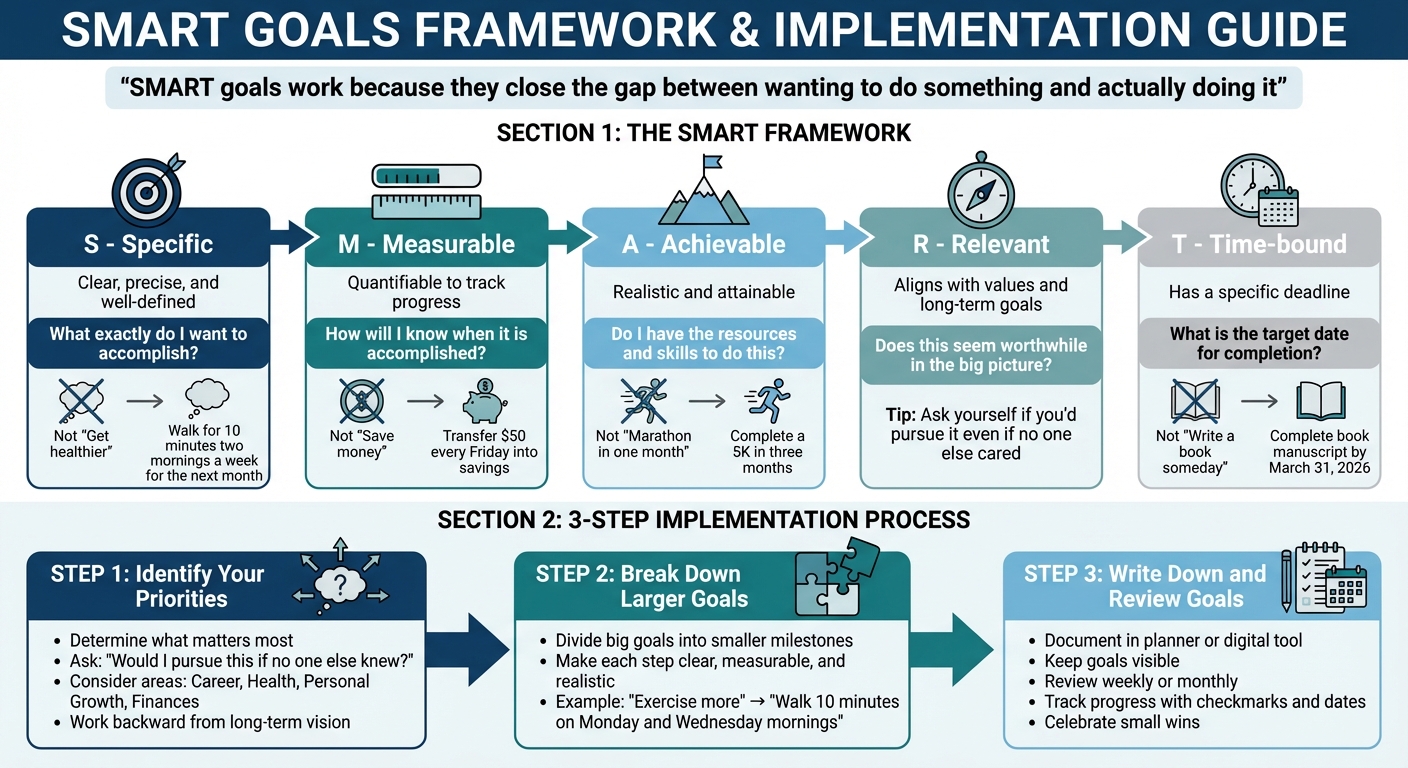
SMART Goals Framework: 5 Components and 3-Step Implementation Process
What Are SMART Goals?
SMART goals take lofty ambitions and break them down into actionable steps. The acronym SMART stands for Specific, Measurable, Achievable, Relevant, and Time-bound, offering a structured approach to goal setting. This framework ensures that your objectives are not just aspirational but also practical and attainable. Each element works together to turn vague ideas into clear, actionable plans.
By using SMART goals, you align your ambitions with your resources, creating a roadmap that fits your life and energy levels. It’s like giving yourself a built-in system for tracking progress and celebrating small wins, making big goals feel less overwhelming and more within reach.
| Component | Definition | Key Question to Ask |
|---|---|---|
| Specific | Clear, precise, and well-defined | What exactly do I want to accomplish? |
| Measurable | Quantifiable to track progress | How will I know when it is accomplished? |
| Achievable | Realistic and attainable | Do I have the resources and skills to do this? |
| Relevant | Aligns with values and long-term goals | Does this seem worthwhile in the big picture? |
| Time-bound | Has a specific deadline | What is the target date for completion? |
Let’s break down each element into actionable steps.
Specific Goals
Specificity sharpens your focus. A specific goal answers the "five Ws": What do I want to accomplish? Why is it important? Who is involved? Where will it happen? Which resources will I need? By addressing these questions, you eliminate ambiguity and channel your energy toward what truly matters.
Take this example: "Get healthier" is vague and hard to act on. But "walk for 10 minutes two mornings a week for the next month" is specific. It tells you exactly what to do, when to do it, and how to measure success. Without this clarity, it’s easy to get distracted or lose motivation.
Measurable Goals
Measurable goals give you a way to track progress and celebrate milestones. They rely on clear, quantifiable criteria - like numbers, dates, or percentages - that make it easy to see how far you’ve come. This not only keeps you accountable but also taps into your brain’s reward system, reinforcing your efforts with a sense of accomplishment.
For instance, "save money" is too vague. But "transfer $50 every Friday into a savings account" is measurable and actionable. Similarly, "increase revenue by 15% in Q2" is a clear target, unlike the ambiguous "grow the business." These measurable steps keep you on track and motivated.
Achievable Goals
Achievability ensures that your goals are challenging yet realistic. It’s about finding the balance between stretching yourself and setting yourself up for success. Goals that are too ambitious can lead to burnout, while goals that are too easy may not feel rewarding.
For example, if you’re new to running, aiming to complete a marathon in one month is likely unrealistic. But setting your sights on a 5K in three months? That’s a goal that pushes you without overwhelming you. If a goal feels out of reach, adjust it to something more manageable and build from there.
Relevant Goals
Relevance ensures that your goals align with your bigger picture. A relevant goal connects to your values, long-term plans, or organizational objectives, making your efforts meaningful and purposeful.
Ask yourself: "Would I still pursue this goal if no one else cared?" This helps you focus on what truly matters to you, rather than chasing goals driven by external pressures. For example, "gain the skills needed for a promotion" is relevant if career growth is a priority. But if your main focus is work-life balance, that same goal might not align with what’s most important to you right now.
Time-bound Goals
Deadlines create urgency and keep your goals from getting lost in the shuffle of daily life. Without a clear timeline, it’s easy for important objectives to drift to the back burner.
"A goal without a deadline can lose momentum." – Success.com
Consider the difference between "I want to write a book someday" and "I want to complete my book manuscript by March 31, 2026." The latter gives you a clear endpoint and helps you map out what needs to happen each week or month. Deadlines aren’t restrictive - they’re tools that help you maintain consistent progress and stay on track.
How to Set SMART Goals
Use the SMART framework to turn your ambitions into actionable, clear steps.
Step 1: Identify Your Priorities
Start by figuring out what matters most to you. What does success look like in your eyes? Ask yourself: "If no one else knew about this goal, would I still pursue it?" If the answer is no, it might not align with your core values.
Jake Munday, Founder and CEO of Custom Neon, shares his approach to prioritizing goals effectively:
"Understanding the end game allows me to reverse engineer the steps needed to get there, which I then shape into specific SMART goals".
Begin with your long-term vision - whether it’s advancing your career, improving your health, or achieving financial stability. Then, work backward to identify the steps that will lead you there.
Be mindful of conflicting goals. For example, if you’re prioritizing work-life balance, pursuing a promotion that demands 60-hour workweeks might not align with your current priorities. Think through areas like career, health, personal growth, and finances to see where your energy is most needed.
Once your priorities are clear, break them down into smaller, actionable steps.
Step 2: Break Down Larger Goals
Big goals can feel overwhelming, but breaking them into smaller steps makes them manageable. The SMART framework helps by focusing on milestones that are clear, measurable, and realistic.
Take Ritchie Tendencia, CEO of CSV Now, as an example. In 2024, he set a SMART goal to reduce employee turnover by at least 10% within a quarter:
By outlining actionable steps - such as implementing a structured training program and prioritizing employee satisfaction - the company achieved a 15% reduction in turnover and improved client satisfaction.
If a goal feels too daunting, simplify it further. Instead of saying, "I’ll exercise more", try something specific like, "I’ll walk for 10 minutes on Monday and Wednesday mornings." If even that feels tough, scale it back further. The idea is to create clear, small steps that you can act on right away.
Once you've broken down your goals, the next step is to make them tangible by writing them down.
Step 3: Write Down and Review Goals
Writing your goals down is a powerful way to solidify your commitment. Julia Kay, a Certified Life and Health Coach at BetterUp, highlights the importance of this step:
"Goals that exist only in your mind are easy to forget or ignore. Document your SMART goal in a planner or calendar and track your progress regularly".
Keep your written goals visible - whether in a physical planner or a digital tool - and review them often. Weekly or monthly check-ins help ensure your goals align with your current schedule and energy levels. This practice reinforces the "Time-bound" aspect of the SMART framework.
Regular reviews also give you a chance to celebrate small wins, which keeps you motivated. Use simple tools like checkmarks, dates, or short notes to track your progress. As the Calm Editorial Team puts it:
"SMART goals work because they close the gap between wanting to do something and actually doing it".
Documenting and revisiting your goals transforms your intentions into actionable results.
Using malife to Set and Track SMART Goals

Once you’ve outlined your SMART goals, the next step is to keep them organized and actionable. That’s where malife comes in. It’s a tool designed to help you manage goals across all areas of your life - not just work - by blending structure with flexibility.
Organize Goals by Life Areas
malife sorts your goals into distinct Life Areas like Career, Health, Relationships, and Personal Growth. This setup gives you a clear snapshot of what’s progressing smoothly and what needs more attention, helping you maintain balance across different priorities.
By separating goals into categories, you prevent work-related deadlines from overshadowing personal aspirations. For instance, under "Career", you might set a SMART goal to earn a certification by March 31, 2026, while your "Health" category tracks your aim to walk 10,000 steps three times a week. This separation ensures that each goal has its own space, keeping them Relevant and focused.
Within each Life Area, you can add both projects and individual tasks, grouping related actions together. This clear organization strengthens your ability to set and pursue focused goals effectively.
malife takes it a step further with its Today & Next views, which help you prioritize and schedule your tasks.
Track Goals with Today & Next Views
malife uses a kanban-style workflow with two key views: Today and Next. The Today view highlights tasks that need your immediate attention, while the Next view organizes upcoming priorities without overwhelming you.
This system aligns perfectly with the Time-bound aspect of SMART goals. For example, if your goal is to submit a project proposal by Friday, it will appear in your Today view when it’s time to act. Need to adjust deadlines? malife’s quick rescheduling tools (+10 minutes, +1 hour, +1 day) make it easy to stay realistic and keep your goals Achievable, even when plans shift.
To help you stay focused, malife also includes a Focus Timer. This feature encourages uninterrupted work on high-priority tasks, turning your intentions into measurable progress.
Prioritize Goals by Impact and Effort
malife doesn’t just help you organize and track goals - it also helps you decide what’s worth your time. Using an Impact vs. Effort prioritization framework, malife guides you toward goals that deliver the most value with the resources you have.
Here’s how it works: tasks are divided into four categories based on their impact and effort levels. Each category comes with a strategy to help you decide what to tackle first.
| Quadrant | Impact | Effort | Strategy |
|---|---|---|---|
| Quick Wins | High | Low | Do Now: Focus here to build momentum quickly. |
| Major Projects | High | High | Schedule: Break these into smaller steps and plan carefully. |
| Fill-Ins | Low | Low | Do Later: Handle these during downtime or gaps in your schedule. |
| Thankless Tasks | Low | High | Delegate/Remove: Avoid these or offload them if possible. |
This approach keeps your attention on tasks that offer the greatest value, helping you make the most of your time and energy. With malife, you’re not just setting goals - you’re making meaningful progress toward achieving them.
Conclusion
SMART goals transform vague ideas into actionable plans. By ensuring your goals are Specific, Measurable, Achievable, Relevant, and Time-bound, you create a clear path to success. This approach works across all areas of life - whether you're looking to grow professionally, improve your health, or nurture relationships.
Start small to build momentum. The SMART framework helps break down even the most ambitious dreams into manageable, daily steps. By focusing on goals that are clear and trackable, you can stay on course and make consistent progress. And remember, goals aren’t set in stone - adjust them as needed to align with changing circumstances.
With tools like malife, turning SMART goals into daily habits becomes seamless. Features like Life Areas for organization, Today & Next views for focus, and Impact vs. Effort prioritization ensure you're managing your goals effectively across all aspects of your life.
FAQs
How do I keep my SMART goals realistic and achievable over time?
To keep your SMART goals within reach, it’s important to check in on your progress regularly and make adjustments when circumstances or priorities shift. This way, your goals continue to match your current resources and abilities.
Breaking down bigger goals into smaller, more manageable steps can make a huge difference in staying motivated and on track. Take time to revisit your timeline and milestones to ensure they’re still reasonable and relevant. Adjusting your goals along the way not only helps you tackle obstacles but also allows you to take advantage of new opportunities, keeping you on the path to success.
Tools like malife can make this process easier. With features like persistent reminders, voice capture, and an impact vs. effort prioritization system, malife helps you stay organized and focused, ensuring your goals remain clear and achievable over time.
What are the best ways to track and measure progress toward SMART goals?
To keep tabs on your progress toward SMART goals, start by establishing specific, measurable benchmarks that tie directly to what you want to achieve. This could mean tracking numbers, hitting deadlines, or reaching certain milestones - anything that lets you clearly see how far you've come.
Consider using tools or apps like malife to streamline the process. These can help you set reminders, prioritize your tasks, and check in on your progress regularly. Breaking big goals into smaller, manageable tasks with clear deadlines can also make the journey less overwhelming and much more organized.
Don’t forget to set aside time for regular check-ins - whether weekly or monthly. Use these sessions to evaluate what’s working, tweak what’s not, and stay motivated as you move closer to your goals. A consistent, structured approach like this ensures you stay on track and maintain momentum.
How can I prioritize SMART goals across different areas of my life?
To effectively prioritize SMART goals, assess each one by its impact and effort. This method ensures your energy is directed toward goals that provide the most value for the work you put in. Breaking bigger goals into smaller, achievable steps can make them easier to tackle while keeping them aligned with your broader vision.
Tools like malife can help streamline this process by categorizing your goals into different life areas, offering a clear snapshot of where you should focus. This approach helps you maintain balance and ensures you're dedicating time to what truly matters, all while staying mindful in your pursuit of success.