
How to Create a Future Vision Aligned with Purpose

How to Create a Future Vision Aligned with Purpose
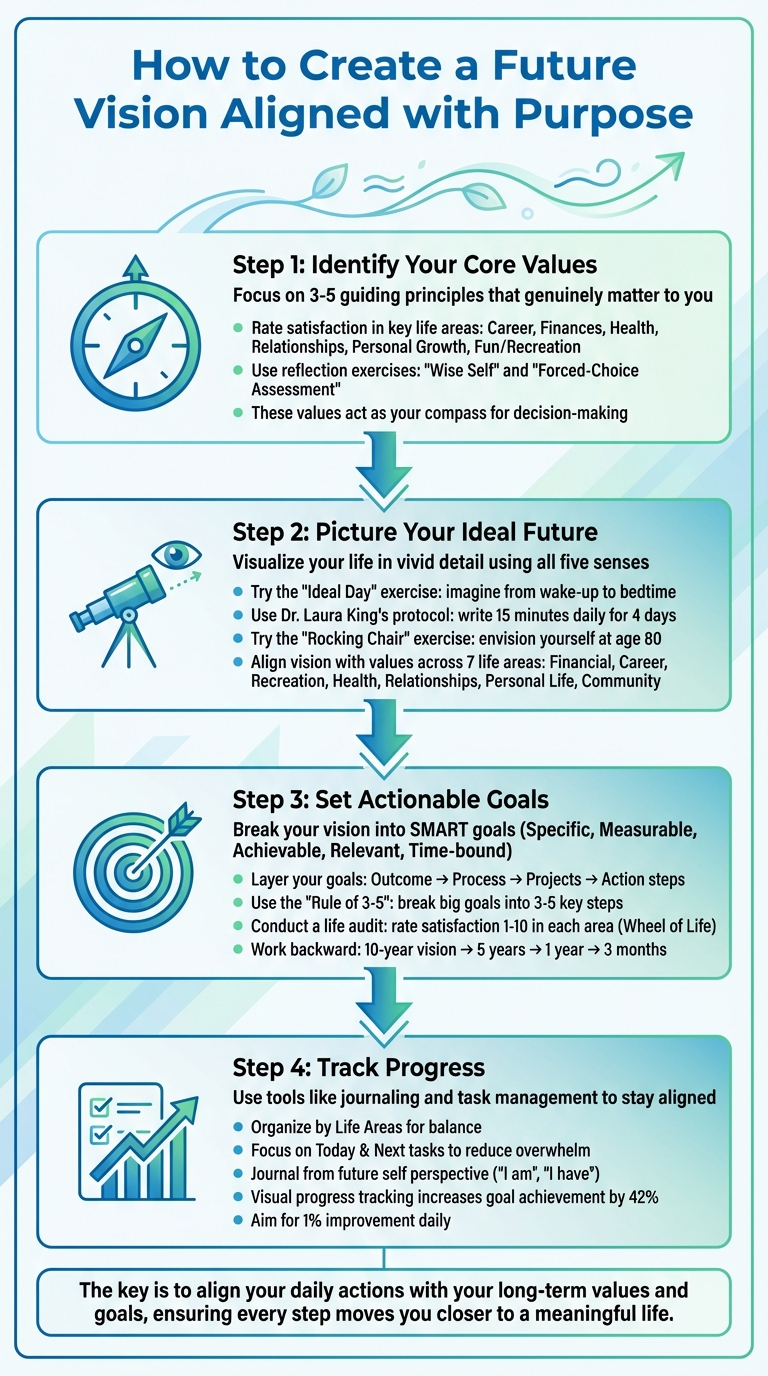
Creating a future vision that aligns with your purpose means defining what truly matters to you and using that clarity to guide your decisions. Many people chase external success but end up feeling unfulfilled because their goals don't reflect their core values or personal purpose. Here's how to avoid that:
- Identify Core Values: Focus on 3–5 guiding principles that genuinely matter to you. These values act as your compass for decision-making.
- Imagine Your Ideal Future: Visualize your life in detail - what you do, who you spend time with, and how it feels. Use exercises like the "Ideal Day" or "Rocking Chair" method to picture this.
- Set Actionable Goals: Break your vision into SMART goals (Specific, Measurable, Achievable, Relevant, Time-bound) and work backward to create small, manageable steps.
- Track Progress: Use tools like journaling or task management systems to stay aligned with your vision and measure your progress.
The key is to align your daily actions with your long-term values and goals, ensuring every step you take moves you closer to a life that feels meaningful and fulfilling.
4-Step Process to Create a Purpose-Aligned Future Vision
Step 1: Identify Your Core Values and Life Purpose
Building a meaningful vision for your future starts with understanding what truly matters to you. Core values are the guiding principles that shape your decisions and behavior - not what you think you should value, but what you genuinely care about deep down. Many people spend years chasing goals influenced by external pressures, only to feel unfulfilled or stuck once they achieve them.
Focus on narrowing your values to 3–5 core principles. Studies suggest that identifying too many values - more than 10 - can make it harder to use them effectively in decision-making. Think of these values as your compass: they direct how you live, while your goals determine what you accomplish.
Identify Key Life Areas
To pinpoint your priorities, take a closer look at specific aspects of your life: Career/Professional, Finances, Health (both physical and mental), Relationships (family, friends, romantic), Personal Growth, and Fun/Recreation. Rate your satisfaction in each of these areas to uncover where you're thriving and where you might feel out of sync.
"You are never too old to set another goal or to dream a new dream".
Ask yourself: Which areas give you energy, and which leave you feeling drained? What parts of your life would you regret neglecting in the long run? This self-audit helps you identify where to focus your energy and create a vision that aligns with your purpose.
Use Reflection Exercises
To gain deeper clarity, try using reflection techniques. For instance, the "Wise Self" exercise invites you to imagine yourself at the end of your life. Ask, "How will I know I’ve lived well?" Work backward from that vision to uncover the values that define your legacy. Another helpful tool is the Forced-Choice Assessment, where you compare values directly against one another to reveal your true priorities, cutting through societal or external expectations.
Look back at past decisions you’ve made - those you embraced and those you passed on. Were your choices guided by fear, or did they align with what truly matters to you? Group similar ideas together; for example, "nutrition", "fitness", and "self-care" might all fit under "Mind-Body Wellness". This process helps you uncover patterns and clarify the principles that genuinely drive you forward.
Step 2: Picture Your Ideal Future
After pinpointing your core values, the next step is to imagine your future in vivid detail. This isn't about jotting down a vague wish list - it’s about crafting a clear and actionable vision. Studies show that when people vividly picture their ideal future, they’re far more likely to achieve their goals. Why? Because visualization trains your brain to recognize opportunities that align with your aspirations.
Think of this vision as your personal GPS, steering you toward a life filled with purpose and intention. The trick is to focus on what you genuinely want, not what others or societal expectations suggest you should want. This clarity will set the stage for transforming your vision into tangible goals in the steps ahead.
"If you don't know what you want, you'll end up with what you get." - Emma-Louise Elsey, Founder of The Coaching Tools Company
Create a Detailed Future Vision
Start with an exercise called the "Ideal Day". Picture a typical day in your future, from the moment you wake up to the time you go to bed. Don’t just list activities - immerse yourself in the experience. Who are you spending time with? How does your morning routine feel? What kind of work are you doing, and where are you doing it?
To make your vision feel real, engage all five senses. Describe what you see, hear, smell, taste, and feel in your ideal environment. These sensory details make your vision more tangible and achievable, transforming it from an abstract idea into something you can almost touch.
Another helpful tool is Dr. Laura King's 15-minute writing protocol. For four consecutive days, spend 15 minutes writing about your "best possible future" across all areas of your life. Write in the present tense, as though you’re already living this future. This approach deepens your emotional connection to the vision and helps your brain believe it’s within reach.
You might also try the "Rocking Chair" exercise. Picture yourself at age 80, reflecting on your life. What would you regret not achieving? What legacy would you want to leave? This perspective helps you cut through the noise of daily distractions and focus on what truly matters.
Align Your Vision with Your Values
Once you’ve painted a vivid picture of your future, make sure it aligns with your core values. A vision that doesn’t reflect your values can feel empty. Think of your values as your guiding compass, keeping you on track and shielding you from distractions or competing priorities.
Break your vision into specific areas of life, such as Financial, Career, Recreation, Health, Relationships, Personal Life, and Community. For each area, ask yourself: How do my core values come into play here? For instance, if "connection" is one of your values, your vision should include meaningful relationships - not just "having friends", but who you’re spending time with and how those interactions feel.
To dream without limits, try the "Magic Wand" question: If you had a magic wand that erased all fears and obstacles, what life would you create? This exercise helps uncover your deepest desires, free from the constraints of self-doubt or perceived limitations. And remember, it’s not just about what you want to achieve - it’s about who you want to become. Focusing on your purpose creates a stronger emotional connection and lasting motivation.
"You have to have a big vision and take very small steps to get there. You have to be humble as you execute but visionary and gigantic in terms of your aspiration." - Jason Calacanis, Entrepreneur
Step 3: Turn Your Vision into Actionable Goals
Having a clear vision is motivating, but it’s the actionable goals that turn dreams into reality. The key to bridging the gap between what you imagine and what you achieve lies in breaking your vision into manageable, practical steps you can tackle daily.
Start by breaking your vision into layers: outcome goals, process goals, projects, and action steps. Each layer narrows the focus and brings you closer to action. For example, if your 10-year vision includes "living a healthy, active lifestyle", your 12-month outcome goal might be "complete a half-marathon." Process goals could involve increasing endurance, improving your diet, and staying injury-free. From there, you can identify projects like "follow a 12-week training plan", and break those projects into action steps, such as "run 3 miles this Tuesday at 6:00 a.m." These steps transform an inspiring vision into a concrete daily plan.
"We are stubborn on vision. We are flexible on details." - Jeff Bezos, Founder, Amazon
Set SMART Goals
Vague goals often lead to vague outcomes. To avoid this, make your goals SMART: Specific, Measurable, Achievable, Relevant, and Time-bound. Instead of saying, "I want to get healthier", reframe it as, "I will lose 15 pounds by June 30, 2026, by exercising four times a week and tracking my meals daily." This version leaves no room for confusion about what success looks like or when it needs to happen.
Pay close attention to the "Relevant" part of SMART. This is where your core values come into play. Ask yourself: Does this goal align with my values? Does it move me closer to my long-term vision?. For instance, if "family" is a core value, spending two hours alone at the gym every evening might not feel right, even if it’s measurable and specific. A better goal might be to hike with your family every Saturday morning, combining health and connection.
Another useful approach is the "Rule of 3-5": break every big goal into 3–5 key steps, and then divide each step into 3–5 smaller projects. This approach keeps things manageable and prevents overwhelm.
Conduct a Life Audit
Before setting out on your journey, it’s important to assess where you currently stand. A life audit helps you evaluate your present situation. Divide your life into key areas, such as Career, Health, Finances, Relationships, Personal Growth, and Recreation. Rate your satisfaction in each area on a scale of 1–10. This exercise, often called the Wheel of Life, gives you a clear picture of where you’re thriving and where you need to focus more energy.
Next, conduct a gap analysis. Look at your current life and identify what doesn’t align with your future vision. Also, note what’s missing now that you want in your future. Comparing your current routine with your envisioned day will help you pinpoint where to prioritize your efforts.
"Your burdens - whether they're limiting beliefs, unresolved challenges, or societal expectations - can hold you back from dreaming freely." - Megan Dalla-Camina, Founder and CEO of Women Rising
Don’t overlook internal and external barriers. Internal barriers might include self-doubt (e.g., "I’m not smart enough to start a business") or fear (e.g., "What if I fail?"). External barriers could be a lack of resources, limited time, or an unsupportive environment. Once you identify these obstacles, you can develop strategies to overcome them. Finally, use backward planning: start with your 10-year vision and work your way back to 5 years, 1 year, and even 3 months. This ensures that your daily actions are directly tied to your ultimate goals. Knowing where you’re starting from lays the groundwork for aligning your present efforts with your long-term aspirations.
Step 4: Use Tools and Systems for Consistent Progress
Turning your vision and goals into consistent daily action requires a solid system. A vision without structure is like having a map but no compass - you might know your destination, but without a plan, it’s easy to lose your way. With malife, you can bridge the gap between intention and action, transforming your purpose into steady progress.
Organize by Life Areas in malife
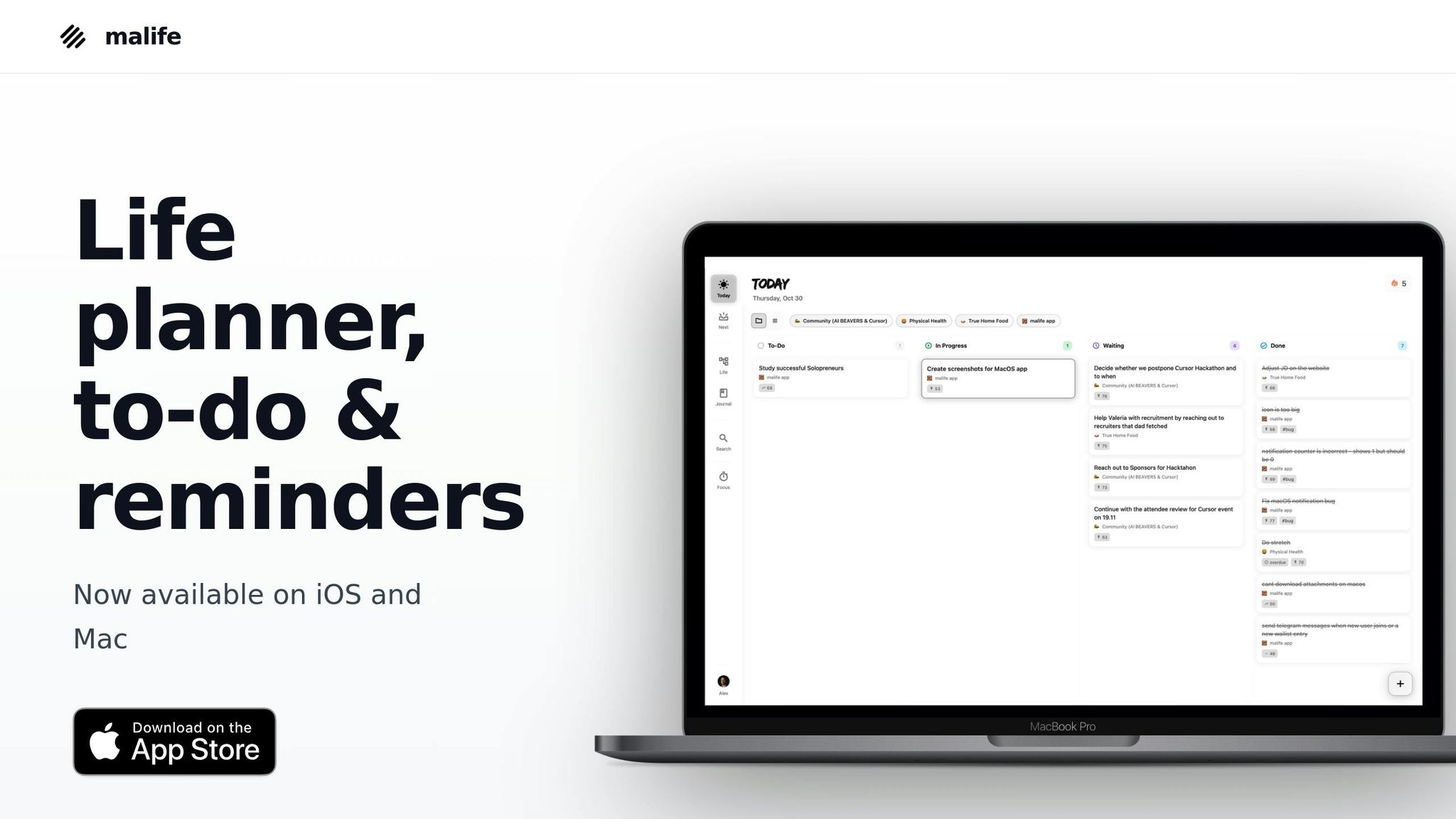
Life isn’t just one big project; it’s made up of different areas that all need attention. malife’s Life Areas feature helps you stay balanced by focusing on key aspects of your life - like career, health, family, and personal growth. Instead of juggling an endless to-do list, you can organize tasks by these domains, making it easy to see which areas are thriving and which might need extra care.
"The primary purpose for anything provides the core definition of what its 'word' really is. It is the ultimate job description."
– Mohammed Ali Vakil, GTD Practitioner
This structure helps prevent the common mistake of excelling in one area while neglecting others. By keeping your daily actions aligned with your values, you can ensure consistent growth across all parts of your life.
Use the Today & Next Flow for Focus
Big visions can feel overwhelming when you think about them every day. malife’s Today & Next flow simplifies this by focusing your attention on the next actionable step. Using a kanban-style approach (Today, Next, Later), it keeps you grounded in the present while steadily moving you toward your long-term goals.
By narrowing your focus to immediate tasks, this system reduces decision fatigue and keeps you on track with your SMART goals. Each completed task naturally leads to the next, creating momentum without the need to constantly revisit a distant 10-year plan. Once your short-term priorities are clear, the next step is tracking your progress.
Track Progress with Journaling and Persistent Reminders
Tracking your progress is essential, and malife offers tools to help you stay connected to your goals. The Journal feature provides a space for evening reflection, where you can review your actions and assess how they align with your future self. Writing from the perspective of your future self - using phrases like "I am" or "I have" - can help rewire your mindset and strengthen your emotional commitment to change.
"The research shows that it's not about receiving that letter but it's actually about writing that letter that changes how you think about yourself and your role in future shaping."
– Ari Wallach, Executive Director, Longpath
malife’s Persistent Reminders ensure you stay focused on your Most Important Tasks. With quick settings like +10 minutes, +1 hour, or +1 day, and customizable repeats, you can avoid distractions and keep your priorities front and center. Research shows that visual progress tracking can increase goal achievement by 42%. Plus, every time you check off a task, your brain releases dopamine, creating a positive feedback loop that keeps you motivated.
Conclusion
Shaping a future aligned with your purpose isn’t a one-and-done task - it’s an ongoing journey that influences every decision you make. By identifying your core values, imagining your ideal future in detail, and breaking it down into actionable SMART goals, you’ve created a clear path to turn aspirations into reality. As Royale Scuderi, Creative Strategist, wisely puts it:
"A life of fulfillment does not usually happen by chance, but by design."
The next step is pairing your vision with a system that turns it into action. Without a clear plan, it’s easy to slip into autopilot or get stuck in routines that don’t serve your goals.
That’s where malife comes in. Its features keep your vision front and center by organizing tasks around Life Areas, focusing on what matters most, and tracking progress with tools like journaling and reminders. As Lora Devries, Intentional Living Expert, reminds us:
"The choices you make today are shaping your life of tomorrow."
Commit to improving just 1% each day - those small, consistent efforts add up over time. Regularly revisit and refine your vision as you grow, ensuring your purpose stays at the heart of everything you do. With clarity, balance, and the right tools, you’re not just checking off tasks - you’re actively designing the life you want.
FAQs
How can I discover and define my core values?
Discovering your core values starts with taking a step back and reflecting on what truly matters to you. Begin by jotting down qualities that resonate deeply - like integrity, growth, or creativity. Think about times when you felt proud or completely fulfilled. What values were at play in those moments? From there, look for patterns and narrow your list to focus on values that genuinely represent who you are today, rather than who you think you should be.
Once you’ve pinpointed your top 4–5 values, put them to the test. Ask yourself, “Are my choices and actions aligning with these values?” If the answer is no, think about what changes you can make to live in a way that feels truer to yourself. Tools like the malife app can help you stay on track. Use it to create a dedicated “Life Area” for your values, write short descriptions for each, and set reminders to check in regularly. The app’s impact-vs-effort feature can also help you prioritize actions that honor your values in your day-to-day life. Revisiting this process from time to time ensures your goals and decisions remain grounded in what’s most important to you.
What are some effective ways to visualize my ideal future?
Visualizing your ideal future works best when you mix creativity with practical steps. Start with a Future-Self Visualization: close your eyes and picture your life five or ten years from now. Focus on the details - where you are, how you feel, and what your daily life looks like. This mental exercise helps clarify what you truly want. Next, try a written future narrative - spend 15 minutes writing about the best version of your life. Cover areas like your career, relationships, and health. Let your thoughts flow freely; this often reveals goals you didn’t even realize you had.
To bring your vision to life, create a vision board. Use photos, quotes, or even sketches that represent your dreams and goals. Then, apply backward planning: picture your future self, and work backward to figure out the steps and habits needed to get there.
With malife, these exercises become even more actionable. Use the journal feature to write your future narrative or document your visualization. Add digital images to build a virtual vision board, and use the "Today & Next" view to create tasks that align with your goals. Tools like impact-vs-effort prioritization and persistent reminders ensure you stay on track while working toward your dream life.
How can I make sure my goals align with my life purpose and long-term vision?
To make sure your goals truly align with your life's purpose and vision, start by painting a clear picture of the future you want. Think about key areas like your career, relationships, health, and personal development. Then, pinpoint the core values - like creativity, personal growth, or community - that shape your decisions and priorities. These values act as your "North Star", guiding you to determine if your goals genuinely support what matters most.
Try working backward from your vision. Picture your ideal future, then outline the steps needed to get there. For every goal, ask yourself: Does this directly contribute to my long-term vision or align with my values? If not, it might be time to adjust or let it go. Break your goals into smaller, manageable tasks, and schedule them to keep moving forward.
Tools like malife can be a game changer for staying organized and focused. It offers features like "Life Areas" to structure your goals, a journal to capture your vision, and prioritization tools to zero in on what matters most. With reminders and a focus timer, malife helps turn your vision into actionable, meaningful progress.