
5 Tips for Balancing Long-Term and Short-Term Goals
5 Tips for Balancing Long-Term and Short-Term Goals
Balancing long-term goals, like saving for a house or switching careers, with daily tasks, such as meeting deadlines or paying bills, can feel overwhelming. The key is to align your everyday actions with your bigger ambitions. Here's how:
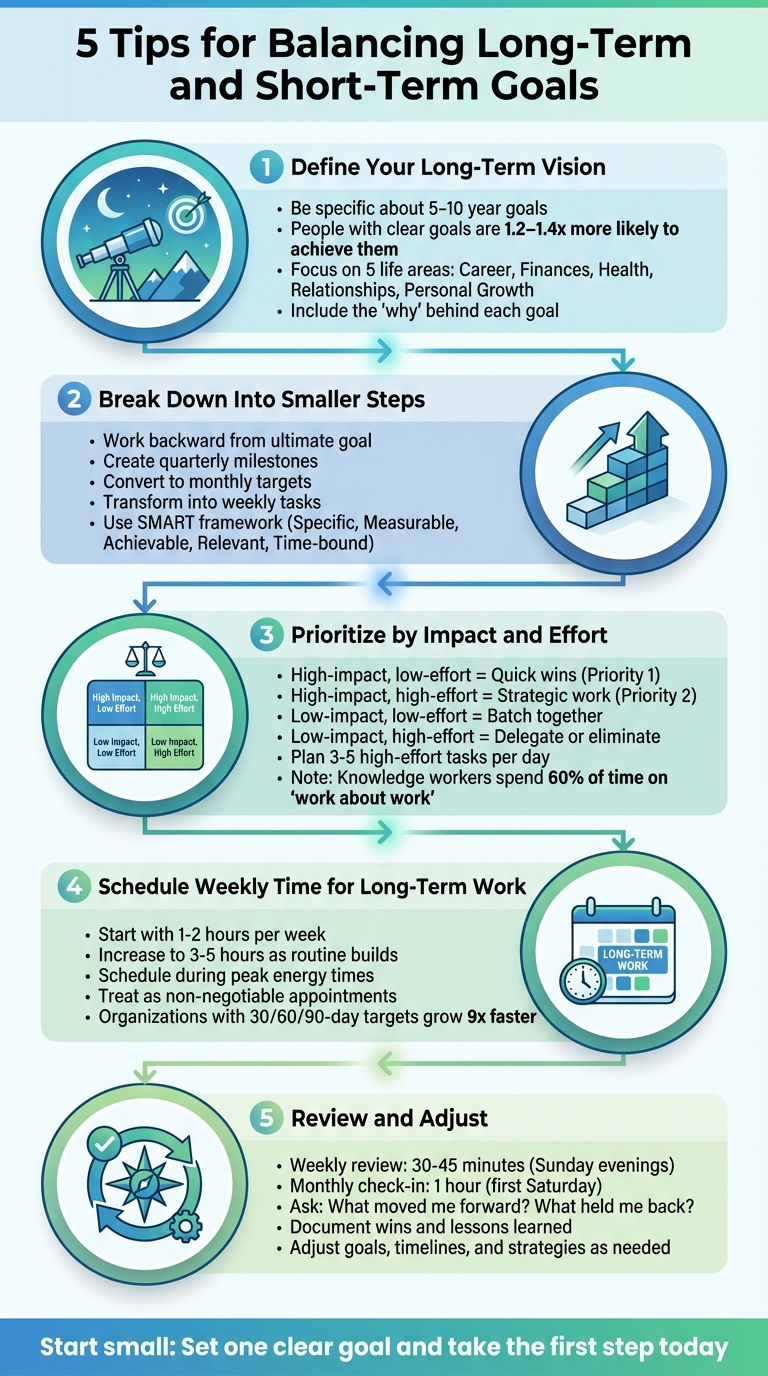
- Define a clear vision: Be specific about where you want to be in 5–10 years and why it matters to you.
- Break big goals into steps: Turn long-term plans into smaller, actionable tasks you can tackle weekly.
- Prioritize by impact and effort: Focus on tasks that contribute most to your goals while managing your energy.
- Schedule time for long-term work: Dedicate regular blocks of time to projects that move you forward.
- Review and adjust: Regularly reflect on your progress and refine your plans to stay on track.
Tools like malife can help organize your goals, streamline tasks, and keep you focused on what matters most. Start small by setting one clear goal and taking the first step today.
5-Step Framework for Balancing Long-Term and Short-Term Goals
1. Define Your Long-Term Vision
Creating a long-term vision means painting a clear, detailed picture of where you want to be in 5–10 years. This isn’t about vague ideas like “be successful” or “get healthier.” Instead, think of something specific and measurable. For instance, instead of saying, “I want to be successful,” you could aim for, “I earn $120,000 annually as a senior product manager with a flexible, remote schedule.” Why does this matter? Research shows that people who clearly describe their goals are 1.2 to 1.4 times more likely to achieve them.
Start by outlining one or two long-term goals for key areas in your life: career, finances, health, relationships, and personal growth. For example, you might write, “By 2030, I’m debt-free with $50,000 in savings,” or “Within five years, I run a half marathon and exercise 150 minutes a week,” or even, “By age 45, my partner and I take one 3–5 day trip together annually.” The key is to be specific - use numbers, timeframes, or actions so you’ll know exactly when you’ve hit your target. This clarity helps guide your daily decisions.
Equally important is understanding the why behind each goal. Ask yourself, “What will achieving this do for me?” and dig deeper with each answer. For instance, “save $50,000” might mean “more freedom,” which could lead to “less stress,” and eventually, “being calm and present with my kids.” Write down your goals for each life area, and include a brief explanation of why they matter. This emotional connection will keep you motivated, even when progress feels slow or when life’s distractions get in the way.
To keep everything organized, malife’s Life Areas feature can help you map out your long-term goals. This tool links your vision to actionable tasks, ensuring your big-picture goals are not just ideas floating in your head but are visible and structured. Each Life Area can hold projects and tasks tied directly to your vision, giving you a practical way to prioritize and balance different parts of your life. This approach helps avoid the common trap of focusing too much on one area, like your career, while neglecting others, like health or relationships.
Think of your long-term vision as a living plan, not something set in stone. Schedule an annual review to adjust and refine your goals. With malife, you can create a recurring reminder like “Review 2030 vision – every 12 months” to ensure your direction stays relevant and aligned with your evolving priorities. This way, you can stay flexible while keeping your eyes on the bigger picture.
2. Break Down Long-Term Goals Into Smaller Steps
Setting a five-year goal is inspiring, but turning it into actionable steps you can tackle weekly is what makes it achievable. Breaking down a big goal - like "save $20,000", "run a marathon", or "switch careers" - into smaller, manageable tasks helps you avoid feeling overwhelmed and gives you clear, actionable steps to focus on. This method connects your big-picture vision to your day-to-day actions.
Start by working backward from your ultimate goal. For example, if you want to save $10,000 for an emergency fund in 18 months (ending June 30, 2027), break it into quarterly milestones: $2,500 by March 31, 2026, $5,000 by June 30, 2026, $7,500 by September 30, 2026, and $10,000 by June 30, 2027. Then, convert those milestones into monthly targets (about $555 per month) and weekly tasks, like "Transfer $140 every Friday" or "Reduce dining out expenses by $100 per month." This way, a long-term savings goal becomes a simple, actionable weekly habit.
This approach works for other goals, too. Take a career objective like "become a team lead in two years." You could break it into six-month milestones, such as "Lead one small project by June 30, 2026", "Complete a management course by December 31, 2026", and "Attend one manager meeting per month." Then, translate these milestones into specific actions, like scheduling mentoring sessions or suggesting improvements at work. Using the SMART framework (Specific, Measurable, Achievable, Relevant, Time-bound) makes your steps clearer. For instance, "Study leadership skills for 30 minutes, three nights per week" is far more actionable than a vague "Work on career development".
To stay on track, tools like malife's Today & Next views can simplify your planning. Assign bite-sized tasks - like "Walk 30 minutes", "Transfer $140", or "Write 500 words" - to the Today view so you're always focused on the next step rather than the entire goal. Use the Next view for upcoming tasks tied to milestones, keeping them visible without cluttering your immediate to-do list. Organize everything under specific Life Areas (like Health, Career, or Finances) to maintain balance and ensure long-term objectives don’t get buried under daily priorities.
Finally, take a few minutes each week (10–20 minutes) to review and prioritize your next steps. Set aside 30–45 minutes at the end of each month to adjust your targets as needed.
3. Prioritize Daily Tasks by Impact and Effort
Once you've broken down your long-term goals into smaller, actionable steps, the next step is making sure your daily tasks actually move the needle. To do this, evaluate each task based on two factors: impact (how much it contributes to your key goals) and effort (the time, energy, and resources it requires). This helps ensure that your daily actions align with both your immediate priorities and your bigger-picture objectives.
One practical tool for this is an impact/effort matrix divided into four quadrants. Here's how it works:
- High-impact, low-effort tasks: These are your "quick wins" and should be your first priority. For example, spending 10 minutes sending a follow-up email that could secure a $5,000 client deal is a no-brainer.
- High-impact, high-effort tasks: These require more time and focus, like preparing a two-hour strategic presentation. Block out dedicated time for these during your peak energy hours.
- Low-impact, low-effort tasks: Think of small, routine tasks like minor adjustments or quick admin work. Group these together and handle them during a designated time slot.
- Low-impact, high-effort tasks: These are often time-wasters, like attending a long meeting with no clear agenda. When possible, delegate, postpone, or eliminate these entirely.
To consistently evaluate a task's impact, tie it back to your long-term goals rather than short-term distractions. Ask yourself questions like, "If I complete this today, what measurable result will it create?" or "Does this task support a milestone, a key performance indicator, or a broader goal?" High-impact tasks are those that move deadlines forward, contribute to revenue, build important skills, or strengthen relationships. When estimating effort, consider not just the time required but also the mental energy involved. For instance, a task that takes an hour might feel much harder at the end of the day than first thing in the morning.
A good rule of thumb is to plan for 3–5 high-effort tasks per day. This keeps you productive without overwhelming your schedule.
Tools like malife's Impact/Effort feature can simplify this process. It allows you to assign values to tasks, highlighting high-priority items in your Today view for quick wins and focused work. The Life Areas view helps you maintain balance by showing which parts of your life - like Work, Health, or Relationships - are receiving attention. Additionally, the kanban-style Today–Next–Later flow ensures that important tasks don’t get buried in your to-do list, while voice capture makes it easy to add tasks on the go, such as "Draft Q1 budget proposal, high priority."
One common pitfall is confusing urgency with importance. For example, treating every email as high-impact just because it's time-sensitive can lead to wasted effort. Research by McKinsey shows that knowledge workers spend up to 60% of their time on "work about work" - things like emails, status updates, and meetings - rather than meaningful output. By focusing on tasks that genuinely justify their impact and cutting back on low-impact, high-effort activities, you can avoid the trap of busywork and stay focused on what truly matters.
4. Schedule Weekly Time for Long-Term Work
Long-term projects often take a backseat to the daily whirlwind of emails, meetings, and unexpected tasks. Without dedicated time set aside, these larger goals can stall, leaving progress crawling at a frustratingly slow pace. Research backs this up: organizations that tie their strategies to specific 30/60/90-day targets grow nearly nine times faster. The same logic applies to personal goals - consistent, planned effort is what drives real results over time.
Start small. Block off 1–2 hours each week specifically for long-term work, and increase this to 3–5 hours as it becomes part of your routine. Pick times when your energy is highest and distractions are at a minimum. Treat these sessions like non-negotiable appointments. For instance, someone aiming for a leadership position might reserve Monday mornings from 7:00 to 8:00 a.m. for a leadership course and Thursday evenings from 7:30 to 8:30 p.m. for building a professional portfolio.
The secret to making these blocks effective? Plan ahead. During your weekly review, decide exactly what tasks you'll tackle during these sessions - like “Draft outline for Chapter 1” or “Research industry trends.” This approach not only reduces decision fatigue but also taps into research on implementation intentions, which shows that having a clear plan for when, where, and what you'll do significantly increases your chances of following through. A digital planner can help streamline this process.
If you're using malife, the app simplifies everything. Create a Life Area for your long-term goal - let's say "Career Growth" or "Health." Add a Project under it and set up recurring tasks for your weekly sessions, complete with specific due dates and times. Persistent reminders ensure you stick to your schedule, while the Today & Next view keeps your long-term work visible alongside daily tasks. When it’s time to get started, launch the focus timer to stay on track and measure your progress. This method keeps your big-picture goals aligned with your daily priorities, ensuring steady progress toward your vision.
5. Review Your Progress and Adjust Your Plans
Taking time to review your progress ensures your actions stay aligned with your goals. Without regular check-ins, it's easy for immediate tasks to overshadow the bigger picture, leaving long-term ambitions stuck on the back burner. This applies to both professional and personal goals - consistent reflection and tweaking are what keep you moving forward instead of feeling stuck.
Set aside time for a weekly review (30–45 minutes, Sunday evenings often work well) and a monthly check-in (about an hour, perhaps on the first Saturday of the month). During these sessions, ask yourself questions like: Which tasks moved me closer to my long-term goals? Where did I waste time or energy? What challenges held me back, and how can I address them? These aren't just theoretical questions - write down your answers. Over time, you'll notice patterns. For example, maybe you're consistently more productive in the mornings, or perhaps a particular goal keeps getting neglected, signaling it might need to be revised or even dropped.
malife's journal offers a straightforward way to document these reflections. After your weekly review, jot down your top three wins, one key lesson learned, and one specific change to test in the coming week (e.g., "Limit high-effort tasks to three per day"). The journal is integrated with your Life Areas, allowing you to tag entries by categories like Career, Health, or Personal Growth. Over time, scrolling through these notes can be incredibly motivating. Even if big achievements feel slow, you'll see evidence of the skills you're building and the momentum you're gaining.
Use these insights to adjust your approach as needed. If you're falling behind, consider revising your goals, timelines, or strategies. Often, the long-term vision remains solid, but the steps might be too ambitious, or you're juggling too many priorities. Tools like malife's Today–Next–Later views can help you refocus. For example, you can push less urgent tasks out of sight, reschedule deadlines (like moving "Draft Chapter 1" from 12/15/2025 to 01/05/2026), or update impact and effort ratings so your Today view reflects your current priorities. This way, you're not letting goals fade into a forgotten to-do list.
Conclusion
Balancing long-term ambitions with short-term responsibilities is an ongoing process that brings focus, reduces overwhelm, and ensures steady progress. By aligning your daily tasks with your broader vision, you can transform distant goals into actionable steps. The strategies outlined here - clarifying your big-picture vision, breaking it into smaller milestones, prioritizing tasks based on impact and effort, dedicating regular time to long-term projects, and reviewing your progress consistently - work together to keep you on track, whether you're juggling work, family, personal health, or financial goals.
The secret lies in revisiting your vision regularly and adjusting your actions as life evolves. A simple weekly routine can make this easier to manage: set aside 30–45 minutes, perhaps on Sunday evening, to review your long-term goals, outline the next steps, choose a few high-impact tasks for the week ahead, and block out focused time for deep work. Even 30–60 minutes of intentional planning paired with small, consistent actions can create meaningful momentum.
This rhythm of reflection and adjustment becomes even smoother with tools that bridge the gap between long-term planning and daily execution. malife helps simplify this balance by organizing your Life Areas and tasks, offering features like Today & Next views, impact/effort prioritization, persistent reminders, and a focus timer to streamline your planning process.
If you feel stuck, start small. Begin with a single clear vision and aim for one small win. Use malife to capture everything on your mind, sort it into Life Areas, and decide what needs attention today versus what can wait. This structured approach transforms scattered efforts into a focused plan you can act on right away. By deciding what to do now, what to address next, and what to defer, you take control of your schedule and create a life that reflects intentional choices - not just reactions to the chaos of the moment.
FAQs
How can I align my daily tasks with my long-term goals effectively?
To make sure your daily tasks contribute to your long-term goals, start by breaking those big ambitions into smaller, manageable steps. Focus on what matters most by prioritizing tasks based on their importance and effort required. Tools like visual boards can be a great way to keep everything organized and maintain a clear overview. Take time to regularly review your progress so your daily efforts stay aligned with your bigger plans.
malife offers features like Life Areas and the Today & Next flow to help you stay on track. These tools make it easier to manage your short-term tasks while keeping your long-term aspirations in sight.
How can I effectively prioritize tasks based on their impact and effort?
To manage your tasks efficiently, consider evaluating each one based on two key factors: impact - how much it aligns with and contributes to your goals - and effort - the time and energy needed to complete it. Begin by tackling tasks that offer high impact but require minimal effort. These are the ones that can quickly move the needle on your priorities.
Tools like malife's impact/effort prioritization feature can make this process even smoother. By visually mapping out your tasks, you can clearly see where to focus your energy for maximum results. This method helps you stay productive, ensuring your time is spent on work that truly matters while maintaining a sense of balance.
How often should I review and update my long-term goals to stay aligned with my progress?
It's wise to revisit and refine your long-term goals every three months. This gives you the chance to assess your progress, adapt to shifting priorities, and confirm that your day-to-day tasks are still steering you toward your larger ambitions.
Frequent reviews also keep you energized and on track by showing you both the strides you've made and the areas that need more focus. If quarterly check-ins feel too spaced out, try monthly reviews for smaller, more manageable tweaks.