
Life Domains: Balance Through Time Allocation

Life Domains: Balance Through Time Allocation
Balancing your life isn’t about splitting time equally - it’s about prioritizing what truly matters to you. Whether it’s work, health, relationships, or personal growth, aligning your time with your values can help reduce stress and avoid burnout. Here’s how to achieve this:
- Identify your life domains: Common categories include health, relationships, work, and hobbies.
- Track your time: Audit a week of your activities to see where your time actually goes.
- Prioritize effectively: Use tools like the Wheel of Life or Eisenhower Matrix to focus on what’s important.
- Schedule intentionally: Timebox tasks, block time for priorities, and leave room for flexibility.
- Review regularly: Weekly and monthly reviews help maintain balance and adjust your focus as needed.
Defining Your Life Domains
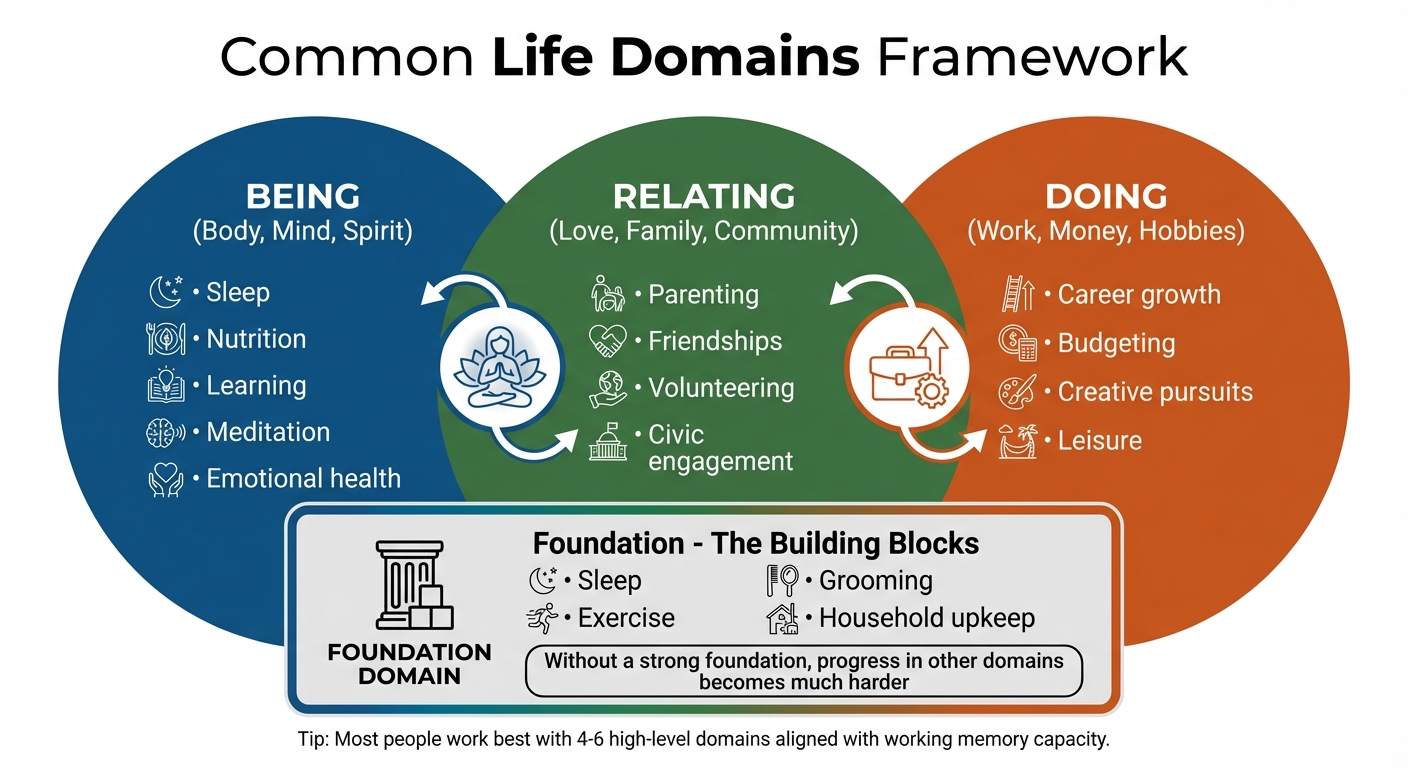
Life Domains Framework: Three Circles Model with Examples
To manage your time effectively, it’s crucial to identify the areas of life that matter most to you. These areas, often referred to as "life domains", represent the key categories that define your existence. Research suggests there are models that include anywhere from 5 to 15 domains. The structure you choose should align with your personal circumstances.
For most people, sticking to 4 to 6 high-level domains works best. This aligns with the human brain's ability to manage about four distinct items in working memory at once. Too many categories can feel overwhelming, requiring simple organization tips to regain control, while too few might overlook important aspects of your life.
Common Life Domains
Many people organize their lives around a few core areas. One well-known framework divides life into three circles: Being (body, mind, spirit), Relating (love, family, community), and Doing (work, money, hobbies). Another popular model, the 5Ps, breaks life into People, Profession, Passion, Personal, and Physical.
| Domain Category | Specific Life Domains | Examples of Activities/Focus |
|---|---|---|
| Circle of Being | Body, Mind, Spirit | Sleep, nutrition, learning, meditation, emotional health |
| Circle of Relating | Love, Family, Community | Parenting, friendships, volunteering, civic engagement |
| Circle of Doing | Work, Money, Hobbies | Career growth, budgeting, creative pursuits, leisure |
One often-overlooked category is the "Foundation" domain - activities like sleep, exercise, grooming, and household upkeep. These are the building blocks that support all other areas of life. Without a strong foundation, progress in other domains becomes much harder.
You might also define your domains based on the roles you play (e.g., parent, manager, friend), the groups you’re part of (e.g., church, team, neighborhood), or the values you hold dear (e.g., creativity, financial independence). For example, a college student’s domains will look very different from those of a parent in their 40s - and that’s perfectly natural.
Identifying Your Priorities
Once you’ve outlined your potential domains, it’s time to figure out which ones need the most attention. A helpful tool for this is the Wheel of Life exercise. Draw a circle with 6–8 spokes, label each spoke with a domain, and rate each one from 0 to 10 based on your current satisfaction. Then, compare these scores to where you’d like them to be. The gaps between your current and ideal scores will show you where to focus your energy.
"A balanced life does not mean getting 5 in each life area: some areas need more attention and focus than others at any time." - Simon Bell, MindTools
Another practical method is tracking how you actually spend your time. For one or two weeks, monitor your daily activities and compare this to how you want to spend your 168 hours each week. For instance, the 2019 American Time Use Survey found that adults average 5.19 hours of leisure time per day - a number that often surprises people when they take a closer look at their own schedules.
Keep in mind that some activities can span multiple domains. For example, joining a neighborhood book club might fulfill both community involvement and mental stimulation.
Once you’ve identified your priorities, you’ll be ready to assess your current time usage and realign your schedule accordingly.
Tracking Your Current Time Use
Before you can balance your schedule, it’s important to see where your time is actually going. Many of us underestimate how long we spend on certain tasks. What feels like a quick email check can stretch into half an hour, and a "short" scroll through social media might turn into a major time sink. A time audit helps you cut through assumptions and provides real data, showing the difference between how you think you spend your time and how you actually do.
Here’s how it works: track everything you do for 5 to 7 days straight. A full week gives you a complete picture of your work-life rhythm, including both weekdays and weekends. Break your day into 30- to 60-minute chunks and sort your activities into categories like Deep Work, Admin, Self-Care, Household Tasks, and Leisure. The key is to log your activities as they happen - setting hourly reminders can help keep you on track.
"Your decisions about allocating your personal time, energy, and talent ultimately shape your life's strategy." - Clay Christensen, Author
You can use whatever tracking method works best for you: pen and paper, a spreadsheet, or a digital tool. The specific method isn’t as important as sticking with it consistently for the whole week. Once you’ve gathered your data, review it to uncover patterns and make adjustments.
When analyzing your results, calculate how much time you spend in each category and compare it to your priorities. For instance, studies reveal that the average office worker achieves only 2 hours and 53 minutes of actual productive work each day - far less than the 7 hours they believe they work efficiently. You might spot similar gaps in your own schedule, like meetings that drag on, too much time on social media, or areas you’ve been neglecting, such as exercise or hobbies. These insights can guide you in reshaping your schedule to align better with your goals.
How to Balance Time Across Life Domains
Balancing your time doesn’t mean splitting your hours equally across every area of life. Instead, it’s about aligning your schedule with what truly matters to you. By being intentional, you can protect neglected areas while staying productive.
Timeboxing and Scheduling
Think of timeboxing like budgeting your money - you allocate specific hours to different aspects of your life and stick to it. For example, you might set aside 40 hours for work, 14 hours for family, 5 hours for exercise, and 4 hours for personal growth each week. This approach makes trade-offs crystal clear. If work starts creeping toward 50 hours, you'll immediately see what’s being sacrificed.
Time blocking is another powerful tool. It divides your day into dedicated chunks for specific activities, creating a visual roadmap of your schedule. You can even color-code tasks - for instance, blue for self-care, yellow for work, and green for family. This makes it easy to spot imbalances at a glance. Combine this with timeboxing to counter Parkinson’s Law, which states that work expands to fill the time available. Instead of setting aside three hours to "work on the report", commit to finishing it in two hours. Cal Newport, author of Deep Work, explains the value of structure:
"A 40-hour time-blocked work week, I estimate, produces the same amount of output as a 60+ hour work week pursued without structure".
To keep things flexible, add 15-minute buffers between tasks for transitions or unexpected interruptions.
For more complex schedules, consider day theming - assigning entire days to specific types of work or life domains. For example, Mondays could focus on administrative tasks, Tuesdays on creative projects, and Wednesdays on meetings. Mike Vardy, founder of Productivityist, notes:
"Knowing what the day 'means' to me allows me to get the things I need and want to accomplish without seeing undetermined 'ought to do' items on a to-do list".
This reduces the mental strain of constant context switching.
Here’s a key tip: schedule your priorities before your obligations. Block time for exercise, family dinners, or rest before filling your calendar with work commitments. Tools like malife make this practical by allowing you to set recurring blocks for each area of life and make quick adjustments when plans change. The Life Areas view helps you track which areas are getting attention and which are being overlooked, so you can correct course before imbalance becomes a problem.
Once your schedule is structured, use prioritization techniques to focus on what matters most within each time block.
Prioritization Methods
Prioritization frameworks help you focus on tasks that truly move the needle. The Eisenhower Matrix is a classic tool that sorts tasks into four categories based on urgency and importance. Most people spend their time in Quadrant 1 (urgent and important) or Quadrant 3 (urgent but not important), constantly putting out fires. True balance comes from investing in Quadrant 2 - important but not urgent tasks like exercise, relationship building, and skill development. These are the activities that prevent future crises.
Another useful framework is the Impact/Effort matrix, which helps you prioritize tasks that deliver the most results with the least effort. Start with high-impact, low-effort tasks, then tackle high-impact, high-effort projects. Low-impact tasks, regardless of effort, should be minimized or eliminated. Malife’s built-in prioritization tools make this process even easier by highlighting tasks in each Life Area that can drive meaningful progress.
For daily planning, the 1-2-3 Method provides a simple structure: focus on one major task, two medium tasks, and three smaller tasks each day. This ensures you tackle high-value work while clearing smaller items that might cause mental clutter. It’s worth noting that 41% of tasks on to-do lists never get completed, often because they aren’t chosen with intention.
Context-based prioritization is another smart approach. It considers your current situation - like your location, available time, and energy levels. For instance, if you have 20 minutes between meetings, use that time for quick administrative tasks rather than diving into deep, strategic work. And don’t fall into the multitasking trap: only about 2.5% of people are true "supertaskers" who can handle multiple tasks without performance drops. For most of us, focusing on one thing at a time is far more effective.
Limiting your work in progress is another game-changer. Keep only 2–3 tasks in your "Doing" column to avoid the mental drain of juggling too much at once. Tools like malife’s Today & Next view help you maintain a calm, focused workflow. When you complete a task, move it to "Done" to free up mental space, leveraging the Zeigarnik Effect, which shows that finished tasks take up far less mental energy than unfinished ones.
Stephen Covey summed it up perfectly:
"The key is not to prioritize what's on your schedule, but to schedule your priorities".
Building Your Weekly Schedule
Creating a weekly schedule that aligns with the key areas of your life helps ensure your time is spent intentionally and with balance. Start by listing all your routine activities across work, personal, and family priorities - everything from managing emails and preparing meals to exercising and tackling project work. Break down larger tasks into smaller, more manageable steps. For instance, instead of a vague "email management" task, split it into categories like urgent replies, archiving, and organizing.
Once you’ve outlined your tasks, estimate how long each one will take, and add a 25% buffer to account for unexpected interruptions. Then, assign specific time blocks to each task. Plan to tackle demanding or high-focus work during your peak energy periods - mornings are often best for most people - and reserve low-energy times for simpler, routine tasks.
To avoid overloading yourself, schedule only 75% of your time and leave the remaining 25% open for flexibility. Identify your "anchor" tasks - those non-negotiable commitments like meetings or workouts - and structure the rest of your schedule around them.
Take the example of Sarah Chen, a Marketing Director, who applied this method in January 2026. She managed 23 daily routine activities by breaking down her email management into four categories: urgent emails, team updates, newsletters, and organization. By allocating specific time blocks - 8:00–9:00 AM for email and 2:00–2:30 PM for social media - she reduced task-switching by 70% and freed up 2.5 hours daily for strategic work.
Tools like Malife's Life Areas view make this process even easier by visually showing which parts of your life are receiving attention and which might need more focus. The Today & Next feature streamlines your priorities, helping you focus on what matters without being overwhelmed by a long to-do list. You can also set up recurring tasks for weekly anchors, such as a Friday team meeting or a Tuesday morning workout, so they automatically appear in your schedule. Features like voice capture allow you to quickly add tasks on the go, while the Impact/Effort prioritization tool helps you decide which tasks deserve your limited time.
Once your week is mapped out, the next step is to regularly review and tweak your schedule to keep everything balanced.
Reviewing and Adjusting Your Schedule
A schedule isn’t meant to be static - it’s a flexible system that requires regular attention. Spending 15–30 minutes on daily reviews allows you to adjust your plans based on what actually happened and ensures you stay on track for the week. Beyond that, weekly reviews are crucial for maintaining balance. Set aside 30–120 minutes at the end of the week (Friday afternoon works well) or the start of the next week (Sunday evening or Monday morning) to tie up loose ends and prepare for the days ahead.
David Allen, author of Getting Things Done, emphasizes the importance of this habit:
"The whirlwind of activity is precisely what makes the Weekly Review so valuable. It builds in some capturing, reevaluation, and reprocessing time to keep you in balance".
During your weekly review, follow a consistent process. Start by clearing your email inbox, reviewing your calendar for the upcoming week, organizing your desktop and downloads, processing any stray notes, and updating your task list. Reflect on key questions: Did this task bring you closer to your goals? Which area of your life got overlooked this week? What needs more attention next week?
Interestingly, only 38% of a productivity-focused audience reported completing weekly reviews regularly. Why? Many try to overcomplicate the process. Keep it simple - a focused review can take just 30 minutes if you stick to clearing digital workspaces and updating tasks rather than attempting a full life reset.
In addition to weekly check-ins, monthly reviews (1–2 hours) help you evaluate medium-term goals and ensure balance across your priorities, whether it’s work, family, or health. Use this time to spot patterns. Are you consistently overloading your schedule with work while family time gets pushed aside? Are health-related goals perpetually delayed?
Malife’s journal feature provides an easy way to document your reflections during these reviews - what worked, what didn’t, and what adjustments are needed. Its recurring task feature ensures your review sessions are automatically scheduled, so they don’t slip through the cracks. Plus, the Life Areas overview gives real-time insights into whether your schedule is balanced or leaning too heavily in one direction. If you notice a particular area has been neglected for two weeks, you can immediately adjust your schedule to address it before it becomes a bigger issue.
Conclusion
Achieving balance across different areas of your life isn’t about striving for a perfect daily routine. Instead, it’s about making thoughtful decisions with the 168 hours you have each week. By dividing your time among work, health, relationships, and personal growth, you can identify how your hours are currently spent versus how you’d like them to be. This awareness is a crucial first step toward easing stress and avoiding burnout.
The strategies shared in this guide - such as tracking your time, timeboxing your schedule, and conducting regular reviews - aren’t just about boosting productivity. They’re tools to safeguard your mental well-being. Studies have shown that working over 55 hours a week is linked to more than 23.3 million work-related injuries and serious health issues. On the flip side, effectively managing your time can lower anxiety, improve sleep, and help combat depression.
Colin Deyman, an Academic Advisor at SNHU, reinforces this idea:
"Time management is probably the single most important skill that will help a student succeed".
Focus on one area of life at a time, and consider using the 3/3/3 method: spend 3 hours on your most important task, tackle 3 shorter urgent tasks, and handle 3 maintenance tasks to keep things moving forward.
To make this process even smoother, tools like malife can help. With features like the Life Areas view, Today & Next planner, recurring tasks, voice capture, and journaling, it simplifies staying organized and enables you to shift from feeling overwhelmed to living with intention.
FAQs
How can I identify the life areas that matter most to me?
Start by considering the key aspects that contribute to a well-rounded life: career, health, relationships, finances, personal growth, recreation, community, and spirituality. Take a moment to think about what each of these areas means to you. What gives you a sense of purpose? Which aspects align with your long-term goals and vision? Jotting down your thoughts can help bring clarity to what truly matters most in your life.
Once you've outlined these areas, take stock of where you stand in each one. Are you satisfied with your progress? Tools like the Wheel of Life or even a simple self-rating system can help you get a clearer picture. These methods allow you to see which areas feel strong and which might need more attention. From there, you can focus on the aspects that resonate most with your values and have the potential to make the biggest difference in your overall happiness.
To stay on track, you might want to use a life-planning tool like malife. It’s designed to help you organize tasks by Life Areas, zero in on what truly matters, and manage your time effectively. Remember, life is always changing, so it’s important to regularly revisit and adjust your priorities to stay in tune with your evolving goals and maintain a sense of balance.
How can I effectively track and analyze how I spend my time?
Tracking your time effectively begins with understanding where it actually goes. A time audit - where you log your daily activities over a specific period - can uncover the difference between how you think you spend your time and how you truly do. This insight can pinpoint areas where your time might be slipping away or not being used to its full potential.
To make time tracking more manageable, you can try different techniques like keeping a manual log, using digital timers, or adopting time-blocking. Time-blocking involves dedicating specific chunks of your day to particular tasks and then reviewing how well you stuck to the plan. Adding priority levels, such as weighing tasks by their impact versus effort, can also help you focus on what really matters.
The malife app makes this process easier. It includes tools like Life Areas, which give you a clear breakdown of how your time is spread across your priorities. Its Today & Next board helps you concentrate on what’s immediately important and what’s coming up next. Plus, features like persistent reminders and a focus timer ensure you stay on track. With malife, you can fine-tune your schedule to make sure your time aligns with your goals.
How can I create a schedule that reflects my life priorities?
To align your schedule with what truly matters in your life, start by identifying the key areas - or life domains - that are most important to you. Think about categories like health, family, work, and personal growth. These domains shape your overall well-being, but not all of them will need the same amount of attention. The idea is to prioritize your time based on what you value most, while still maintaining some balance across all areas.
Take a close look at your current schedule and sort your activities into these domains. For instance, a morning run might fit under Health, while a client meeting would fall under Work. Once you've sorted everything, evaluate how much time you're spending in each category. Are you neglecting something important, like relationships or self-care? If so, try to identify tasks that are less meaningful or could be postponed, and use that time for what truly aligns with your priorities.
If this sounds overwhelming, tools like malife can simplify the process. Its Life Areas feature provides a clear view of how you're spending your time. Plus, with options like time-blocking and task prioritization, it helps you focus on what matters most. By regularly reviewing and tweaking your schedule, you can create a routine that not only reflects your values but also supports your goals.