
How to Use RICE for Task Prioritization
How to Use RICE for Task Prioritization
RICE is a method for prioritizing tasks by scoring them based on Reach, Impact, Confidence, and Effort. Developed to simplify decision-making, it helps you focus on what matters most by assigning each task a numerical score. Here's the formula:
(Reach × Impact × Confidence) ÷ Effort
- Reach: How many people or areas benefit from the task.
- Impact: How much value the task creates.
- Confidence: How certain you are about your estimates.
- Effort: Time or energy required to complete the task.
Use RICE to rank tasks objectively, reduce overwhelm, and make better use of your time. To start, list your tasks, assign scores for each factor, calculate their RICE values, and sort them by priority. Regularly review and adjust as needed.
This method works for personal goals, work projects, and even daily to-dos. Tools like Malife can simplify the process by organizing tasks and automating calculations.
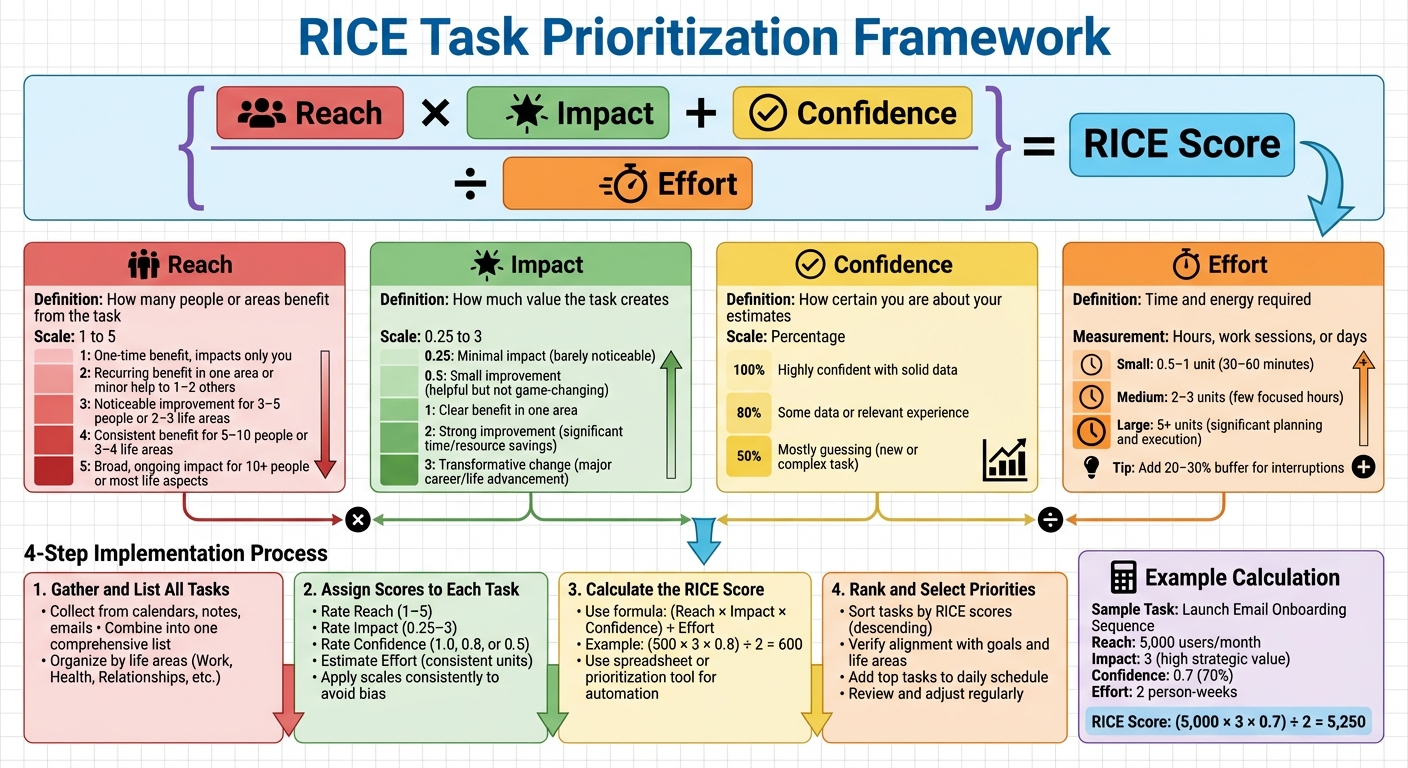
RICE Task Prioritization Framework: Formula, Scoring Scales, and 4-Step Implementation Process
Understanding the RICE Framework
Reach: Measuring the Scope of Impact
Reach gauges how many people or areas in your life benefit from completing a task, as well as how often that benefit occurs. In the workplace, this could mean the number of coworkers, clients, or customers positively affected by your efforts each month. For personal tasks, it’s about identifying how many aspects of your life - like health, relationships, finances, or personal growth - are improved.
You can rate Reach on a scale from 1 to 5:
- 1: A one-time benefit that impacts only you.
- 2: A recurring benefit in one area or minor help to 1–2 others.
- 3: A noticeable improvement for 3–5 people or 2–3 areas of your life.
- 4: A consistent benefit for a small team or household (5–10 people) or 3–4 life areas.
- 5: A broad, ongoing impact that helps 10+ people or significantly enhances most aspects of your life.
Impact: Evaluating the Value Created
Impact measures how much a task improves something important once it’s completed. For work-related tasks, this might mean increasing revenue, enhancing quality, boosting customer satisfaction, or improving team efficiency. For personal tasks, it could involve bettering your health, relationships, finances, or mental clarity.
Impact is often rated on a scale from 0.25 to 3:
- 0.25: Minimal impact, like a small tweak that’s barely noticeable (e.g., changing the color scheme of a spreadsheet).
- 0.5: A small improvement that’s helpful but not game-changing.
- 1: A clear benefit in one area, such as completing a short online course that sharpens a job skill.
- 2: A strong improvement, like creating a workflow that saves your team hours each week.
- 3: A transformative change, such as earning a certification that significantly boosts your career prospects.
Confidence: How Certain Are Your Estimates?
Confidence reflects how sure you are about the accuracy of your Reach, Impact, and Effort estimates. It’s not about whether the task will succeed but rather how reliable your numbers are. Including Confidence in the RICE framework helps to avoid over-prioritizing tasks based on overly optimistic guesses.
Confidence is typically expressed as a percentage:
- 100%: You’re highly confident, with solid data to back your estimates. For example, repeating a proven process with minor adjustments.
- 80%: You have some data or relevant experience, but at least one estimate involves some guesswork - like trying a new team workflow inspired by another team's success.
- 50%: You’re mostly guessing because the task is new, complex, or involves many unknowns, such as launching a completely new business idea.
Effort: Estimating Time and Energy
Effort measures the time and energy required to complete a task. For individual task management, it’s best to use consistent units like hours, focused work sessions, or days for larger projects. Make sure to account for setup time, context switching, and any follow-up work to get a realistic picture of the energy involved.
To estimate Effort accurately:
- Break the task into smaller steps and estimate the time needed for each.
- Add a buffer of 20–30% to account for interruptions or unexpected challenges.
- Base your estimates on past experiences with similar tasks.
For example:
- Small tasks might take 0.5–1 unit (30–60 minutes).
- Medium tasks might require 2–3 units (a few focused hours).
- Large tasks could take 5+ units and demand significant planning and execution time.
How to Apply RICE to Your Tasks
Step 1: Gather and List All Your Tasks
Start by pulling together every task from your calendars, notes, emails - basically, anywhere you jot things down. Combine them into one comprehensive list.
Tools like malife make this easier by organizing your tasks into Life Areas such as Work, Health, Relationships, Finances, and Personal Growth. It even allows quick task entry using voice commands, so nothing gets left out.
Once your master list is complete, you’re ready to evaluate each task.
Step 2: Assign Scores to Each Task
Next, score your tasks based on four key factors: Reach, Impact, Confidence, and Effort. Here's how to break it down:
- Reach: How many people or areas will this task affect? Rate from 1 to 5.
- Impact: How much value will it bring? Use a scale from 0.25 to 3.
- Confidence: How sure are you about the task's effectiveness? Options are 1.0, 0.8, or 0.5.
- Effort: Estimate the time or energy required, keeping the units consistent.
To keep things objective, apply these scales consistently. For instance, if you rate one task's Impact as 2 because it saves several hours weekly, use the same logic for other tasks. This avoids bias and ensures your scores remain fair and meaningful.
Once all tasks are scored, you’re ready to calculate their RICE values.
Step 3: Calculate the RICE Score
Use the formula: (Reach × Impact × Confidence) ÷ Effort. For example, a task with a Reach of 500, an Impact of 3, a Confidence of 0.8, and an Effort of 2 would score 600: (500 × 3 × 0.8) ÷ 2 = 600.
A spreadsheet can make this step faster. Set up columns for task name, Reach, Impact, Confidence, Effort, and RICE, and use a formula like =(Reach*Impact*Confidence)/Effort to calculate scores automatically. Any updates to the scores will adjust the RICE value instantly.
If spreadsheets feel like too much work, malife offers built-in prioritization tools. These tools help you visually compare tasks, making it easier to identify those that provide the most value with the least effort.
Step 4: Rank and Select Your Priorities
Now, sort your tasks by their RICE scores in descending order. Then, double-check that your top-ranked tasks align with your goals and the different areas of your life.
With malife's Life Areas view, you can see how your priorities stack up across areas like Work or Health. This ensures your focus isn’t skewed toward just one domain. Once you’ve chosen your top tasks, add them to your Today view and tackle them with confidence. Don’t forget to revisit and adjust scores as circumstances change, keeping your priorities relevant and effective.
Adjusting RICE for Different Situations
Using RICE for Different Task Types
The RICE framework can be tailored to suit a variety of tasks by tweaking its measurement parameters. For one-off tasks, you can estimate reach based on the number of people or areas of life impacted, assign impact a score from 1 to 5, set confidence as a percentage (50–100%), and measure effort in hours. For example, a task like "Schedule annual physical exam" might affect 1–3 people (yourself and family), have an impact score of 4 (important for long-term health), confidence of 90%, and take 1–2 hours. This would yield a high RICE score, making it a top priority on your personal list.
For projects, RICE can be applied to the project as a whole or to its key milestones. Reach could be the number of users affected monthly, impact might align with revenue or strategic goals, and effort measured in person-weeks or person-months. Take "Launch email onboarding sequence" as an example: it might reach 5,000 users monthly, have an impact score of 3, confidence of 70%, and require 2 person-weeks of effort (around 80–100 hours, assuming 8-hour workdays).
Recurring tasks and habits require a slightly different approach. Here, you estimate reach and impact over a specific period - weekly or monthly - and factor in ongoing effort during that timeframe. For instance, daily exercise might have a reach of 1 (just you), an impact score of 4 (strong long-term benefits), confidence of 80–90%, and require about 0.5 hours daily. To simplify, you can create default scores for recurring tasks, adjusting only when circumstances change or a task becomes unusually impactful.
In Malife, reach can reflect how many Life Areas (such as Work, Health, Relationships, Finances, or Personal Growth) a task touches. Tasks that span multiple areas naturally score higher in reach. The app’s built-in impact/effort priority feature mirrors RICE’s "value vs. cost" principle, helping you compare tasks quickly without manual calculations. By using the Today & Next views, you can focus on high-priority tasks for today while parking less urgent ones in a kanban-style flow for later.
Once your RICE scores are set, revisit and refine them regularly to stay aligned with your evolving priorities.
Updating Your RICE Scores Regularly
RICE scores aren’t static - they’re meant to adapt. Regular reviews, whether daily or weekly, are key. For instance, if a task suddenly requires more time than expected, adjust the effort score. Similarly, update confidence levels as you gather new information or feedback. During a weekly review - often done on Friday afternoons or Sunday evenings in the U.S. - spend 30–60 minutes revisiting your top tasks. Check that your estimates still reflect current priorities, performance data, or life changes. Archive or downgrade tasks that no longer hold the same importance.
The Malife journal feature can help you track outcomes and lessons learned, which you can review weekly to refine your reach, impact, and effort estimates. With voice capture, you can quickly add tasks and score them later, keeping your workflow uninterrupted.
Once your scores are updated, recognize when RICE might not be the best tool for the job and adjust accordingly.
When Not to Use RICE
RICE is most effective when you’re juggling multiple options or feeling overwhelmed by choices. However, urgent or non-negotiable tasks - like emergency repairs, compliance work, or time-sensitive deadlines - don’t need RICE scoring. These must be handled immediately, regardless of their calculated priority, and should be managed outside your RICE list.
Avoid overanalyzing trivial tasks or using inconsistent scales. Keep it simple: define clear scales (e.g., 1 = small, 3 = moderate, 5 = major) and reserve RICE for decisions that truly matter.
Once you’ve sorted tasks by RICE score, consider real-world factors:
- Do I have the energy for this right now? High-RICE, high-effort tasks are often best tackled in the morning when energy levels are higher, while lower-effort tasks can be saved for later in the day.
- Are prerequisites completed? Skip high-RICE tasks if they depend on unfinished work.
- How much time do I have? Fit high-RICE tasks into focused 60–90 minute blocks and use smaller gaps for quicker, low-effort items.
RICE provides a strong starting point, but it’s essential to adapt it to your immediate context and needs. Tools like Malife's focus timer can help you protect time blocks for important tasks, reducing distractions and avoiding constant context switching.
Conclusion
RICE turns the often overwhelming task of prioritization into a clear, measurable process. By scoring tasks based on Reach, Impact, Confidence, and Effort, it helps identify which tasks offer the greatest return on your time and energy. This approach reduces decision fatigue, minimizes procrastination, and ensures your focus stays on what truly matters - whether that's a work project, a health goal, or a financial milestone.
Think of RICE as a flexible system rather than a rigid formula. Priorities shift, and schedules change, so taking 10–15 minutes for a quick review - say, on Sunday evening or Monday morning - can help you adjust your scores and keep your to-do list aligned with your current goals. Even rough estimates can help separate meaningful tasks from distractions, making this review a valuable part of ongoing task management.
RICE isn't just for work; it can guide decisions across all areas of life. For instance, scheduling a yearly physical might take just an hour but could deliver long-term health benefits, making it a high-priority task. By applying RICE to areas like health, relationships, finances, and personal growth, you can create a more balanced and fulfilling life - not just a productive one.
If digital tools are your thing, platforms like Malife can simplify this process. These tools often organize tasks by life category and use an impact-versus-effort framework that naturally complements RICE, helping you focus on what’s most important without the hassle of setting up spreadsheets.
Ready to give it a try? Start with 5–10 tasks, assign simple scores for Reach, Impact, Confidence, and Effort, calculate their RICE scores, and reorder your to-do list accordingly. Try this method for a week and see how it reshapes your approach to priorities. With regular reviews and RICE as your guide, you’ll find yourself making meaningful progress toward your biggest goals.
FAQs
How do I keep my RICE scores accurate over time?
Keeping your RICE scores accurate requires regular updates as situations evolve. Changes in project scope, available resources, or stakeholder priorities can all influence the Reach, Impact, Confidence, or Effort assigned to tasks.
It's a good idea to set a regular schedule - weekly or biweekly works well for most teams - to revisit your priorities. Use these reviews to re-evaluate each task's metrics and adjust the scores to match the current situation. This approach helps ensure your focus remains on tasks that genuinely move the needle toward your goals.
What can I do if multiple tasks have similar RICE scores?
If multiple tasks end up with similar RICE scores, shift your focus to impact and effort to help make a decision. Think about which task is likely to produce the most meaningful results or which one demands the least effort while still delivering significant benefits.
A tool like malife can simplify this process by helping you visualize and organize your tasks based on what truly matters. With features like Impact/Effort prioritization and Life Areas, malife makes it easier to figure out what should take priority and deserves your attention next.
Can the RICE framework be used for team projects?
The RICE framework works well for team projects, offering a structured way to evaluate tasks using four key factors: Reach, Impact, Confidence, and Effort. This method helps teams work together to determine priorities and distribute resources wisely.
By using this approach, teams can ensure everyone stays on the same page about what’s most important. It encourages focusing on tasks that bring the most value while cutting down on unnecessary work. It’s a straightforward tool that makes teamwork and decision-making more efficient.