
How AI Improves OKR Tracking for Teams
How AI Improves OKR Tracking for Teams
AI is transforming how teams manage Objectives and Key Results (OKRs). By automating processes, analyzing data, and providing predictive insights, AI helps teams set clear goals, align efforts, and track progress effectively. Here's how AI makes a difference:
- Data-Driven Goals: AI analyzes past performance and trends to create measurable, role-specific objectives.
- Alignment Across Teams: AI identifies overlaps and gaps in goals, ensuring everyone works toward shared priorities.
- Real-Time Tracking: Automated dashboards and alerts provide instant updates and flag potential issues early.
- Enhanced Collaboration: AI simplifies goal creation, highlights dependencies, and fosters better communication.
- Dynamic Adjustments: AI helps teams respond to market changes and refocus resources on high-impact areas.
With these tools, businesses can save time, improve goal clarity, and stay aligned with organizational priorities.
AI-Powered OKR Tracking: Key Statistics and Impact Metrics
How AI Improves Objective Setting and Team Alignment
Creating Objectives Based on Data
AI takes the guesswork out of setting objectives by analyzing historical performance, industry trends, and organizational priorities to create clear, achievable goals. Automated tools can turn vague ideas into structured SMART drafts, complete with suggested metrics and timelines.
Emily Helen Arnold, People Strategy Specialist at Teamflect, explains: "Using AI for goal setting helps managers create SMART goals faster, align team objectives with company OKRs, and track progress in real time."
AI also tailors metrics to specific roles. For example, sales teams might receive recommendations based on pipeline metrics, while customer support teams could focus on response times. This ensures each department has actionable, measurable targets. Predictive modeling takes it a step further by estimating the likelihood of success for these goals, helping teams focus on objectives with the highest potential impact.
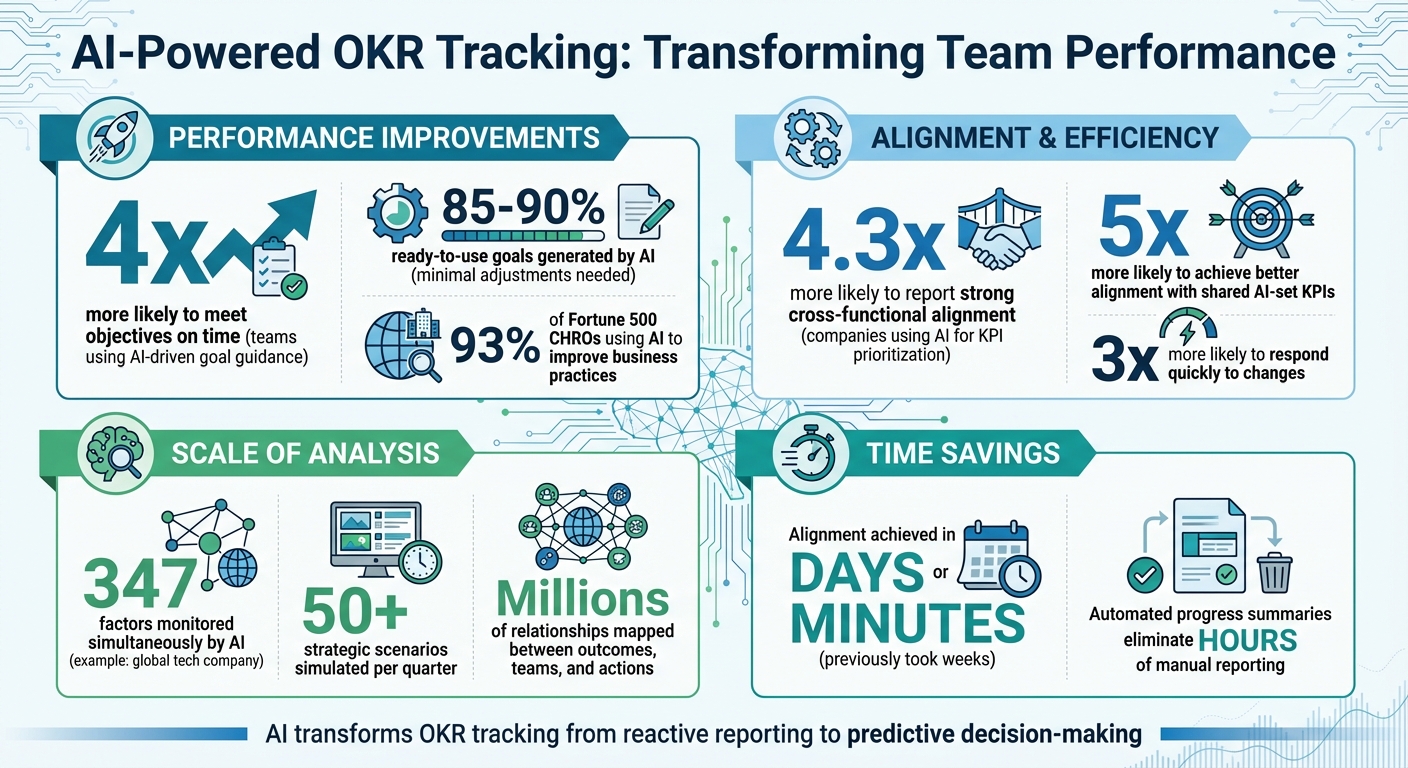
One global tech company applied AI to monitor 347 factors - ranging from engineering velocity to customer feedback sentiment - to assess and predict the success of their quarterly OKRs. Clarity scoring algorithms further ensure that objectives meet measurable standards. In fact, teams using AI-driven goal guidance based on psychometric and behavioral science are 4x more likely to meet their objectives on time.
To make the most of these tools, it’s crucial to provide detailed inputs rather than generic phrases. For instance, specifying "improve project delivery timeliness" will yield more actionable recommendations than vague goals. This data-driven precision naturally encourages alignment across departments.
Aligning Goals Across Departments
Defining individual objectives is just the first step - aligning these goals across departments is key to ensuring unified progress.
AI excels at identifying overlaps, gaps, and conflicts between team objectives. In one case, a Fortune 500 financial services company adopted AI-powered OKR analytics in 2024. Within six months, the system flagged resource allocation conflicts before they could disrupt project timelines and uncovered collaboration opportunities that leadership had overlooked.
Advanced AI systems can map millions of relationships between outcomes, teams, and actions, even in sprawling enterprises. This automated mapping ensures that every task ties directly to the organization’s broader mission.
Deidre Paknad, CEO and Co-Founder of WorkBoard, notes: "Generative AI helps us eliminate the last remaining friction in perfect strategy execution for customers by collapsing the time to align on long-range and near-term outcomes, develop action plans to achieve them, and manage against them efficiently at high scale and speed."
With this technology, alignment that once took weeks can now be achieved in days - or even minutes. Automated cascading connects high-level initiatives directly to individual contributors, streamlining the entire process and keeping everyone on the same page.
Real-Time Progress Monitoring and Analysis
Automated Dashboards and Reporting
AI-powered dashboards have transformed how progress is tracked by seamlessly pulling data from CRMs, project management tools, and communication platforms, eliminating the need for manual updates. These dashboards provide real-time updates, replacing the tedious process of manual spreadsheet entries. Beyond just predictive insights, they offer continuous, detailed updates that keep everyone in the loop.
What makes these dashboards especially effective is their tailored approach. Executives, team leads, and individual contributors can access role-specific dashboards, ensuring the information they see is relevant and actionable. Features like color-coded indicators (red, yellow, green) and percentage-based scores (ranging from 0.0 to 1.0) make it easy to gauge the status of objectives at a glance.
The shift from manual reporting to automated tracking not only saves time but also increases efficiency. Instead of spending hours preparing updates for weekly meetings, AI-generated progress summaries are automatically delivered to stakeholders. Quantitative Key Results, such as revenue goals or Daily Active Users (DAUs), can be tracked automatically, while qualitative objectives that require human input can still be updated manually.
This streamlined tracking process naturally supports proactive alerts and interventions.
Smart Alerts and Notifications
Building on the foundation of real-time dashboards, AI introduces smart alerts to catch potential issues before they escalate. By analyzing performance trends and historical data, these systems can predict the likelihood of achieving specific objectives. For example, if progress on a goal falls below a critical threshold - like less than 20% completion halfway through the quarter - the system sends timely alerts to prompt action.
AI also keeps an eye on subtle warning signs, such as missed check-ins or delayed updates, which could indicate disengagement or hidden obstacles. Advanced systems are capable of analyzing hundreds of variables - ranging from engineering progress to shifts in customer sentiment - to identify risks that might otherwise go unnoticed. In one instance, AI flagged potential issues by monitoring 347 different factors, allowing for early intervention on objectives at risk.
"WorkBoard is enabling companies to harness the intelligence of their own strategy execution data... to generate strong suggestions faster", says Daryoush Paknad, CTO and Co-Founder at WorkBoard.
How AI Supports Team Collaboration and Feedback
Simplifying OKR Creation and Updates
AI takes the guesswork out of crafting OKRs (Objectives and Key Results) by generating role-specific goals from simple, plain-language inputs. Instead of struggling to start from scratch, teams can describe their objectives, and AI transforms these descriptions into tailored OKRs. For instance, marketing teams receive goals focused on campaigns and outreach, while engineering teams get objectives aligned with technical deliverables.
Beyond drafting goals, AI plays a critical role in identifying cross-departmental dependencies. When one team sets an objective, AI scans other teams' plans to highlight overlaps or potential synergies. For example, if the product team is gearing up to launch a new feature and the marketing team is planning a campaign, AI connects the dots, prompting both teams to align their timelines. This kind of insight breaks down barriers between departments, fostering better collaboration and ensuring everyone understands how their work fits into the bigger picture.
AI also keeps OKRs alive through automated check-ins. By prompting teams for weekly updates, it turns OKR tracking into an ongoing dialogue. This continuous feedback loop encourages adaptability and keeps goals relevant as priorities shift.
Enabling Ongoing Feedback and Coaching
AI doesn’t just help with goals - it actively supports team engagement and coaching. By monitoring patterns like missed updates, sudden spikes in progress, or overall activity levels, AI can flag potential issues or opportunities. For example, it might suggest celebrating a recent success or scheduling a one-on-one meeting when engagement dips.
"AI Coach really puts an expert coach and assistant in every manager's pocket." - John Joseph, Head of People Analytics, Asana
AI tools can even analyze the tone and sentiment of check-ins and feedback to uncover how the team is feeling. This insight helps managers adjust their approach to better support their team’s morale. Additionally, AI compiles data from peer feedback, self-reflections, and progress updates into clear, concise performance summaries. This reduces the mental strain of performance reviews and makes the process more efficient. With 93% of Fortune 500 CHROs already leveraging AI to improve business practices, it’s clear that these tools are becoming an essential part of modern data-driven coaching.
Adjusting OKRs in Changing Business Conditions
Making Real-Time Adjustments to Market and Internal Changes
AI is revolutionizing how teams adapt to unexpected changes, offering the ability to analyze vast amounts of data at once. By combining insights from internal dynamics and external market signals, AI predicts how likely quarterly OKRs are to succeed.
When priorities shift, AI steps in to pinpoint underperforming objectives and suggests reallocating resources to areas that need extra attention. For instance, if customer sentiment takes a sudden dip or a competitor launches a new product, AI integrates this external intelligence to figure out whether the issue lies in internal execution or external market conditions. Machine learning can detect early warning signs of potential failure weeks ahead of traditional metrics, giving teams the chance to adjust their approach before problems escalate.
"AI didn't just make their current goal management better; it changed the way they planned and carried out their strategies." - Profit.co
AI-powered tools can simulate over 50 strategic scenarios each quarter, helping leaders see how different resource allocation choices might affect both short-term results and long-term positioning in the market. This ability to adapt dynamically ensures that businesses maintain their strategic momentum, even in volatile conditions.
Keeping Focus on Long-Term Goals
Beyond real-time adjustments, AI plays a critical role in keeping long-term strategies on track. By continuously evaluating how short-term changes might influence final outcomes, AI helps leaders balance immediate needs with overarching goals. Companies leveraging AI to prioritize KPIs are 4.3 times more likely to report strong alignment across functions compared to those that don’t.
AI systems monitor progress across all departments, flagging any deviations from the company’s top-level objectives. Take Maersk, for example: the company used AI to resolve a conflict between speed and reliability in its shipping operations. While port managers pushed for faster loading times, AI demonstrated that a slightly slower process reduced bottlenecks and cut costs, ultimately improving overall efficiency. Similarly, Pernod Ricard employed AI to balance two competing priorities - boosting profit margins and expanding market share - allowing the company to dynamically optimize both goals.
This kind of multi-dimensional analysis ensures that short-term adjustments are informed by data rather than reactive decisions, directly supporting long-term strategic planning. Organizations using AI to set shared KPIs are five times more likely to achieve better alignment and three times more likely to respond quickly and effectively to changes.
Conclusion
AI is reshaping the way organizations approach OKR tracking and achievement. By moving from reactive reporting to predictive decision-making, AI helps businesses identify potential challenges weeks in advance and uncovers opportunities that might otherwise go unnoticed. It's no surprise that 93% of Fortune 500 CHROs are already leveraging AI tools to enhance business processes.
What makes AI truly impactful is its ability to handle vast amounts of complexity in real time. It delivers analysis across hundreds of variables simultaneously - something no human team could achieve manually.
"AI isn't just about writing better goals - it's about making every part of the OKR process smarter: spotting misalignment mid-cycle, suggesting next steps when goals are hit early, and helping teams course-correct before they drift off track."
- Steven Macdonald, Founder, OKRs Tool
Beyond tracking, AI boosts team productivity by automating repetitive tasks, recommending high-impact actions, and offering tailored coaching suggestions. With AI-driven goal setting, objectives are typically 85–90% ready to use, requiring only slight adjustments for context. This shift allows managers to focus their energy on strategy and leadership rather than getting bogged down in administrative details.
FAQs
How does AI help align OKRs across different teams?
AI simplifies the process of aligning OKRs by analyzing data across the organization and spotting trends to suggest customized objectives for each team. It keeps these objectives updated in real time, adjusting to shifts in performance metrics and market dynamics. This ensures that all teams stay connected to the broader company strategy.
By taking over these tasks, AI minimizes manual work, improves transparency, and encourages collaboration between departments, keeping everyone aligned on common goals.
How does AI help teams adjust OKRs to changing business needs?
AI plays a key role in refining OKRs by analyzing real-time market trends and internal performance metrics. It can automatically shift priorities, refresh objectives, and align them with changing business needs.
This flexible approach ensures teams stay focused on what truly matters, even as circumstances evolve, fostering better agility and smarter decision-making throughout the organization.
How does AI help teams track OKRs in real time?
AI-powered dashboards simplify OKR tracking by automatically collecting and updating key metrics. This means teams can access up-to-date progress reports without spending time on manual updates.
With real-time insights at their fingertips, teams can spot problem areas, adjust goals when necessary, and stay focused on what matters most. By eliminating the guesswork, AI helps teams make quicker, more informed decisions to reach their objectives efficiently.